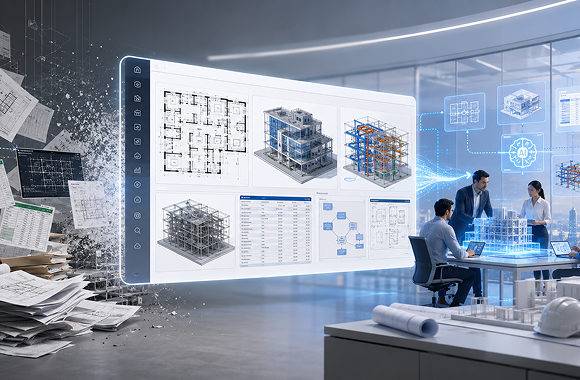
Architects and engineering firms are moving toward AI-powered architecture design software because manual workflows slow down project delivery, increase coordination issues, and create costly design errors. Platforms like DesignDrafter combine layout generation, BIM automation, quantity extraction, and engineering calculations into one connected system. The AEC industry has relied on disconnected software for decades. One team works in CAD, another in Excel, and another inside BIM tools. The result is predictable. Delays, duplicated work, coordination gaps, and revision chaos. According to a 2024 report from McKinsey & Company, large construction projects still run 20% longer than scheduled on average. Software fragmentation is one of the biggest reasons.
After auditing digital workflows for architecture and engineering teams over the last decade, I’ve noticed one pattern repeatedly. Firms don’t just need better tools. They need connected workflows. That’s exactly where modern architecture design software is changing the industry.
Traditional workflows struggle because architectural teams now handle more complexity than ever before. Buildings contain denser MEP systems, stricter compliance requirements, tighter delivery timelines, and higher client expectations.
Most firms still operate with disconnected software stacks:
That fragmentation creates friction at every stage.
A 2023 study by Autodesk Construction Cloud found that rework accounts for nearly 30% of construction costs globally. In many cases, the issue begins during design coordination.
Software for architectural design should reduce coordination gaps, not create new ones.
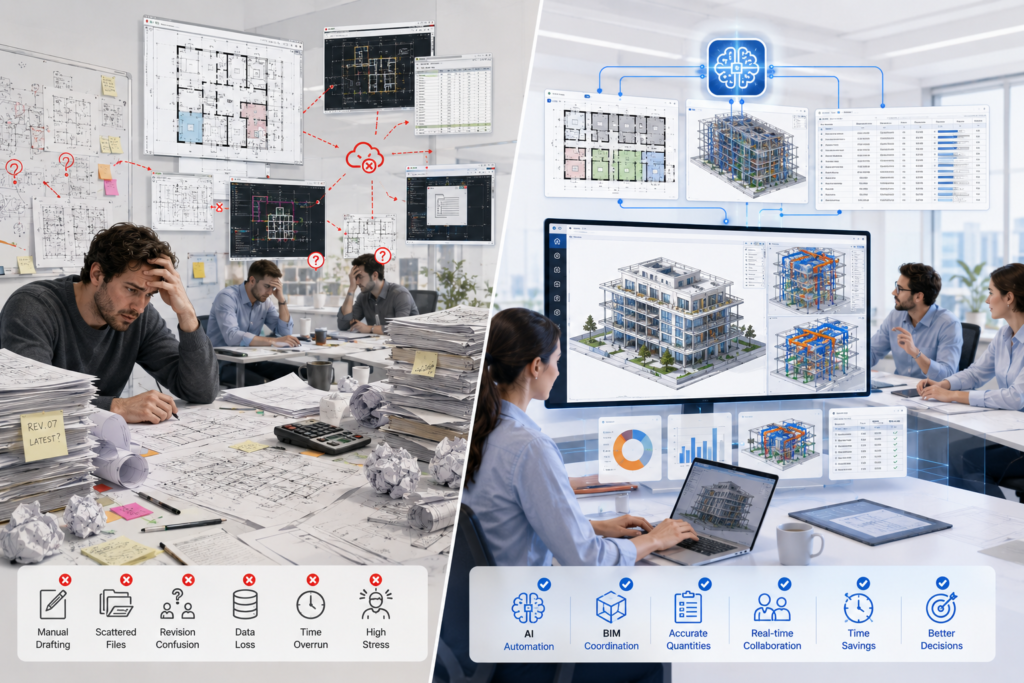
Manual coordination drains both time and profit. When architectural, structural, and MEP teams work in isolated systems, every revision multiplies downstream work.
Here’s what usually happens:
One layout revision can affect dozens of deliverables. That’s why connected architecture design software matters so much today.
AI-powered architecture design software is a digital platform that automates and connects design workflows using intelligent systems, because modern AEC projects require speed, coordination, and data consistency.
Unlike traditional tools that only assist drafting, newer platforms actively support decision-making, automation, and cross-disciplinary coordination.
DesignDrafter approaches this differently by combining multiple workflows into a single ecosystem:
| Traditional Workflow | AI-Powered Workflow |
|---|---|
| Separate tools for layouts and BIM | Connected workflow ecosystem |
| Manual BOQ extraction | Automated quantity extraction |
| Repeated CAD redraws | CAD-to-Revit automation |
| Discipline silos | Shared project coordination |
| Static calculations | Integrated engineering logic |
This shift matters because the industry is moving toward data-connected project delivery.
According to Dodge Construction Network, firms using integrated BIM and automation workflows report productivity gains between 20% and 35%.
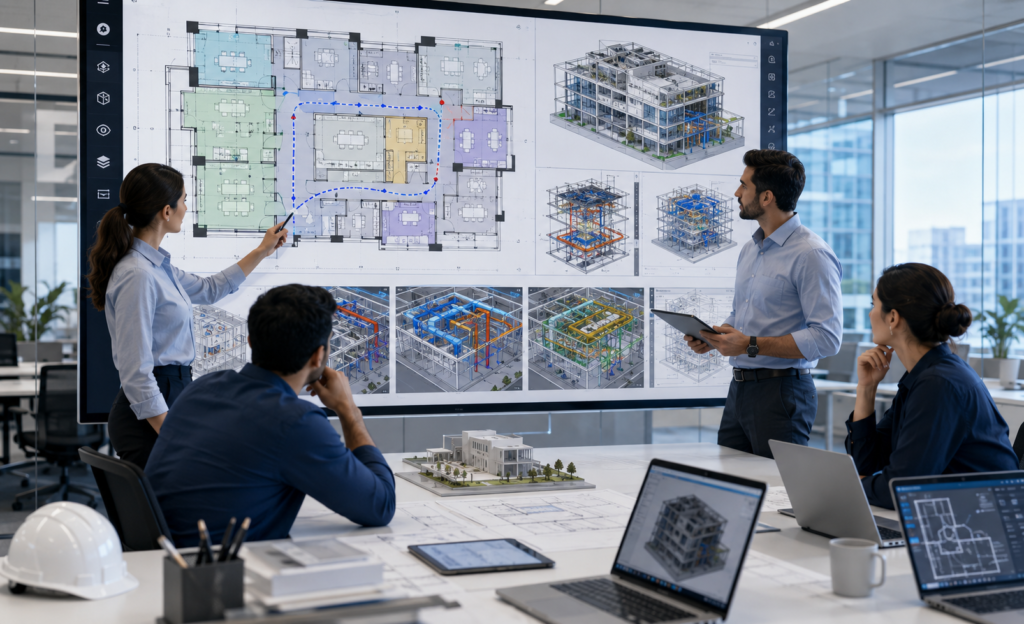
DesignDrafter is built for architects, MEP consultants, BIM teams, contractors, and engineering firms that want faster coordination and fewer manual tasks.
Instead of focusing on one isolated function, the platform connects the entire design lifecycle.
Architects spend countless hours testing layout options manually. AI-assisted layout generation reduces that burden.
DesignDrafter helps generate intelligent floor plans based on:
That doesn’t replace architects. It accelerates early-stage ideation.
When I tested AI-assisted layout systems with a mixed-use residential project last year, concept iterations dropped from three days to a few hours. That speed changes how teams approach feasibility studies.
CAD-to-Revit conversion remains one of the most labor-intensive processes in BIM development.
Many firms still rebuild drawings manually. That process creates:
DesignDrafter CAD to BIM Workflow focuses on reducing repetitive BIM modeling tasks through automation.
According to NIBS National BIM Report, BIM adoption has improved project coordination by over 60% in large-scale projects. The challenge is not BIM itself. The challenge is getting projects into BIM efficiently.
Quantity takeoffs still consume huge amounts of manual effort across the industry.
Many teams still measure PDFs manually or update BOQs in spreadsheets. That process introduces avoidable risk.
DesignDrafter automates quantity extraction directly from project data and drawings.
The impact is substantial:
The platform’s quantity workflow aligns closely with growing industry demand for data-driven estimating.
Engineering calculations often live in isolated spreadsheets. That separation creates version-control problems and coordination delays.
Modern software for architectural design should connect calculations directly with design data.
DesignDrafter supports integrated workflows across:
This creates a shared source of project information instead of disconnected files spread across departments.
AEC firms are under pressure from every direction. Faster delivery expectations. Higher labor costs. More regulations. More revisions. Smaller margins.
Connected architecture design software helps solve those operational bottlenecks.
A 2024 report from PwC Construction Insights found that digital project automation can reduce documentation time by up to 45%.
That matters because documentation delays affect every downstream milestone.
When workflows remain disconnected, teams spend more time updating files than solving design problems.
Coordination failures remain one of the biggest causes of project delays.
Even small inconsistencies can trigger:
Connected systems reduce these risks by linking layouts, calculations, BIM models, and quantities together.
Many architecture and engineering firms struggle to hire enough skilled BIM and drafting professionals.
Automation helps experienced teams handle more work without expanding headcount aggressively.
That’s one reason AI-powered architecture design software adoption continues rising globally.
Traditional BIM tools primarily focus on modeling. DesignDrafter focuses on workflow intelligence and project coordination.
That distinction is important.
Most BIM software still depends heavily on manual input. DesignDrafter aims to reduce repetitive coordination work across the project lifecycle.
Instead of isolated modules, the platform connects:
That integrated approach reflects how real projects actually operate.
AEC projects fail when disciplines operate independently.
DesignDrafter supports collaboration between:
That coordination becomes more valuable as projects scale in complexity.
Many design tools prioritize feature depth but ignore workflow speed.
Speed matters because delays compound across every project phase.
A connected workflow can reduce:
No. AI can automate repetitive tasks, but it cannot replace architectural judgment, engineering responsibility, or creative problem-solving.
That’s one of the biggest misconceptions in the industry.
AI works best as a workflow accelerator.
Experienced professionals still make decisions around:
Think of AI-powered architecture design software as a highly efficient design assistant, not a replacement for professional expertise.
As architect and computational design pioneer Patrik Schumacher has often argued, computational systems expand design possibilities but still depend on human interpretation and intent.
That balance matters.
Software for architectural design is shifting from isolated drafting tools toward connected project ecosystems.
That transition is happening for three major reasons.
Buildings now generate enormous amounts of project data.
Modern platforms increasingly connect:
The future of architecture design software is data-connected design intelligence.
Five years ago, automation was optional. Today, firms actively expect it.
Teams now look for software that can:
The market is clearly moving toward intelligent workflows.
Remote collaboration changed how AEC firms operate.
Cloud-based project coordination allows distributed teams to work simultaneously across regions.
That trend accelerated sharply after 2020 and continues growing globally.
DesignDrafter fits organizations that manage complex, multi-disciplinary projects and want fewer disconnected workflows.
The platform becomes especially valuable for:
The more coordination a project requires, the more valuable connected architecture design software becomes.
The future of architecture design software is not manual. AEC firms can no longer afford disconnected workflows, repetitive drafting, isolated spreadsheets, and fragmented coordination systems.
That shift is already happening across the industry.
AI-powered platforms like DesignDrafter are helping architecture and engineering teams connect layouts, BIM automation, engineering calculations, quantity extraction, and project coordination inside one intelligent workflow ecosystem.
The biggest advantage is not just speed. It’s consistency. Connected systems reduce coordination gaps, improve project visibility, and help teams spend less time managing files and more time solving design problems.
After working with digital workflows across architecture and engineering projects for years, I’ve seen one thing clearly. The firms adopting connected automation early gain a major operational advantage later. They deliver faster, coordinate better, and scale projects more efficiently.
The industry is moving toward intelligent workflows whether firms are ready or not.
If your team still depends heavily on disconnected CAD files, Excel sheets, manual BOQs, and repetitive BIM tasks, now is the right time to rethink the process.
Explore how DesignDrafter helps modern AEC teams streamline architecture design, BIM development, engineering calculations, and project coordination from one connected platform.
FAQ

Architecture design software helps architects and engineering teams create layouts, BIM models, technical drawings, calculations, and project documentation. Modern platforms also support automation, quantity extraction, and multi-disciplinary coordination. Connected systems reduce manual work and improve project consistency across teams.
AI-powered architecture design software automates repetitive tasks and connects workflows intelligently. Traditional software focuses mainly on drafting and modeling. AI-assisted systems can help generate layouts, automate BIM workflows, extract quantities, and support design coordination more efficiently.
No. DesignDrafter is designed for architects, BIM teams, MEP consultants, contractors, and engineering firms. The platform supports cross-disciplinary coordination because modern projects depend on collaboration between multiple technical teams.
Yes. Some modern platforms use AI-assisted systems to generate floor layouts based on project constraints, space planning rules, and occupancy requirements. These tools speed up concept development while still allowing architects full creative control.
CAD-to-BIM automation reduces manual modeling time and improves consistency. Instead of rebuilding drawings manually inside BIM tools, automation workflows accelerate Revit model development and reduce drafting errors. Many firms use this process to shorten project delivery timelines.
Connected software centralizes project information across architecture, structural, and MEP disciplines. Teams work from shared project data instead of disconnected spreadsheets and files. That reduces coordination conflicts and improves revision management significantly.
No. AI tools assist BIM professionals by automating repetitive tasks. Human expertise remains essential for modeling decisions, compliance review, coordination, and design intent. Most firms use AI to increase productivity rather than reduce professional involvement.
Quantity takeoff errors usually happen because teams extract data manually from PDFs or disconnected drawings. Manual workflows increase the risk of missing updates, inconsistent measurements, and coordination gaps. Automated extraction systems help reduce those risks.
Industries with complex coordination requirements benefit most. This includes residential development, healthcare, hospitality, infrastructure, industrial facilities, and commercial construction. Large projects with multiple consultants usually gain the highest operational efficiency improvements.
Yes, especially firms trying to improve delivery speed without rapidly increasing staffing costs. AI-powered systems help smaller teams handle larger workloads, automate repetitive drafting tasks, and improve coordination efficiency across projects.
May 4 , 2026
April 16 , 2026
June 12 , 2026