Ask any quantity surveyor or project estimator about the part of their job they would most like to change, and the answer is almost always the same. The manual counting. The measurement from drawings. The endless cross-referencing between plans, sections, elevations, and schedules to extract a number they are reasonably confident in.
Quantity extraction has traditionally been one of the most labor-intensive, error-prone, and time-consuming steps in the entire construction project lifecycle. A single missed measurement or a misread dimension can cascade into a cost estimation error that affects a bid, damages a client relationship, or eats into a contractor's margin. In 2026, that process is being fundamentally transformed by AI-powered quantity extraction tools that can read building models and drawings, identify every material and element, measure it accurately, and produce structured BOQ-ready outputs in a fraction of the time it used to take.
This guide explains what quantity extraction actually is, why it matters more than ever, how the AI-powered process works, and why Indian AEC firms and contractors who are still doing it manually are leaving money and time on the table.
Before getting into the technology, it is worth establishing a clear definition because the term is used in slightly different ways across different parts of the industry.
Quantity extraction, also called quantity takeoff (QTO) or material takeoff (MTO), is the process of identifying, measuring, and listing all materials, components, and resources required to construct a building or infrastructure project. The output of this process is typically a Bill of Quantities (BOQ) or a Bill of Materials (BOM) that forms the basis for cost estimation, procurement planning, and contractor tendering.
In a typical building project, quantity extraction covers:
Each of these categories feeds into a cost line item in the project estimate. The accuracy of the quantity extraction directly determines the accuracy of the cost estimate.
The BOQ is the formal document that lists all items of work with their quantities and unit rates. The quantity extraction process is what produces the quantity column in that BOQ. Without accurate quantity extraction, there is no reliable BOQ. Without a reliable BOQ, there is no reliable project budget, and without a reliable budget, the entire financial foundation of the project is built on guesswork.
The construction industry has known for decades that manual quantity extraction is inefficient. The question has always been: inefficient enough to justify changing? In 2026, the answer is unambiguously yes.
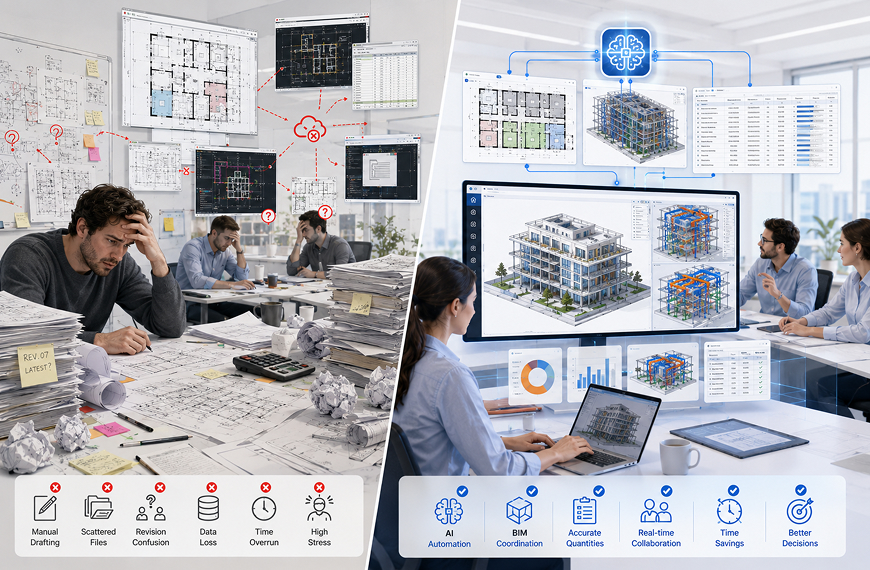
Here is what a traditional manual quantity takeoff actually looks like in practice:
For a medium-sized commercial building, this process takes an experienced quantity surveyor four to ten working days. For a large project, it can take weeks. And throughout this process, human error is a constant companion.
Each of these error types translates directly into financial risk, either underbidding (which destroys margin) or overbidding (which loses the contract).
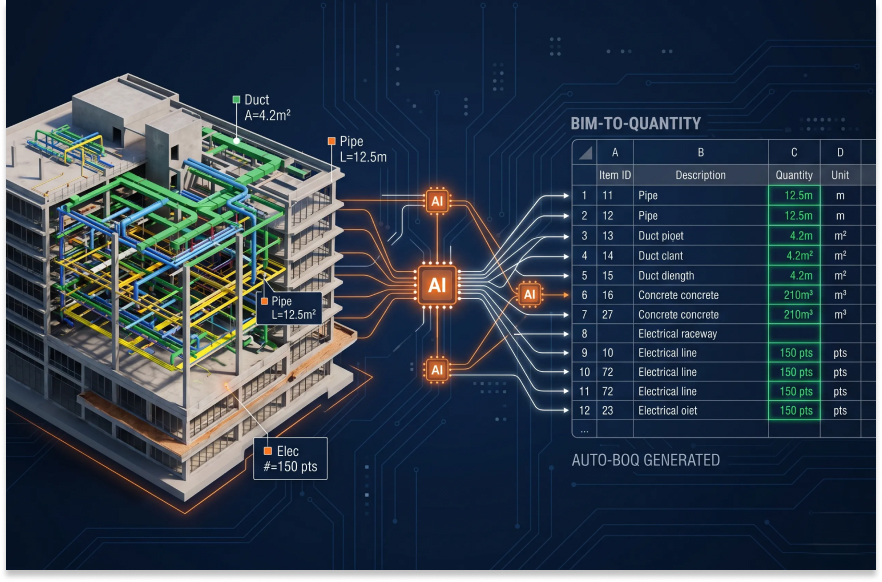
AI-powered quantity extraction works by reading building drawings or BIM models directly and automatically identifying, classifying, and measuring every element without human intervention at the measurement step.
Step 1: Input your drawings or BIM model. Upload your floor plans, sections, elevations, and MEP drawings, or connect your BIM model directly. The AI reads the file regardless of whether it is a 2D PDF, a DWG CAD file, or a 3D Revit model.
Step 2: Element recognition and classification. The AI identifies every building element in the drawing or model. It distinguishes between walls, columns, beams, slabs, doors, windows, pipes, ducts, fixtures, and all other components using pattern recognition trained on millions of construction documents.
Step 3: Automated measurement. For each identified element, the AI calculates the appropriate quantity automatically. Walls are measured in square meters of area or linear meters of length depending on the requirement. Concrete is calculated in cubic meters. Pipe runs are measured in linear meters by diameter. Ducts are measured in square meters of surface area. Every calculation follows consistent rules applied uniformly across the entire project.
Step 4: Specification mapping. The AI maps each extracted element to its material specification, whether from an attached specification document, a product library, or a pre-configured project template.
Step 5: BOQ output generation. The extracted quantities are assembled into a structured BOQ in your preferred format, ready for review, markup, and submission. This output is typically available in Excel, PDF, and other standard formats.
The critical difference is not just speed. It is the elimination of omission errors. A human estimator working under deadline pressure will miss elements. An AI system scanning the same drawing set will find every pipe, every fixture, every square meter of wall area, every time. It does not get tired. It does not skip sections because it is running behind schedule.
One of the most common questions in this space is whether AI quantity extraction works better from BIM models or from 2D drawings. The honest answer is that both work, but they have different strengths.
When working from 2D CAD or PDF drawings, AI extraction tools analyze the geometry of the drawing and apply measurement rules. This approach works well for standard building elements, particularly architectural quantities like floor area, wall area, and room counts.
The limitation of 2D extraction is that some quantities are difficult to measure accurately from flat drawings. Structural concrete volumes, for example, require understanding the 3D geometry of elements that may only be partially visible in plan view. MEP quantities from 2D drawings can also be less precise because single-line representations carry less dimensional information than 3D models.
When the source is a 3D BIM model, quantity extraction becomes dramatically more accurate and comprehensive. Every element in the model has known dimensions, material properties, and spatial relationships. The AI does not need to interpret geometry from a 2D projection. It simply reads the data that is already embedded in the model.
This is one of the most powerful arguments for completing your CAD to BIM conversion before attempting quantity extraction. Once your drawings are in BIM format, your entire cost estimation workflow becomes faster, more accurate, and more defensible. DesignDrafter's Smart Drawing Development module handles the CAD to BIM conversion step, so your team can proceed directly to AI-powered quantity extraction without a separate workflow.
For firms working on new projects: Design directly in BIM, then extract quantities from the BIM model.
For firms working with legacy CAD files or client-supplied 2D drawings: Convert CAD to BIM first using DesignDrafter's AI conversion capability, then extract quantities from the resulting BIM model. This two-step process delivers significantly better quantity accuracy than extracting directly from 2D drawings.
While quantity extraction is important across all building disciplines, it delivers particularly high value for MEP projects. Here is why.
MEP systems are three-dimensional by nature, and their routing through a building involves complex spatial decisions that are difficult to represent in 2D drawings and even more difficult to measure accurately from them. A pipe run that goes up through a shaft, across a plant room, and drops down through a false ceiling requires the estimator to track it across multiple plan levels, sections, and system diagrams. Miss one segment and your pipe quantity is wrong.
Electrical quantities are similarly complex. A cable route from a main distribution board to a sub-distribution board to individual circuit outlets involves tracking conductors of different sizes across a three-dimensional routing path. Manual extraction of cable quantities from 2D drawings is inherently imprecise.
DesignDrafter's Extract Quantity module is specifically engineered for MEP quantity extraction alongside architectural quantities. The platform reads MEP system data from the BIM model, identifies pipe runs by system type and diameter, duct runs by shape and dimensions, cable routes by circuit type, and equipment by category and specification.
The output is a structured MEP BOQ that covers:
This level of MEP quantity detail is extremely difficult and time-consuming to produce manually. AI does it automatically and consistently.
Quantity extraction matters to different teams for different reasons. Here is how the value breaks down.
Architects use quantity extraction primarily for design-stage cost checking. Being able to extract quantities from a design model and generate a rough order of cost at early design stages allows the team to validate that the design is within budget before it becomes fully developed. This prevents the painful (and expensive) cycle of detailed design followed by a cost overrun followed by design revision.
DesignDrafter's Architects Solution integrates quantity extraction directly into the design workflow, so cost checking is a continuous part of the design process rather than a separate exercise at the end.
MEP consultants use quantity extraction to produce MEP-specific BOQs for tender documentation and to validate that their system designs are within the MEP budget. With AI-powered extraction, MEP BOQs that previously took days to produce can be generated in a fraction of the time, with greater accuracy. The MEP Consultants Solution on DesignDrafter is built around this specific workflow.
Contractors use quantity extraction for bid preparation, procurement planning, and site material management. Accurate quantities at the bid stage prevent cost overruns during execution. Procurement driven by AI-extracted quantities means materials are ordered in the right amounts, reducing waste and cash flow pressure. DesignDrafter's Contractors Solution supports this workflow from bid preparation through to site execution.
Cost consultants and independent QS firms use quantity extraction to produce project estimates, tender BOQs, and post-contract cost reports. AI-powered extraction dramatically increases the throughput of a QS team, allowing a small team to handle a larger portfolio of projects without sacrificing accuracy.
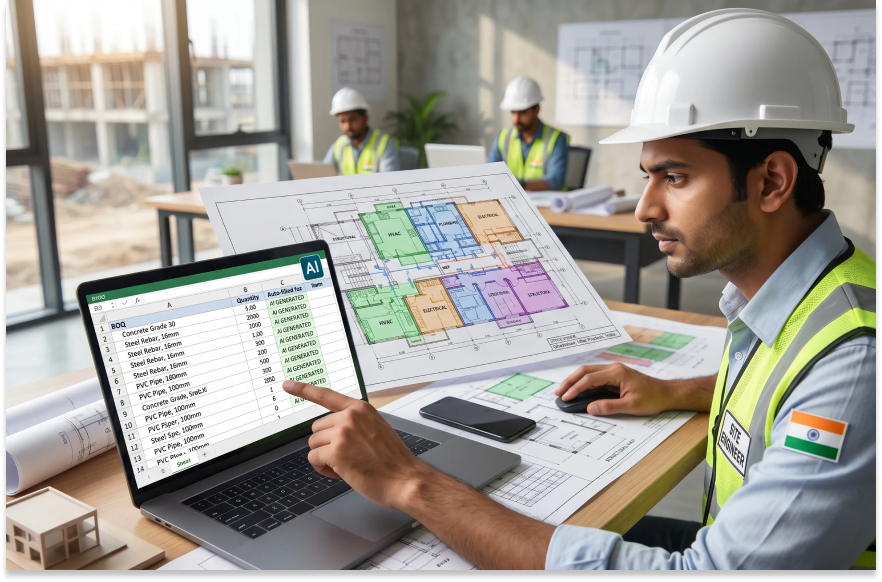
Not all AI quantity extraction tools are built the same way. Here are the features that separate genuinely useful tools from those that look impressive in demos but fall short in practice.
The best tools do not just give you a spreadsheet of numbers. They mark up the source drawing or model to show you exactly which elements have been measured and which quantities they represent. This makes review fast and transparent. DesignDrafter's quantity module includes item markups on drawings, so your team can verify the extraction output visually.
Quantity extraction is only the first step. The real value comes when you can attach specifications and preferred brands to each extracted item and generate a branded BOQ that reflects your project's actual procurement preferences. DesignDrafter allows you to edit specifications and brands directly within the platform, so your BOQ reflects real-world pricing and sourcing, not just generic descriptions.
The output needs to be usable in your existing workflow. DesignDrafter exports BOQ-ready outputs in structured formats (PDF and Excel) that can be imported into cost management software or submitted directly to clients and contractors.
Quantity extraction works best when it is part of a connected workflow, not an isolated step. DesignDrafter integrates quantity extraction with its Design Calculation modules so that MEP sizing calculations feed directly into the quantity extraction engine. When you design and size an HVAC system in the platform, the calculated duct sizes and equipment selections flow into the BOQ automatically.
For complex projects, DesignDrafter's AI Design Agent can manage the entire quantity extraction workflow autonomously, from receiving the model to producing the final BOQ, with minimal human intervention. This is the highest level of automation available in the current market.
Even with AI-powered tools, there are practices that reduce the quality of quantity extraction output. Here are the ones to watch for.
Starting extraction before the design is sufficiently developed. Extracting quantities from a schematic design model will give you approximate numbers that look precise. Wait until the design is at LOD 300 or above before running a formal BOQ extraction.
Not validating MEP quantities against system calculations. Extracted MEP quantities should always be cross-checked against the engineering design calculations to confirm that the quantities make physical sense. DesignDrafter's integrated calculation and extraction workflow makes this validation step easy.
Using extraction output without reviewing item markup. Always check the visual markup on the drawings to confirm that the AI has correctly identified and measured every element. Edge cases and unusual drawing conventions can occasionally cause misclassification.
Treating the first extraction as the final BOQ. The AI-extracted quantities are the starting point for your BOQ, not the end point. Review, apply contingencies, add preliminaries, and check against historical benchmarks before submitting.
The trajectory of AI-powered quantity extraction points toward a construction industry where cost information is continuously available, always up to date, and generated without dedicated manual effort.
The near-term developments include:
DesignDrafter's roadmap is aligned with these directions. The platform's AI Design Agent already handles multi-step quantity and documentation tasks autonomously, and the platform continues to evolve toward a fully connected design, calculation, extraction, and documentation environment.
Most global quantity extraction tools are designed around Western construction standards, pricing databases, and regulatory frameworks. Indian AEC firms using these tools often find they need significant customization before the output is actually useful in an Indian project context.
DesignDrafter is built in India, for Indian projects. The platform understands:
This makes the platform's quantity extraction output immediately usable without translation or reformatting for the Indian market.
For MEP consultants specifically, DesignDrafter's integration of engineering calculations with quantity extraction means that a consultant who sizes their HVAC system using the Design Calculation module can extract the BOQ for that system directly from the calculation output, with no manual data transfer required.
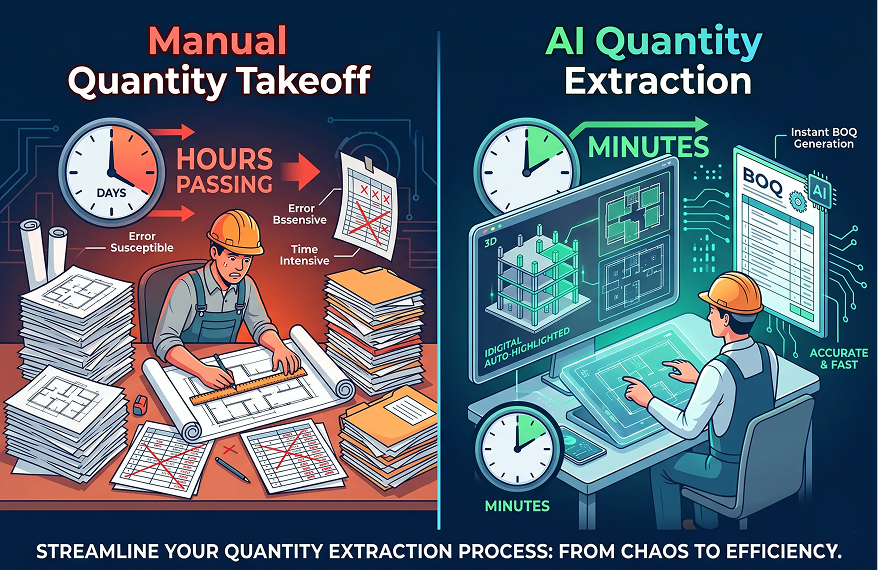
It is worth being honest about what AI quantity extraction replaces and what it does not replace, because unrealistic expectations lead to poor adoption decisions.
The goal of AI-powered quantity extraction is not to eliminate the quantity surveyor or estimator. It is to eliminate the part of their job that involves staring at drawings and typing numbers into a spreadsheet, so they can focus on the professional judgment and client interaction that genuinely requires human expertise.
The construction industry in India is growing at a pace that manual processes simply cannot support. Project timelines are getting shorter. Client expectations for cost accuracy are getting higher. The volume of MEP complexity in modern buildings is increasing with every new project typology. Manual quantity extraction was never a great solution. It was just the only solution available. That is no longer true.
AI-powered quantity extraction through platforms like DesignDrafter gives Indian AEC firms, MEP consultants, contractors, and cost consultants the ability to produce accurate, complete, structured BOQs in a fraction of the time that manual extraction required. The output is more accurate, more consistent, and more defensible than anything a team working under deadline pressure can produce by hand.
More importantly, faster and more accurate quantity extraction changes the economics of your firm. You can bid on more projects. You can respond to client queries faster. You can adjust your cost estimates when designs change without going back to the drawing board every time. And you can free your best estimators from tedious manual counting so they can focus on the strategic decisions that genuinely grow your business.
If your team is still extracting quantities manually, the cost of continuing that approach is now higher than the cost of changing it.
Start your free trial on DesignDrafter today and run your first AI-powered quantity extraction on a real project. See the difference for yourself before committing to any plan.
FAQ

Quantity extraction is the process of identifying and measuring all materials and components from project drawings or BIM models. A Bill of Quantities (BOQ) is the structured document that lists those extracted quantities alongside descriptions and unit rates. Quantity extraction is the input process. The BOQ is the output document. AI-powered platforms like DesignDrafter automate the extraction step and generate the BOQ output automatically.
Yes. DesignDrafter can extract quantities from both 2D CAD drawings and 3D BIM models. However, extraction from BIM models is significantly more accurate because the model already contains 3D geometry and embedded element data. For best results, convert your CAD drawings to BIM first using the platform’s Smart Drawing Development module, then run quantity extraction from the converted model.
AI-powered quantity extraction is generally more accurate than manual extraction for the standard building elements it is trained to recognize because it applies measurement rules consistently without human fatigue or interpretation variability. The accuracy advantage is particularly large for MEP systems, where manual extraction from 2D drawings is inherently imprecise. Human review of the AI output adds a further quality check that ensures the final BOQ is both accurate and professionally validated.
DesignDrafter extracts architectural quantities (floor area, wall area, ceiling area, door and window counts), structural quantities (concrete volume, formwork area), and MEP quantities (pipe lengths by system and diameter, duct quantities by type and size, cable lengths, equipment counts, fixture counts). The platform covers the full range of building disciplines in a single extraction run.
Yes. DesignDrafter’s quantity extraction module includes full specification editing capability. You can adjust quantities, change material grades, assign preferred brands, and add project-specific notes to any BOQ line item before exporting the final document. The platform is designed to give you AI-generated starting data that your team refines, not a locked output you cannot modify.
Yes. The platform is designed to scale across project sizes. Individual consultants and small firms working on residential projects benefit from the speed and accuracy of AI extraction on smaller drawing sets. Larger MEP consultancies, EPC firms, and design firms managing multi-discipline commercial projects benefit from the platform’s ability to handle complex model inputs, multi-system MEP extraction, and structured BOQ outputs that meet client and tender requirements at scale.

May 9 , 2026
July 14 , 2026
May 7 , 2026