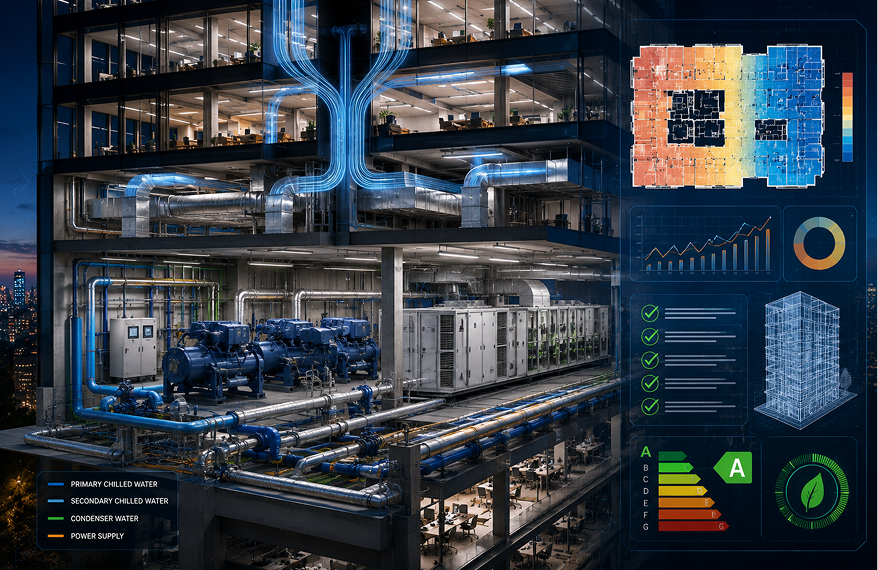
In Short
HVAC design in India has historically been one of the most calculation-heavy, time-consuming, and conflict-prone disciplines in building engineering. A medium-scale commercial project requires heat load analysis for dozens of zones, ventilation calculations by occupancy type, duct sizing across multiple air handling unit branches, chiller selection, pump sizing, and full ECBC energy performance documentation — all before a single piece of ductwork is installed.
If you have sat through a project coordination meeting where a duct conflict with a structural beam gets flagged six weeks before handover, you already understand what late HVAC coordination actually costs. And it is rarely just money. It is timeline pressure, client trust, and the kind of last-minute rework that no MEP engineer wants to explain on a call.
HVAC design in India has always been one of the most calculation-heavy, time-consuming, and conflict-prone disciplines in building engineering. A medium-scale commercial project requires heat load analysis across dozens of zones, ventilation calculations by occupancy type, duct sizing across multiple AHU branches, chiller selection, pump sizing, and full Energy Conservation Building Code documentation, all before a single piece of ductwork goes up.
For most Indian MEP consultants, this means several days in Carrier HAP, manual cross-referencing of ASHRAE 62.1 tables, separately maintained Excel workbooks, and a final report assembled by hand before submission. When the architectural layout changes, and it always does, the full sequence starts again from scratch.
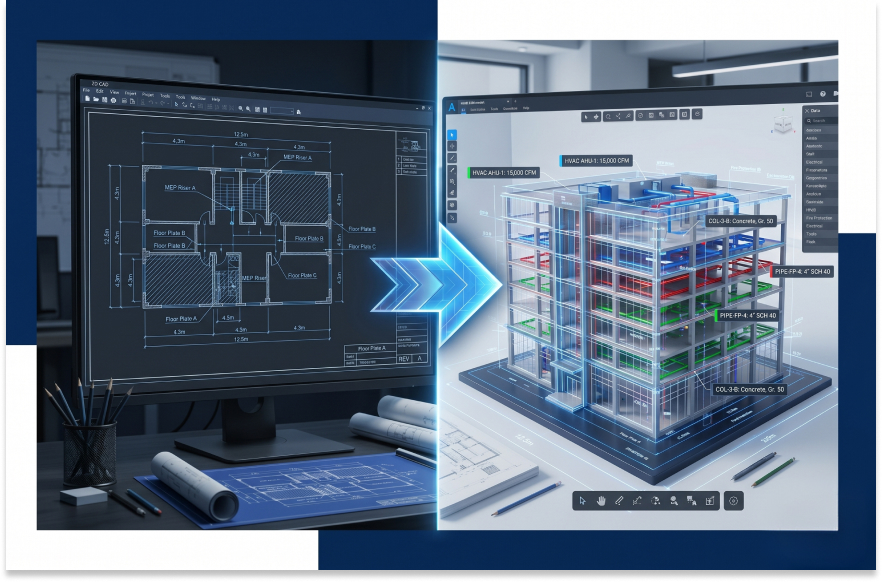
In 2026, this workflow is being replaced. AI-powered HVAC design calculation tools are allowing MEP engineers in India to complete the full calculation cycle in a fraction of the time, with standard compliance embedded in the output and revision management handled automatically.
This guide walks through the entire HVAC design calculation process for Indian buildings, identifies where the traditional workflow fails, and explains how AI-powered platforms like DesignDrafter are transforming how MEP engineers work from heat load analysis all the way through to submission-ready reports.
HVAC stands for Heating, Ventilation, and Air Conditioning. In the Indian context, heating is rarely a primary concern outside of hill stations and cold-climate zones, but ventilation and air conditioning are critical for almost every building type, from a 2BHK residential apartment to a 200,000 square foot commercial tower.
HVAC design calculation is the engineering process of determining several key outputs:
Getting these calculations right is not optional. Undersized equipment fails to maintain comfort under peak load. Oversized equipment wastes capital cost, consumes excess energy, and short-cycles compressors, leading to premature failure. Incorrect duct sizing causes velocity noise, uneven airflow, and poor zone control. Non-compliant ECBC documentation results in permit rejection and expensive redesign cycles.
HVAC design calculation is one of the most technically demanding and consequential parts of any MEP engineering workflow, and also one of the most time-consuming to execute manually.
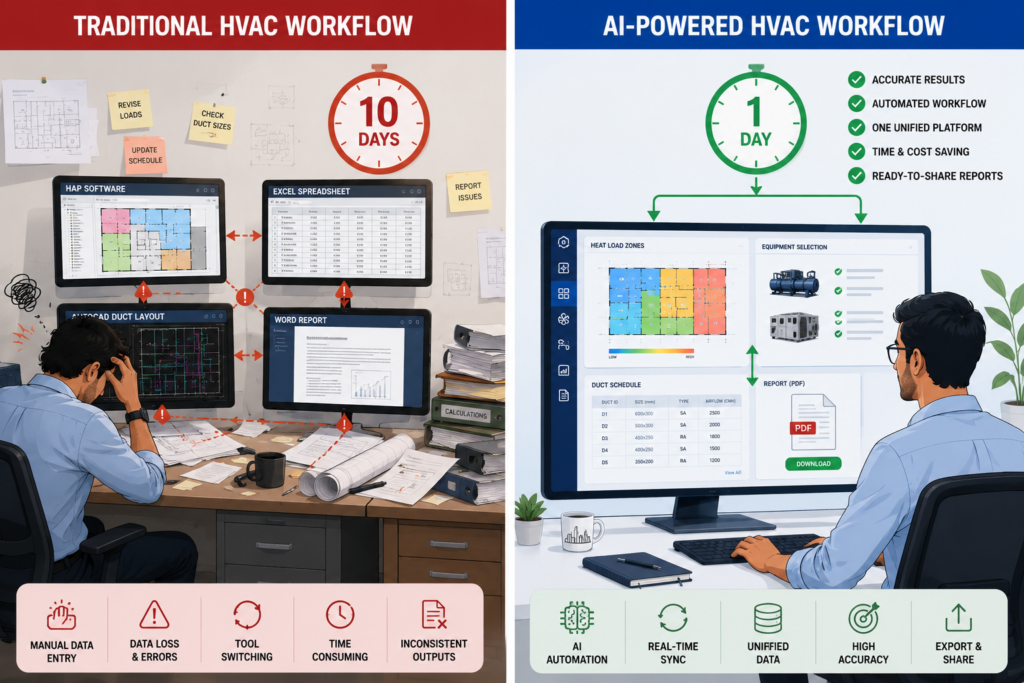
To understand how much AI changes this process, it helps to walk through how HVAC design currently works in most Indian MEP consulting firms.
The HVAC engineer begins by collecting architectural drawings, including floor plans, sections, elevations, and schedules, to extract room areas, ceiling heights, wall types, window-to-wall ratios, orientation data, and occupancy programs. This information forms the foundation for every heat load calculation that follows.
In practice, this step is more time-consuming than it looks. Architectural drawings are often in preliminary stages when MEP design begins. Room areas may not be tabulated. Ceiling heights are inconsistently noted. Window schedules may lack glazing performance specifications. The HVAC engineer essentially needs to audit the architectural drawings before any calculation can begin.
Using the extracted architectural data, the engineer performs a room-by-room heat load analysis covering:
Most Indian MEP engineers use Carrier HAP for this step, which requires manual entry of all building geometry, envelope specifications, occupancy schedules, and equipment loads. Setting up a new project in HAP takes several hours even for an experienced user. When inputs change, every entry must be updated manually.
Based on heat load results, the engineer selects air handling units, fan coil units, cassettes, or split systems for each zone, plus chillers, cooling towers, primary and secondary pumps, and condensate management equipment for the central plant. Equipment is matched to calculated loads from manufacturer catalogues with appropriate oversizing margins.
This involves multiple rounds of checking: verifying equipment tonnage against calculated loads, confirming that chiller COP meets ECBC Table 4.3 requirements for the applicable climate zone, and checking that pump head and flow selections are adequate for the piping system distribution.
Once air quantities are determined for each zone, the duct distribution network is designed and sized. Indian MEP engineers typically use the equal friction method, which maintains uniform pressure loss per unit length throughout the duct system and balances airflow without excessive damper restriction.
Duct sizing is iterative. The engineer sizes the main trunk, branches to each zone, checks velocity limits to avoid noise, and recalculates total system static pressure to size the supply air fan. When the layout changes, the duct network often needs to be resized entirely.
For commercial buildings above 500 square metres of conditioned area, the ECBC threshold in most states, the building must demonstrate compliance with the Energy Conservation Building Code. HVAC compliance under ECBC requires showing that selected chiller COP, IPLV, and fan power index meet or exceed code minimums for the building's climate zone.
Preparing ECBC compliance documentation is a separate, time-consuming task involving extracting equipment performance data from data sheets, comparing against ECBC minimum values, and formatting the comparison in a way that building authorities will accept.
All calculation outputs, equipment selections, duct schedules, and ECBC documentation are compiled into a submission report. This involves copying outputs from HAP into Word tables, formatting summaries, adding input data tables, writing methodology descriptions, and producing a cover page.
The total time from starting heat load analysis to submitting the HVAC calculation report for a medium-scale commercial project typically ranges from five to twelve working days, depending on project complexity and the quality of architectural input data.
Understanding the specific failure points in the manual HVAC workflow helps explain why the industry is shifting toward AI-powered solutions.
HVAC calculations cannot be finalized until architectural drawings provide reliable room areas, ceiling heights, envelope specifications, and window schedules. In Indian construction practice, MEP design often starts before architectural design is resolved, forcing engineers to work with preliminary data and re-run all calculations when the architecture is updated.
HAP holds the heat load data. Excel holds the equipment selection comparison. A separate spreadsheet holds duct sizing. Word holds the final report. When anything changes, the engineer updates each tool separately. Keeping all versions synchronized is an ongoing administrative burden that consumes more time than the actual engineering work.
Once the HVAC design is complete, preparing the BOQ requires the engineer or an estimator to manually compile equipment lists from HAP outputs, duct quantities from AutoCAD drawings, and insulation and accessory quantities from a separate takeoff. This is slow and error-prone, adding days to the project schedule.
When an architectural revision changes room areas, ceiling heights, or occupancy programs after the HVAC calculation has been completed, the entire calculation sequence must be re-run from scratch. On projects with multiple revision cycles, this rework consumes a disproportionate share of the MEP consultant's engineering budget.
In most Indian MEP consulting firms, ECBC compliance checking happens at the end of the design process, after equipment has already been selected. If selected equipment does not meet ECBC performance minimums, the selection must be revised, triggering a cascade of changes through the calculation report and submission documents.
AI-powered HVAC design platforms address each of these bottlenecks by automating the calculation workflow, integrating all steps into a single platform, and applying code compliance standards as part of the calculation logic rather than as a post-calculation checklist.
Rather than manually entering building geometry into HAP room by room, AI platforms extract building parameters directly from architectural data, whether from BIM models, CAD drawings, or structured input forms, and generate the heat load analysis automatically. Room areas, envelope constructions, glazing ratios, and occupancy programs are processed by the AI calculation engine, which applies ASHRAE heat gain calculation methodology to produce zone-level and total building cooling loads without manual data entry.
This eliminates the largest time sink in the traditional HVAC workflow. What previously took hours of manual setup takes minutes when the AI reads building data directly.
AI HVAC calculation engines embed the applicable standards as part of the calculation logic. Fresh air calculations apply ASHRAE 62.1 occupancy-based ventilation rates. ECBC compliance checking applies climate zone-specific minimum COP and IPLV values during equipment selection rather than as a separate post-selection step. Duct velocity limits are applied automatically to prevent noise generation without the engineer manually verifying each duct section.
For Indian MEP engineers, this means the calculation output is code-compliant by construction rather than by review, reducing the risk of submission rejections caused by methodology errors or missed code requirements.
AI platforms screen equipment options against ECBC performance requirements during the selection process itself, surfacing only equipment that meets applicable energy performance minimums for the project's climate zone. This prevents the expensive post-selection discovery that selected equipment is non-compliant, which forces redesign at the worst possible point in the project timeline.
When HVAC calculations drive equipment selection and duct sizing within an integrated platform, the BOQ can be generated directly from calculation outputs without manual compilation. Chiller tonnage, AHU airflow, ductwork quantities by section, pipe sizes and lengths, insulation specifications, and accessory quantities are all extractable from design data automatically, producing a BOQ in a fraction of the time a manual takeoff requires.
In an integrated AI HVAC platform, updating a building parameter updates all dependent calculations simultaneously. When an architect revises floor areas, changing the input in the platform regenerates the heat load analysis, equipment selection, duct sizing, and BOQ together. The engineer reviews and approves the updated outputs rather than rebuilding everything from scratch.
For residential buildings in India, HVAC design typically covers variable refrigerant flow systems for premium apartments, split and multi-split systems for standard apartments, and central chilled water systems for large gated community clubhouses and amenity areas.
Key calculation considerations for residential HVAC include:
For architects working on residential layouts, integrating HVAC feasibility checks at the layout stage prevents costly conflicts during construction. DesignDrafter's AI Floor Plan Generator applies MEP feasibility logic during layout generation, so residential layouts are HVAC-coordinated before detailed design begins.
Commercial offices represent the highest complexity scenario for HVAC design in India, with multiple zones of varying occupancy density, high internal equipment loads from workstations and servers, diverse facade orientations creating asymmetric solar heat gain, and full ECBC compliance obligations for buildings above 500 square metres.
For commercial office HVAC in India, the calculation sequence typically covers:
ECBC compliance documentation for commercial buildings is a significant submission requirement in major Indian cities including Delhi, Mumbai, Bengaluru, Pune, and Hyderabad.
Healthcare facilities present the most demanding HVAC design requirements of any building type in India. Critical care areas require 100 percent outdoor air systems with no recirculation to prevent cross-contamination. Operating theatres require laminar flow air distribution, HEPA filtration, positive or negative pressurization relative to adjacent spaces, and precise temperature and humidity control within narrow bands.
The calculation complexity for healthcare HVAC is compounded by the regulatory framework. NABH accreditation requirements for Indian hospitals overlay NBC requirements with additional provisions for air change rates, filtration efficiencies, and pressure relationships between spaces. MEP engineers designing healthcare HVAC must satisfy both building code and healthcare accreditation requirements simultaneously.
Hotels present a mix of HVAC requirements: guest rooms with high occupancy diversity factors, lobbies with high solar heat gain and high fresh air requirements, kitchens with large process heat loads and dedicated exhaust systems, banquet halls with variable high-density occupancy, and mechanical rooms with tight space constraints.
For Indian hotel projects, HVAC design must also address local climate zone carefully. A hotel in Rajasthan has a very different HVAC design than the same hotel in Kerala, with dramatically different sensible heat ratios, outdoor air psychrometric conditions, and appropriate system configurations.
Understanding which standards govern HVAC design in India is fundamental to producing compliant calculation outputs. Here is a clear breakdown of each standard and its application:
This standard governs minimum ventilation rates for commercial and institutional buildings. Indian HVAC consultants apply ASHRAE 62.1 Table 6-1 for minimum outdoor air per person and per unit floor area for each occupancy category. ASHRAE 62.1 is applied as the default ventilation standard in India in the absence of an equivalent Indian standard for full ventilation design methodology.
The Bureau of Energy Efficiency administers ECBC compliance in India. State-level building regulations mandate ECBC compliance documentation as part of the building permit process in many Indian states. ECBC 2017 sets minimum chiller COP by capacity range and climate zone, minimum IPLV for part-load performance, maximum fan power index, and variable speed drive requirements for pumps and fans above specific power thresholds.
Indian Society of Heating, Refrigerating and Air Conditioning Engineers standards supplement ASHRAE with India-specific guidance, including outdoor design conditions for Indian cities based on 1 percent design dry bulb and coincident wet bulb temperatures. ISHRAE outdoor design conditions are the reference for peak cooling load calculations on Indian projects.
The National Building Code 2016 Part 8 covers HVAC system design requirements for Indian buildings, including minimum fresh air supply rates for different occupancy types and ventilation requirements for special occupancies including kitchens, parking structures, and assembly areas.
IS:659 covers the air conditioning code of practice for thermal comfort in air-conditioned spaces, including indoor design conditions. The standard typically referenced for Indian office comfort is 24 degrees Celsius dry bulb and 50 percent relative humidity.
For MEP consultants managing compliance documentation across all these standards, DesignDrafter's MEP design calculation platform embeds ASHRAE, ECBC, ISHRAE, and NBC compliance logic into the calculation workflow, producing outputs that reference the applicable standard clause for each calculation step in the submission report.
Here is how the HVAC design calculation process works on an AI-powered platform, compared step-by-step to the traditional manual workflow.
Instead of manually setting up a project in HAP, the engineer enters building parameters into the platform: location and climate zone, building type and occupancy, total conditioned area, number of floors, ceiling height, glazing percentage by facade orientation, and primary occupancy schedule.
These parameters are shared across all MEP discipline calculations within the same project workspace. There is no need to re-enter building data for each discipline separately.
The AI calculation engine processes the building parameters and generates a zone-by-zone heat load analysis automatically. The output includes:
The calculation methodology follows ASHRAE CLTD/CLF or RTS methods, applied to outdoor design conditions from ISHRAE data for the project city.
Based on calculated cooling loads, the AI presents equipment size recommendations with ECBC compliance screening already applied. Chiller options are presented with COP and IPLV values pre-verified against ECBC Table 4.3 for the project's climate zone. Only equipment meeting or exceeding ECBC minimums is presented as the primary recommendation. The engineer retains full control to select any option and receives a clear compliance flag if a non-compliant selection is made.
With air quantities determined, the AI sizes the duct distribution network using the equal friction method, applying maximum velocity limits by duct section type: main trunk, branch ducts, and flexible connections. The output is a complete duct schedule by section, including duct dimensions, velocity, friction rate, and cumulative static pressure from each zone back to the AHU.
The platform generates the complete HVAC calculation report automatically, including:
The report is formatted for direct submission to building authorities or client review, in both PDF and Excel.
Simultaneously with the calculation report, the platform generates the HVAC BOQ from the design data: chiller units with full specifications, AHUs and FCUs with airflow and cooling capacities, ductwork quantities by material and size range, pipe quantities by diameter, insulation quantities, and all accessories. This BOQ is fully editable for brand specifications and item markups before export.
Learn more about DesignDrafter's AI-powered Quantity Extraction for MEP projects and how it integrates with the HVAC calculation workflow.
DesignDrafter is built specifically for the Indian AEC market, with every calculation module aligned to the standards Indian MEP engineers must comply with on every project.
Here is how the platform supports the HVAC workflow end-to-end:
When architects use the AI Floor Plan Generator to generate layouts, MEP feasibility logic is applied during the layout generation process itself. Wet areas are grouped for plumbing and HVAC drainage feasibility. MEP shaft locations are allocated in the floor plan before structural elements are positioned. Ceiling void depths are considered for duct sizing requirements.
This means that by the time the HVAC engineer receives the architectural layout, the fundamental spatial decisions that affect HVAC feasibility have already been made correctly, reducing the back-and-forth between disciplines that is the most common source of coordination delays on Indian projects.
For a deeper understanding of how AI layout generation works for architects, visit the DesignDrafter Architects Solution page.
The DesignDrafter MEP platform covers HVAC calculations within the full MEP calculation suite, alongside electrical, plumbing, and fire fighting modules. Building parameters entered once are shared across all discipline calculations, so when an architectural revision changes the floor area, all four discipline calculations update from the same revised input.
HVAC calculation outputs on the platform include:
For EPC contractors and design firms managing construction-stage coordination, DesignDrafter's BIM automation capabilities convert HVAC calculation outputs into coordinated Revit models with clash detection applied before construction drawings are issued. Visit the DesignDrafter home page to explore BIM automation capabilities including CAD to Revit conversion, clash resolution, sheet creation, and quantity takeoff for MEP projects.
HVAC design calculation is one of the most technically demanding and time-consuming parts of MEP engineering in India. The traditional workflow, with its manual data entry, disconnected tools, separate documentation preparation, and late-stage ECBC compliance checking, was not designed for the pace at which Indian construction projects now move.
AI-powered HVAC design platforms change this in a concrete, practical way. By automating heat load analysis, embedding code compliance into the calculation logic, integrating equipment selection with ECBC screening, generating BOQs from design data, and producing submission-ready reports automatically, these platforms allow MEP engineers to complete the HVAC design calculation cycle faster, more accurately, and with far less administrative overhead than the traditional workflow allows.
For Indian MEP consultants and architects who want to move beyond the limitations of HAP, Excel, and manual report compilation, the integrated AI approach is no longer a future concept. It is available now and being used on real projects across India.
Explore how DesignDrafter's AI-powered MEP design platform handles the complete HVAC calculation workflow for Indian building projects, from heat load analysis through to submission-ready reports, all within a single workspace. You can start a free trial with no credit card required and experience the workflow on a real project before committing to a paid plan.
If you are also evaluating BIM Automation tools for MEP coordination or looking to understand how the AI Design Agent can automate repetitive MEP calculation tasks across your full project portfolio, DesignDrafter's unified platform covers all of these capabilities within the same professional workspace built specifically for Indian AEC teams.
Founder
Manas Krishna is a Mechanical Engineer and infrastructure technology entrepreneur with 20+ years of experience in MEP (Mechanical, Electrical, and Plumbing) engineering, public health engineering, and transport infrastructure projects across India.
FAQ

HVAC design calculation is the engineering process of determining the cooling load of each zone in a building, selecting appropriately sized equipment, designing the air distribution network, and verifying code compliance. For Indian buildings, it involves heat load analysis using ASHRAE methods with ISHRAE outdoor design conditions for the project city, fresh air calculations per ASHRAE 62.1 or NBC, equipment selection with ECBC compliance verification, duct sizing using the equal friction method, and preparation of structured calculation reports for authority submission. AI-powered platforms now automate this process end-to-end, reducing calculation time from days to hours.
The most widely used HVAC load calculation software in India includes Carrier HAP, Trace 700, and DesignMaster. Many firms also use custom Excel spreadsheets for smaller projects. AI-powered platforms like DesignDrafter are increasingly being adopted by Indian MEP consulting firms because they integrate heat load calculation, equipment selection, ECBC compliance checking, BOQ generation, and report assembly within a single workflow rather than requiring separate tools for each step.
Yes. ECBC compliance for HVAC is mandatory for commercial buildings above 500 square metres of conditioned area under the Energy Conservation Act. It requires that selected HVAC equipment meets minimum energy performance standards including minimum COP for chillers, minimum ISEER for split systems, maximum Fan Power Index for AHUs, and variable speed drive requirements for fans and pumps above specified power thresholds. ECBC compliance documentation is required as part of the building permit application in most major Indian cities.
For a medium-scale commercial project between 5,000 and 20,000 square metres, manual HVAC design calculation using HAP and Excel typically takes five to twelve working days from data collection to final report submission. With an AI-powered platform that automates heat load analysis, equipment selection with ECBC screening, duct sizing, and report generation, the same scope can be completed in a fraction of that time.
Fresh air requirements for office buildings in India are governed by ASHRAE 62.1, which specifies a minimum outdoor air requirement of 8.5 litres per second per person plus 0.3 litres per second per square metre of office floor area. NBC also provides ventilation rates by occupancy type. These fresh air quantities drive the ventilation load component of the cooling load calculation and the sizing of outdoor air handling systems.
Sensible heat load is the heat that causes a temperature rise in the air, coming from solar radiation, conduction through walls and roofs, lighting, equipment, and occupancy. Latent heat load is the heat associated with moisture addition to the air, primarily from occupant perspiration and respiration and from outdoor air infiltration. In Indian Warm-Humid climates like Mumbai, Chennai, and Kochi, latent loads are a large proportion of total cooling load and must be accurately calculated for correct dehumidification capacity selection.
AI platforms that integrate HVAC design calculations with quantity extraction generate the complete HVAC BOQ automatically from calculation outputs. Chiller units with capacity and COP specifications, AHUs with airflow and coil capacities, ductwork quantities by material and size range, pipe quantities by diameter, insulation volumes, and accessory lists are all extracted from design data automatically, eliminating the manual measurement and compilation process that typically adds days to HVAC project delivery.
The most common HVAC systems in Indian commercial buildings include central chilled water systems with centrifugal or screw chillers for large commercial towers, Variable Refrigerant Flow systems for medium-scale commercial offices and hotels, Direct Expansion packaged systems for small to medium commercial premises, and split and multi-split systems for residential and small commercial applications. The appropriate system depends on building scale, occupancy type, energy performance requirements, and owner lifecycle cost preferences.
Yes. AI-powered HVAC calculation platforms handle the additional complexity of healthcare and clean room HVAC design, including 100 percent outdoor air systems, HEPA filtration pressure drop calculations, positive and negative pressurization requirements, air change rates for critical care areas per NABH and ASHRAE 170, and humidity control within tight tolerance bands. The platform applies applicable standards for healthcare HVAC as part of the calculation logic, producing compliant outputs for regulatory submission.
HVAC design compliance requires verifying that heat load calculations use ASHRAE-approved methodology with ISHRAE outdoor design data for the project city; fresh air quantities meet ASHRAE 62.1 minimum ventilation rates for the occupancy; equipment COP and IPLV meet ECBC minimum values for the project’s climate zone; duct velocities remain within ASHRAE recommended limits for each duct section type; and all calculation results are documented with methodology references in the submission report. AI platforms that embed these standards into the calculation logic produce inherently compliant outputs without the engineer needing to cross-reference each requirement manually.
India has five climate zones under ECBC classification: Composite (Delhi, Agra, Lucknow), Hot-Dry (Ahmedabad, Jaipur, Jodhpur), Warm-Humid (Mumbai, Chennai, Kochi, Kolkata), Temperate (Bengaluru, Pune), and Cold (Shimla, Leh, Srinagar). Each climate zone has different outdoor design conditions, sensible heat ratios, and ECBC minimum performance requirements. A building in the Hot-Dry zone requires different equipment selection, outdoor air treatment, and envelope specifications compared to the same building in the Warm-Humid zone. Understanding the project’s climate zone is the first step in any HVAC design calculation for Indian projects.
DesignDrafter reduces revision cycle time by treating all calculations as input-driven outputs rather than fixed documents. When a project parameter changes, such as a revised floor area or updated occupancy program, the affected HVAC calculations regenerate automatically across all zones and across all four MEP discipline modules simultaneously. The updated report and BOQ are produced from the same revised input without the engineer manually updating HAP, re-running Excel workbooks, or reformatting the submission report. This revision management capability is especially valuable on design-and-build projects in India where the scope evolves rapidly through the early construction phase.
May 15 , 2026
July 25 , 2026
April 27 , 2026