In Short
This post covers the full picture of how AI in construction is transforming professional workflows across architecture, MEP engineering, BIM coordination, and project estimation in 2026. You'll find market data, discipline-specific use cases, a direct comparison table of AI versus traditional workflows, a breakdown of which construction roles benefit most, and a look at where the technology is heading through 2030. Whether you're an architect evaluating AI floor plan tools, an MEP consultant considering automated calculation platforms, or a project manager looking to reduce cost overruns, this guide gives you the evidence and context to make an informed decision without the hype.
Artificial intelligence in construction is reshaping how buildings get designed, coordinated, and delivered, cutting rework by up to 50%, reducing project delays by 30%, and helping teams generate months of manual work in hours. If you work in architecture, MEP engineering, or project management, AI isn't a future concept anymore. It's the tool your competitors are already using.
I've spent the last decade watching the AEC (Architecture, Engineering, and Construction) industry inch toward digital transformation. Most of that decade was frustratingly slow. But 2024 and 2025 changed the pace entirely. AI in construction stopped being a conference talking point and started becoming a daily workflow reality. This post breaks down exactly where AI is making the biggest difference, which disciplines are feeling it first, and what it means for how you deliver projects in 2026.
AI in construction is the application of machine learning, computer vision, natural language processing, and generative algorithms to design, engineering, estimation, and project management workflows. It matters now because the industry's fundamental problems, such as chronic cost overruns, labor shortages, and coordination failures, have hit a breaking point.
McKinsey research shows global construction productivity grew just 0.4% per year over the last two decades, while most other industries doubled or tripled their output per worker. That gap is unsustainable when material costs are rising, skilled labor is retiring faster than it's being replaced, and clients expect faster delivery for less money.
The AI in construction market tells its own story. According to Fortune Business Insights, the global market was valued at $4.86 billion in 2025 and is projected to reach $35.53 billion by 2033. That's not hype; that's where capital is flowing because results are showing up on actual project balance sheets.
AI is changing building design by automating layout generation, optimizing spatial planning against code constraints, and reducing design iteration cycles from weeks to hours.
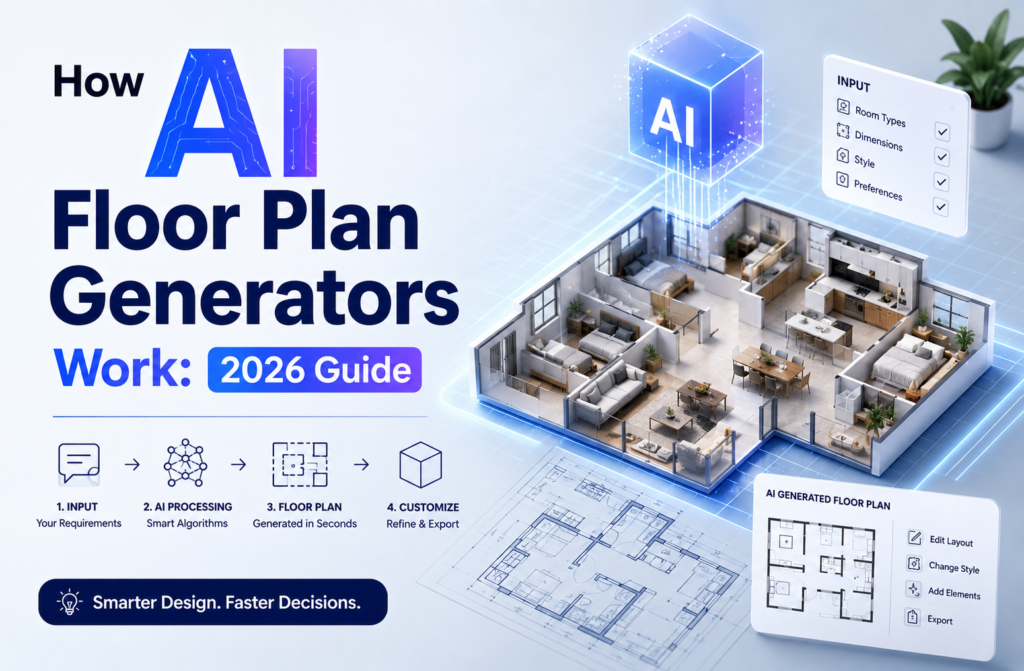
Here's what that looks like in practice. A traditional floor plan exercise starts with an architect manually drafting room arrangements, testing adjacency logic, checking area constraints, and iterating through client feedback cycles. That process might take two to four weeks for a mid-size commercial building. An AI floor plan generator does the same job in minutes. You feed in the inputs (room count, plot area, building type, adjacency rules), and the system produces multiple code-compliant layout options instantly.
DesignDrafter's AI Floor Plan Generator works exactly this way. You define requirements and the AI engine explores optimized layout combinations with proper space planning and compliance logic baked in. Architects then refine rather than start from scratch, which is a fundamentally different (and faster) way to work.
Traditional design gives you one option at a time. Generative AI gives you hundreds simultaneously, ranked by performance criteria you define. Autodesk's collaboration with Daisy AI demonstrated this for timber floor structures, automating layout optimization and reducing conceptual design time dramatically. The same principle applies to any building type.
When I look at how firms using generative design compete against those still doing everything manually, the difference in proposal speed alone is often decisive. Clients notice when you show up with three optimized schemes instead of one.
Rendering used to be a specialist task you outsourced or spent an afternoon doing. Today, AI rendering tools convert simple design inputs into photorealistic elevations and interior visualizations in real time. This matters for client approvals, planning submissions, and catching design intent problems early, before they become construction problems.
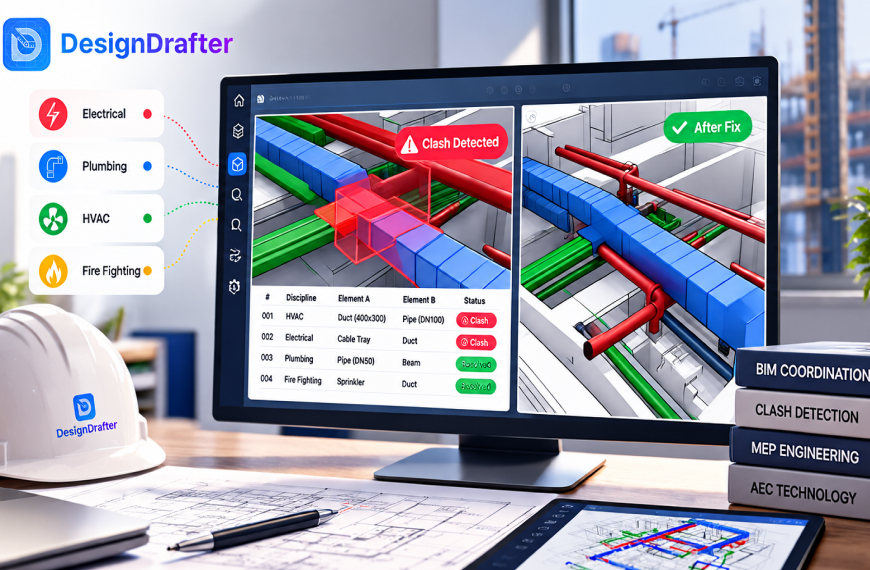
MEP coordination is the process of aligning mechanical, electrical, and plumbing systems within a building so they don't clash with each other or with the structural and architectural elements. It is notoriously the most collision-prone phase of any building project because MEP systems share tight ceiling and wall cavities with structure, and they're often designed in parallel by separate teams.
Clash detection in traditional workflows happens too late, usually when someone's already building something in the wrong place. AI changes that by running automated clash checks continuously as designs evolve, flagging conflicts the moment they arise rather than after the concrete has been poured.
This is where I think AI delivers its most underappreciated value. MEP calculations, which include electrical load analysis, HVAC sizing, plumbing flow rates, and fire suppression system design, are painstaking and time-consuming when done manually. An experienced MEP engineer on a large commercial project can spend weeks just on the calculation phase.
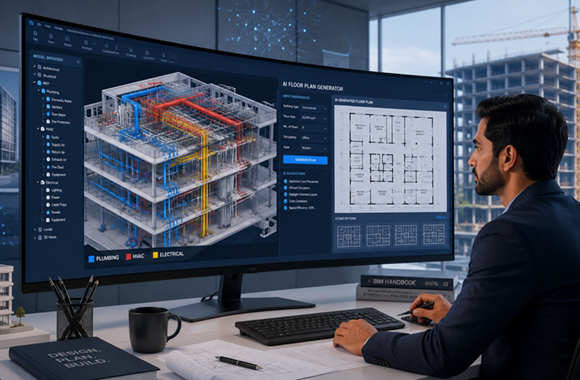
DesignDrafter's MEP Design Calculation module compresses that timeline significantly. The platform handles electrical calculations to IS/IEC standards, HVAC sizing per ASHRAE and ECBC guidelines, plumbing systems to IS:1172 and NBC norms, and fire fighting systems per NFPA and NBC codes. All in one workspace, all connected to the design layout, all structured for submission-ready output.
The practical implication is that an MEP consultant can validate an entire system design in an afternoon rather than a week, and the output is already formatted correctly for client proposals and regulatory submissions.
The CAD to Revit conversion workflow that AI enables is another step-change. Legacy 2D CAD drawings are still the starting point for millions of projects. Converting them to intelligent 3D BIM models manually is expensive and error-prone. AI-powered converters now read 2D CAD files, auto-classify walls, doors, MEP systems, and annotations, and rebuild them as object-based BIM elements in Revit, complete with clash resolution, COBie/Uniclass data, and sheet creation.
What used to take a BIM team weeks now takes hours.
The rise of AI in construction estimation is one of the clearest productivity wins across the entire project lifecycle. Quantity takeoffs, which are the foundation of every cost estimate and tender submission, have historically been manual, time-consuming, and prone to human error.
Industry data from InspectMind AI shows that rework costs construction projects between 5% and 15% of total project value, and 52% of that rework stems from poor project data and miscommunication. Errors in the takeoff phase are one of the biggest contributors.
AI changes this in three ways:
DesignDrafter's Quantity Takeoff feature works this way. Quantities come from actual design data, not approximations, and the output includes item markups, editable specifications, and brand preferences, so estimators stay in control while AI does the heavy lifting.
AI improves construction site safety by using computer vision to monitor real-time site conditions, detect PPE non-compliance, identify fall hazards, and flag unsafe behaviors before incidents happen.
This is a big deal in an industry where, according to the U.S. Bureau of Labor Statistics, construction accounts for one of the highest rates of fatal occupational injuries of any sector. AI-powered cameras don't get fatigued, don't miss a frame, and don't fail to notice that someone walked into a restricted zone without a hard hat.
The applications include:
Pat Keaney, Director of Product Management, Intelligence at Autodesk Construction R&D, put it plainly: "We're leveraging AI to automatically identify root causes of RFIs and to continuously identify high-risk issues by tracking progress and predicting safety incidents. This is happening literally every single day in construction."
Here's where AI creates measurable differences versus conventional project delivery:
| Workflow Area | Traditional Approach | AI-Powered Approach | Typical Improvement |
|---|---|---|---|
| Floor Plan Generation | Manual drafting, 2-4 weeks | AI-generated options, hours | 80-90% time reduction |
| MEP Calculations | Manual, 1-3 weeks | Automated, structured output, 1-3 days | 70% faster |
| Quantity Takeoff | Manual counting, error-prone | Auto-extracted from design data | 50% fewer errors |
| CAD to BIM Conversion | Manual remodeling, weeks | AI-powered, hours | 85% time reduction |
| Clash Detection | End-of-design-phase review | Continuous, real-time monitoring | Conflicts caught 3x earlier |
| Safety Monitoring | Periodic human inspection | 24/7 computer vision | Near-zero blind spots |
The numbers in this table align with findings from arbo.ai's 2025 research, which found that construction firms using AI see a 15-25% reduction in project costs and a 30% reduction in delays on average.
AI doesn't deliver the same value to everyone equally. Here's where the biggest impact lands:
The Springer Nature research published in 2025 found that integrated AI-BIM implementation produced a 30% reduction in design revisions (from 12 down to 8 revision cycles on the observed projects). For a team that bills by the hour, that's a significant overhead reduction on every project.
An AI design agent is a software co-pilot that understands your project workflow, executes complex multi-step tasks autonomously, and remembers project context across sessions.
The difference between a standard AI tool and a design agent is autonomy. A standard AI tool waits for you to ask a specific question. An AI design agent understands your overall project goals and can execute across multiple disciplines simultaneously, generating layouts, running MEP calculations, extracting BOQs, and validating standards in a coordinated workflow.
DesignDrafter's AI Design Agent works this way. You define the task; the agent executes it across the platform's modules. It doesn't just assist; it executes. For firms handling multiple active projects simultaneously, this kind of autonomous execution is the difference between scaling capacity and hiring more staff.
Should you use one? If your team is repeating the same calculation and documentation tasks on every project, yes. The ROI is typically visible within the first few projects.
The rise of AI in construction is moving toward full-cycle integration, where AI supports every phase from concept design through facility management, and where design, engineering, and construction data are unified in one intelligent platform.
Here's what that roadmap looks like based on current trajectory:
The near term (2025-2027) belongs to automation of repetitive professional tasks: calculations, BOQs, clash checks, BIM conversions. This is already happening.
The medium term (2027-2029) will bring autonomous design agents that can manage an entire project phase with minimal human input, coordinating between architecture, structure, and MEP simultaneously.
The longer term (2029-2032) points toward digital twins that use AI to manage building operations post-handover, predicting maintenance needs, optimizing energy use, and feeding performance data back into future design decisions.
Jim Lynch, former Senior Vice President at Autodesk Construction Solutions, framed the direction well: "Ten years from now, will we still need design teams to draw doors, walls, and windows? Or do we apply artificial intelligence to capture the requirements? There's so much out there for us to apply artificial intelligence to."
The market agrees. The Technavio analysis projects the AI in construction market will grow at a CAGR of 56.5% between 2024 and 2029, an unusually aggressive growth rate that reflects how much latent demand exists in an industry that has underinvested in technology for decades.
The DesignDrafter platform is built for exactly this trajectory, giving AEC teams in India and globally a unified workspace for AI-powered design, engineering, estimation, and BIM automation today, with the architecture to scale as AI capabilities expand.
AI in construction is not replacing architects, engineers, or project managers. It's replacing the tedious parts of their jobs so they can focus on the parts that actually require human expertise and judgment.
The evidence is consistent across disciplines. AI-powered design tools reduce floor plan generation from weeks to hours. AI-driven MEP calculation platforms cut engineering time by 70% or more. AI-automated quantity takeoffs reduce estimation errors by up to 50%. And AI-enabled site monitoring is making construction sites measurably safer.
The competitive reality is simple: firms adopting AI now are delivering faster, with fewer errors, at lower cost per project. Firms that aren't are competing on the same fundamentals they used in 2015, and that gap is widening.
If you're an architect, MEP consultant, BIM specialist, or EPC contractor and you haven't seriously evaluated AI-powered workflows yet, 2026 is the year to start. The tools exist. The ROI is documented. The learning curve is shorter than you think.
Your next step: Explore how DesignDrafter's AI-powered platform handles floor plan generation, MEP calculations, BOQ automation, and BIM coordination in a single workspace. Start for free with no credit card required and run your next project through an AI-assisted workflow. See the difference on a real project, not a demo.
The construction industry waited 20 years for meaningful productivity gains. With AI, those gains are finally here. The only question is whether your firm is capturing them.
Founder
Manas Krishna is a Mechanical Engineer and infrastructure technology entrepreneur with 20+ years of experience in MEP (Mechanical, Electrical, and Plumbing) engineering, public health engineering, and transport infrastructure projects across India.
FAQ

AI in construction is the use of machine learning, computer vision, and generative algorithms to automate design, engineering calculation, estimation, and site management tasks. It works by analyzing project data, recognizing patterns, and producing outputs (layouts, BOQs, clash reports, risk scores) faster and with fewer errors than manual methods. The global AI in construction market is projected to reach $35.53 billion by 2033.
Traditional BIM and CAD software are powerful drafting environments, but they require manual input for every element. Artificial intelligence in construction adds an automation layer on top: generating layouts automatically, running engineering calculations, extracting quantities from geometry, and converting legacy CAD files to Revit models. AI doesn’t replace BIM or CAD; it executes the repetitive tasks that slow those workflows down.
The most impactful use cases of AI in construction today are: (1) AI floor plan generation, (2) automated MEP engineering calculations, (3) AI-driven quantity takeoffs and BOQ generation, (4) CAD-to-BIM conversion, (5) real-time clash detection, (6) computer vision safety monitoring, and (7) predictive risk and schedule management. These are live capabilities in production tools, not concepts.
AI reduces construction cost overruns by improving estimate accuracy, catching design clashes before they become field rework, and predicting schedule risks early. Research from arbo.ai found firms using AI see a 15-25% reduction in project costs and 50% less rework. The biggest savings come from fixing problems in the design phase rather than during construction, where changes cost 10-100x more to address.
Yes, AI in construction is particularly well-suited for MEP engineers. AI platforms like DesignDrafter automate electrical load calculations, HVAC sizing, plumbing design, and fire suppression calculations in one structured workflow, aligned with IS, IEC, ASHRAE, NBC, and NFPA standards. MEP consultants who previously spent weeks on calculation phases can complete the same work in days and deliver submission-ready documentation automatically.
The rise of AI in construction shifts job content rather than eliminating jobs. Repetitive drafting, calculation, and documentation tasks get automated; higher-value work like design judgment, client collaboration, coordination strategy, and problem-solving becomes the primary focus. The Autodesk 2025 Design and Make Report found that 76% of construction leaders are increasing AI investment, with the goal of making their teams more productive, not smaller.
A construction AI design agent is an autonomous AI system that understands your project workflows and executes complex multi-step tasks across disciplines, such as generating a floor plan, running MEP calculations, and producing a BOQ, without requiring a separate prompt for each step. A chatbot answers questions. A design agent executes work. DesignDrafter’s AI Design Agent is an example of this, operating across layout, calculation, and documentation tasks in a single session.
AI-generated quantity takeoffs extract quantities directly from design geometry rather than manual counting, which eliminates transcription errors and interpretation differences. Industry data shows 52% of construction rework stems from poor data; AI-driven BOQ generation addresses this at the source. The output requires estimator review for markups and brand preferences, but the base quantities are derived from actual design data, not approximations, making them more reliable than manual takeoffs for most project types.
Yes, smaller firms often benefit more from AI in construction than large ones, because they lack the staff to manually handle every discipline efficiently. A small MEP consultancy using AI for calculations and BOQs can compete on project turnaround with much larger firms. Tools like DesignDrafter offer a Free plan and low-cost plans for individual consultants and small firms (from INR 2,999 a month), with no minimum project size and no credit card required to test the workflow.
The AI in construction market was valued at approximately $4.86 billion in 2025 according to Fortune Business Insights. Multiple analysts project the market reaching $27-35 billion by 2031-2033, with CAGRs ranging from 24% to 56% depending on the segment. Technavio projects a 56.5% CAGR between 2024 and 2029 for the broader AI in construction segment, driven by demand for productivity tools, labor shortage mitigation, and cost control technologies.