In Short
This guide is written for MEP engineers, EPC contractors, quantity surveyors, and AEC firm leaders in India who need a clear, practical comparison of construction cost estimating software in 2026 and how to choose the right tool for their specific project type and firm size. It covers the full MEP cost estimating workflow from design review through quantity takeoff, rate application, BOQ generation, and procurement integration, explaining why MEP estimating requires different software than civil or structural estimating. The guide compares leading platforms including DesignDrafter, Trimble Estimation MEP, Trimble AutoBid, Autodesk Construction Cloud, Procore Estimating, RIB CostX, and STACK across MEP scope coverage, BOQ methodology, Indian GST support, and pricing.
The best construction cost estimating software for MEP engineers in 2026 automates Bill of Quantities generation, extracts quantities directly from design drawings and BIM models, applies current material rates with GST compliance, and connects cost outputs to procurement without requiring a separate manual takeoff exercise. For Indian MEP consultants and AEC firms, DesignDrafter leads this workflow because its BOQ extraction connects directly to MEP design calculations, meaning the sizes and specifications derived from engineering feed procurement automatically. For large enterprise general contractors, Autodesk Construction Cloud and Procore Estimating dominate. For dedicated MEP contractors, Trimble AutoBid and Trimble Estimation MEP are the specialist choices.
The Indian construction industry is under margin pressure that makes accurate estimating non-negotiable in 2026. Material costs rose 15-25% in a single season in many Indian cities, with Delhi NCR TMT steel reaching ₹82,000 per tonne and cement fluctuating between ₹400-425 per bag (Construction Estimator India, 2026). Manual BOQ preparation based on outdated rate sheets is now a reliable path to either underquoting and losing money or overquoting and losing the tender. Digital construction cost estimating software reduces manual estimation errors by 70-90% and cuts material wastage by 10-25% through exact quantity measurements from PDF and CAD drawings (Construction Estimator India, 2026).
The global construction estimating software market was valued at USD 2.1 billion in 2025 and is growing at a CAGR of 9.8% through 2030 (MarketsandMarkets, 2026). In India, approximately 70% of contractors are SMEs who still manage BOQ and quotations primarily in Excel, leaving them exposed to rate errors, scope gaps, and tender deadline failures that digital tools directly address. This guide covers what construction cost estimating software does, which tools matter for MEP engineers and AEC firms specifically, and how to choose the right platform for your Indian project environment.
Construction cost estimating software is a category of digital tools that automates the creation of Bills of Quantities, material takeoffs, labour calculations, and cost reports for construction projects. It replaces manual spreadsheet-based estimation with calculation engines that apply current rates, handle GST compliance, produce procurement-ready output, and maintain an audit trail that clients, banks, and tender committees can verify.
Construction cost estimating software matters for MEP engineers specifically because MEP systems, including HVAC, electrical, plumbing, and fire fighting, typically represent 40-60% of a commercial building's total MEP project cost (Tech MEP Estimates, 2026). The mechanical scope alone (HVAC equipment, ductwork, piping, insulation, and controls) requires detailed component-level quantity extraction: duct length by size and gauge, pipe length by material and diameter, equipment counts with full specifications, fittings, hangers, and accessories. Getting these quantities wrong by even 5-10% on a large commercial project translates directly into procurement cost overruns or margin loss at tender.
The core problem with manual MEP estimation isn't that engineers can't count. It's that counting is disconnected from designing. An MEP engineer sizes a chiller at 500 TR, calculates the duct network, selects the pumps, and documents it all in a calculation report. The estimating team then manually reads that report and counts items separately. Every step of that manual handoff introduces transcription errors, missed scope, and the possibility that design revisions don't flow through to the BOQ before tender submission.
Construction cost estimating software solves this by connecting the design data to the cost data, so revisions propagate automatically and the BOQ always reflects the current design.
Understanding the full workflow helps you identify where software delivers the most value in your specific practice.
A professional MEP cost estimate covers six stages:
Software that automates steps 2 and 3, and connects them to design data from step 1, compresses the total timeline from weeks to days or hours.
MEP cost estimating requires a different approach than civil or structural estimating, and most general construction estimating software platforms underserve MEP scope as a result.
Civil estimating is dominated by area and volume measurements: concrete cubic metres, earthwork cubic metres, reinforcement tonnes, brickwork square metres. These measurements come naturally from drawings and are well-served by generic quantity takeoff tools.
MEP estimating requires component-level extraction across three distinct disciplines, each with its own measurement conventions:
A platform claiming to handle MEP estimating must address all three disciplines with measurement methods appropriate to each. General construction tools that treat ductwork as "area" or plumbing pipes as "linear metres" without distinguishing material grades, diameters, or pressure ratings produce BOQs that aren't detailed enough for competitive tendering or procurement.
Here is a comparison of the leading platforms relevant to MEP engineers and AEC firms.
| Software | Best For | MEP Scope | BOQ/Takeoff Method | Approx. Price | India GST Support |
|---|---|---|---|---|---|
| DesignDrafter | Indian MEP consultants, EPC contractors | Full MEP: HVAC, electrical, plumbing, fire | AI extraction from DWG, PDF, Revit, IFC | Free plan; paid plans from INR 2,999/month | Yes (Indian market built-in) |
| Trimble Estimation MEP | MEP contractors globally | Mechanical, electrical, plumbing takeoff | Graphical PDF takeoff + LUCKINS database | Contact Trimble | No (UK/US market) |
| Trimble AutoBid | HVAC/piping MEP contractors | HVAC ductwork and mechanical piping | Automatic fitting generation, assemblies | Contact Trimble | No |
| Autodesk Construction Cloud | Enterprise GCs and large AEC firms | 2D and 3D BIM quantity extraction | PDF and Revit model-based takeoff | ~USD 2,500-5,000/year | Limited |
| Procore Estimating | Enterprise GCs | Full project cost management | Integrated with project management | ~USD 5,000+/year | No |
| RIB CostX | QS firms, complex BOQ | 2D and 3D BIM takeoff, variation control | Revit model-linked BOQ | Contact vendor | Limited |
| STACK | Mid-market GCs and specialty contractors | Multi-trade takeoff | Cloud-based PDF takeoff | ~USD 2,599/user/year | No |
| PlanSwift | QS and specialty contractors | Fast 2D PDF takeoff | PDF plan measurement | ~USD 1,749/year | No |
| Realx ERP | Indian builders and contractors | Civil and MEP BOQ, GST billing | Manual and PDF-based | Contact vendor | Yes |
DesignDrafter is an AI-powered architecture and MEP design platform for the Indian AEC market. Its quantity extraction module is the construction cost estimating capability specifically built for MEP engineers who need BOQ output that comes from the design itself, not from a separate manual counting exercise.
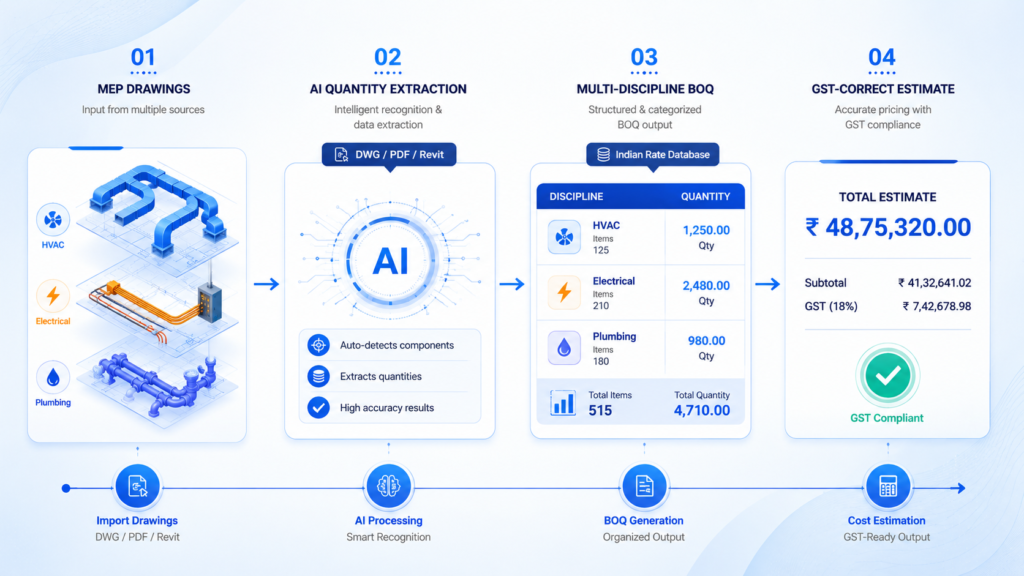
DesignDrafter's AI BOQ and quantity takeoff module accepts uploaded DWG, PDF, Revit, and IFC files and extracts quantities with accuracy derived from geometry rather than manual measurement approximation. The AI recognises all measurable elements across architectural and MEP disciplines, reducing the risk of scope gaps in the BOQ that drive cost overruns on site.
For MEP engineers specifically, this means:
The speed difference from manual takeoff is material. A BOQ that previously took a qualified MEP estimating team one week to prepare manually can be produced in a session using AI extraction. That speed advantage allows estimating teams to evaluate more bid opportunities and prepare more detailed pricing for the bids they choose to pursue.
The full scope of DesignDrafter's AI BOQ and quantity extraction capability is covered at extract-quantity.
Most construction cost estimating software treats the drawing as an external input that the estimating team reads manually to produce quantities. DesignDrafter connects the design calculation to the BOQ output, so the engineering specification drives the cost estimate.
When a mechanical engineer calculates HVAC loads in DesignDrafter and sizes a chiller at 500 TR with specific duct dimensions and pipe specifications, those specifications flow into the quantity extraction module directly. The BOQ reflects the designed system, not an estimator's interpretation of a drawing. When the design changes, the BOQ updates from the revised design data rather than requiring a fresh manual takeoff from revised drawings.
This design-to-cost connection is the core advantage DesignDrafter offers over standalone estimating platforms. It closes the gap between design completion and tender preparation that, in disconnected workflows, accounts for days of manual rework on every project revision.
The DesignDrafter EPC contractor solution covers how this integrated pipeline works for contractors managing design-and-build projects across all MEP disciplines simultaneously.
DesignDrafter handles all four MEP disciplines in a single platform, which is the key differentiator for Indian firms managing multi-discipline commercial and institutional projects:
HVAC: Duct quantities by dimensions and insulation type, equipment (chillers, AHUs, FCUs, VRF units, fans) by specification and count, piping (chilled water, condenser water, refrigerant) by diameter and material
Electrical: Cable schedules by core and cross-section, conduit by type and diameter, cable trays by linear metre and width, panels and distribution boards by specification, devices by type and count
Plumbing: Pipe schedules by material (CPVC, GI, uPVC, SS) and diameter, fixtures and fittings by specification, pumps and calorifiers by count and capacity, valves by type and size
Fire fighting: Sprinkler pipe schedules by diameter, sprinkler head counts by type, fire pump specifications, hydrant and hose reel counts, detector and alarm panel schedules
For EPC contractors competing on multi-discipline projects, the ability to produce a comprehensive, multi-discipline BOQ from a single platform, rather than coordinating manual takeoffs across separate MEP discipline tools, represents a structural advantage in tender preparation speed.
The DesignDrafter MEP consultant solution shows how this multi-discipline BOQ capability connects to the full MEP design and coordination workflow.
After reviewing BOQ errors and cost overrun reports across Indian commercial and institutional MEP projects, the same mistakes appear repeatedly.
Many Indian MEP firms produce a calculation report, hand it to an estimating team, and the team manually interprets the report to produce a BOQ. This manual interpretation introduces scope gaps at every step. A calculation report that specifies "600mm x 400mm supply duct" doesn't tell the estimator how many metres of duct run through the building, how many bends, transitions, and diffusers are connected to it, or how much insulation is required. Only a geometry-based extraction from the actual duct layout drawing produces those quantities accurately.
AI extraction tools like DesignDrafter read the geometry directly, producing counts and linear measures that reflect the actual installation rather than a simplified approximation.
Indian material costs are volatile. Steel, copper, CPVC, and insulation prices can shift 15-25% within a single procurement cycle. A BOQ prepared against rates from last quarter and submitted as a tender this week may win the job for the wrong reason: it's cheap because it's wrong. Software that connects to current market rate databases, or allows rapid rate updates across the entire BOQ when prices change, protects both the contractor's margin and the client's budget.
GST applies at different rates to different MEP materials and services. HVAC equipment typically attracts 18% GST. Certain fire fighting equipment falls at 12%. Electrical fittings vary by category. A BOQ that doesn't correctly classify items by GST slab will produce a tax calculation that's either over or under the actual liability. Institutional clients, government projects, and bank-financed constructions require GST-correct BOQs as a standard submission requirement.
On commercial projects, HVAC, electrical, plumbing, and fire fighting systems share space, coordinate with structure, and are procured through separate or combined packages depending on the project delivery model. A BOQ that covers HVAC accurately but misses fire protection pipe or electrical conduit creates procurement gaps that surface as variation orders on site.
Platforms that handle all four MEP disciplines in one extraction session, with consistent quantity methodology across disciplines, prevent this gap. The DesignDrafter MEP in construction complete guide covers how multi-discipline MEP coordination affects procurement accuracy from the design stage.
AI is changing construction cost estimating by automating the quantity extraction step that previously consumed most of an estimator's time, and by connecting design data to cost data in ways that manual processes can't match.
The practical AI capabilities that matter most for MEP estimating in 2026 are:
Approximately 65% of engineering and construction companies are incorporating AI-enabled design technology by 2026 (Industry Reports, 2026). For Indian MEP firms still doing BOQ preparation manually from PDF drawings, AI-powered construction cost estimating software is the single highest-ROI software investment available right now.
The broader context of AI in AEC workflows, including how AI connects design, estimation, and procurement, is covered in the DesignDrafter architecture design vs. traditional methods guide.
The right construction cost estimating software depends on your firm type, project scope, and the specific stage in the workflow where you need the most support.
Use DesignDrafter if:
Use Trimble AutoBid or Trimble Estimation MEP if:
Use Autodesk Construction Cloud or Procore Estimating if:
Use RIB CostX if:
Use STACK or PlanSwift if:
For a broader evaluation framework that covers how software selection fits into the full Indian AEC workflow, the DesignDrafter how to choose architecture design software guide provides a practical decision methodology.
The most important point from this guide is this: for MEP engineers and AEC firms in India, the highest-value investment in construction cost estimating software is one that connects design data to cost data automatically, rather than requiring manual translation between the two.
The Indian construction market in 2026 is unforgiving on estimating accuracy. Material costs are volatile, tender timelines are tight, GST compliance is mandatory, and clients expect professional BOQs within hours, not days. Manual Excel estimation cannot reliably deliver at that speed and accuracy level. Digital construction cost estimating software that cuts manual errors by 70-90%, extracts geometry-based quantities, and produces GST-correct BOQs in a fraction of the manual time is now a competitive baseline, not a differentiator.
For MEP consultants and EPC contractors in India, DesignDrafter offers the most complete solution in 2026: AI-powered BOQ extraction from DWG, PDF, Revit, and IFC files, across all four MEP disciplines simultaneously, connected to MEP design calculations, and producing structured quantity reports that feed procurement without a separate manual exercise. That end-to-end connection from design to cost estimate to procurement is what standalone estimating tools can't replicate.
For large enterprise contractors running complex international BIM projects, Autodesk Construction Cloud and Procore Estimating provide the coordination depth and data integration that multi-office, multi-project operations require. For specialist MEP contractors in the UK and North American markets, Trimble Estimation MEP and Trimble AutoBid remain the most capable purpose-built options.
The market data makes the direction clear. Construction estimating software is growing at 9.8% CAGR globally, AI adoption in AEC is approaching 65%, and manual BOQ preparation is increasingly a competitive disadvantage against firms using digital extraction tools. The right time to evaluate your estimating workflow is before you lose a tender to a competitor who submitted a more accurate, faster BOQ at a lower margin.
Start for free at designdrafter.com, explore the AI BOQ and quantity extraction module at designdrafter.com/extract-quantity, or review the full EPC contractor solution at designdrafter.com/contractors-solution.
Founder
Manas Krishna is a Mechanical Engineer and infrastructure technology entrepreneur with 20+ years of experience in MEP (Mechanical, Electrical, and Plumbing) engineering, public health engineering, and transport infrastructure projects across India.
FAQ

Construction cost estimating software automates Bill of Quantities generation, material takeoff, labour calculations, and cost reporting for construction projects. MEP engineers need it because MEP systems typically represent 40-60% of a commercial building’s total MEP project cost, and manual BOQ preparation from calculation reports and drawings introduces scope gaps that produce cost overruns on site. Digital tools reduce manual estimation errors by 70-90% and cut material wastage by 10-25% through exact geometry-based quantity extraction.
For Indian MEP consultants and EPC contractors, DesignDrafter is the strongest choice because its AI BOQ extraction covers all four MEP disciplines (HVAC, electrical, plumbing, fire fighting) from DWG, PDF, Revit, and IFC files, connects to MEP design calculations, and produces GST-correct structured BOQs for Indian tender submissions. For enterprise general contractors, Autodesk Construction Cloud handles BIM-connected 3D quantity extraction. For specialist MEP contractors in global markets, Trimble Estimation MEP and Trimble AutoBid are purpose-built options.
AI improves MEP cost estimating by extracting quantities directly from drawing geometry rather than manual counting, recognising discipline-specific MEP symbols and components with higher accuracy than generic tools, automatically generating fitting counts for ductwork and piping from layout geometry, and propagating revisions through the BOQ when designs change. Specialized AI models that understand the difference between a duct diffuser and a light fixture, or between a plumbing riser fixture count and a floor plan symbol, produce more complete BOQs than general-purpose counting tools.
A BOQ (Bill of Quantities) is an itemised list of materials, components, and quantities required to complete a construction project, presented in a structured format with units of measure and item descriptions. A construction cost estimate applies unit rates to BOQ quantities to produce a project cost. The BOQ comes first and is the foundation of an accurate estimate. For MEP projects, a well-structured BOQ separates items by discipline, material grade, and specification to the level of detail that procurement teams need to place orders and that contractors need to price labour accurately.
DesignDrafter accepts uploaded DWG, PDF, Revit, and IFC files and uses AI to extract MEP quantities based on the geometric data in the drawing. For HVAC, it extracts duct lengths by dimensions and gauge, equipment counts by specification, and piping by diameter and material. For electrical, it extracts cable schedules, conduit lengths, device counts, and panel specifications. For plumbing and fire fighting, it extracts pipe schedules, fixture counts, pump specifications, and valve schedules, all directly from the drawing geometry rather than from manual counting.
Construction estimating software for Indian projects should support CPWD DSR (Central Public Works Department Schedule of Rates) for government and public sector projects, state PWD rate schedules for state government work, and current market rate databases for private commercial projects. GST calculation at the correct slab rate (5%, 12%, 18%, 28%) for each material category is mandatory for institutional client submissions, bank financing, and RERA compliance. Software that handles multi-rate GST calculations and input tax credit tracking produces tax-correct BOQs that international platforms cannot replicate without significant customisation.
MEP cost estimating requires component-level extraction across three distinct disciplines, each with its own measurement conventions, unlike civil estimating which is dominated by area and volume measurements. HVAC requires ductwork measurement by size and gauge, equipment counts by specification, and piping by diameter and material. Electrical requires cable schedules by core count and cross-section. Plumbing requires pipe schedules by material and diameter with separate fixture and valve counts. General construction estimating tools that treat MEP scope as generic linear or area quantities produce BOQs that are insufficient for competitive tendering or accurate procurement.
Manual MEP BOQ preparation for a mid-size commercial project (50-100 drawing sheets across all MEP disciplines) typically takes a qualified estimating team 5-10 working days. AI-powered construction cost estimating software reduces this to hours or a single working session for the initial extraction, with additional time for rate application, contingency review, and report formatting. For Indian EPC contractors managing tender deadlines of 24-48 hours, this time compression is the difference between being able to bid competitively and missing the submission window.
The most important features in construction cost estimating software for MEP projects are: AI or geometry-based quantity extraction from DWG, PDF, Revit, and IFC files; discipline-specific measurement for HVAC, electrical, plumbing, and fire fighting separately; automatic fitting generation for ductwork and piping; current material rate databases with Indian market pricing; GST calculation at correct slabs across all material categories; revision propagation when designs change; structured BOQ output in formats suitable for tender submission and procurement; and connection to MEP design calculation data so designed system specifications drive BOQ quantities automatically.
Yes. Professional construction cost estimating software handles multiple BOQ stages: pre-bid or design-stage BOQs based on design drawings for tender submission and client budgeting; contractor BOQs for sub-trade procurement and package splitting; and as-built variation tracking for final account preparation. DesignDrafter’s AI extraction module is particularly suited to pre-bid and design-stage BOQs for MEP-heavy projects because it connects directly to MEP design calculations, ensuring the BOQ reflects the engineered system specifications from the first extraction rather than requiring a separate re-interpretation of completed drawings.
April 4, 2026

May 18, 2026

April 16, 2026