In Short
This guide is written for architects and MEP engineers in India who need a clear, practical understanding of green building design in 2026. It covers the six sustainability pillars that drive certification performance, the difference between LEED, GRIHA, and IGBC certification systems, and the specific MEP calculations that determine whether a building meets ECBC and ASHRAE energy benchmarks. The guide explains how building design software automates energy compliance calculations, connects passive design decisions to MEP load outputs, and generates the documentation that certification bodies require. It includes a certification comparison table, a step-by-step green project workflow, and common mistakes that cause certification failures or rework. Backed by 2026 market data from IGBC, PS Market Research, and ScienceDirect, this is the most complete green building design guide available for Indian AEC professionals this year.
Green building design is the practice of planning, engineering, and constructing buildings that minimize environmental impact by optimizing energy performance, conserving water, reducing carbon emissions, and creating healthier indoor environments from the first sketch through to occupancy. In 2026, it's no longer optional for architects and MEP engineers in India. It's a regulatory requirement, a client expectation, and increasingly, the deciding factor in whether a project gets financed, certified, or approved at all.
India now holds the second-largest green building footprint in the world. As of 2026, the Indian Green Building Council (IGBC) has registered over 19,000 projects covering 15.74 billion square feet of certified green building space (IGBC, 2026). The Indian green building materials market alone is valued at USD 15.5 billion in 2025, projected to reach USD 32.2 billion by 2032 at a CAGR of 11.3% (PS Market Research, 2026). Those numbers aren't just impressive. They represent a fundamental change in what architects and MEP engineers are now expected to deliver on every project.
This guide covers what green building design actually requires in practice, how MEP systems drive or undermine sustainability performance, what the key certifications mean for Indian practitioners, and how building design software automates the calculations that make certification possible.
Green building design is a holistic approach to construction that integrates environmental performance, occupant health, and resource efficiency across every design decision, from site orientation and envelope specification to HVAC sizing, lighting loads, and water system design.
It matters in 2026 because buildings account for approximately 40% of India's total carbon footprint, consuming around 33% of the country's electricity (World Resources Institute, as cited by PS Market Research, 2026). The construction sector is one of the largest contributors to greenhouse gas emissions globally, and India's rapid urbanization means the decisions architects and MEP engineers make right now will shape the built environment for the next 30-50 years.
Green building design is important because it produces buildings that consume 30-40% less energy than conventional construction, reduce operational costs over the building lifecycle, and command higher asset values and occupancy rates from tenants who prioritize sustainability in their leasing decisions.
From working with MEP consultancies and architectural firms across India, I've noticed a consistent pattern: teams that integrate sustainability requirements from day one of design, rather than treating certification as a documentation exercise at the end, spend far less time on rework and coordination. Sustainability built into the calculation workflow is always cheaper than sustainability retrofitted into a completed design.
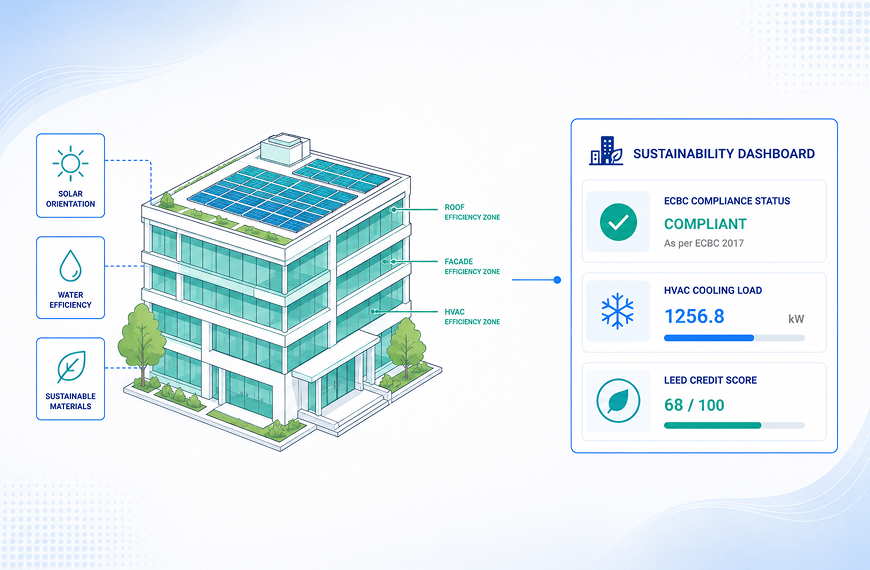
Every credible green building certification system, whether LEED, GRIHA, or IGBC, evaluates buildings against a common set of sustainability pillars. Understanding these pillars tells you where architectural and MEP decisions have the greatest impact on a project's environmental performance.
Energy efficiency is the single highest-weighted category in every major green building rating system. For MEP engineers, this means HVAC systems designed to ECBC and ASHRAE standards, with load calculations optimized for the building's actual occupancy and climate zone, not default assumptions.
HVAC alone typically accounts for 40-50% of a commercial building's total energy consumption in India's hot climate zones. Getting the cooling load calculation right, using fresh air ventilation strategies aligned with ASHRAE 62.1 and ISHRAE, and selecting equipment with the correct COP and EER values are the most impactful decisions an MEP engineer makes on a green building project.
Energy-efficient building components, properly sized and specified, save between 30% and 40% of the total electricity a building uses (Designheed, 2026). That saving doesn't come from installing solar panels after the fact. It comes from accurate load calculations, right-sized equipment, and envelope specifications that reduce the mechanical load in the first place.
Green building rating systems award significant credits for reducing potable water consumption. For MEP engineers, this translates into fixture-level water efficiency calculations, greywater recycling system design, rainwater harvesting integration, and plumbing layouts that minimize distribution losses.
LEED-certified buildings use, on average, 11% less water than conventional buildings through fixture efficiency alone (SolarTech, 2026). More advanced water strategies, including dual-flush fittings, pressure zone management, and recirculation systems, can push that reduction much further.
Passive design strategies reduce mechanical system loads by working with the building's natural environment rather than against it. Architects control these decisions: building orientation relative to the sun path, shading devices over glazing, thermal mass specification, and natural ventilation strategies that allow the HVAC system to operate in reduced-load or free-cooling modes.
A well-oriented and passively designed building can reduce the HVAC cooling load by 15-25% before any active system is even specified. That load reduction directly affects the equipment sizing an MEP engineer calculates, the duct network they design, and the energy performance the building achieves against ECBC or ASHRAE 90.1 benchmarks.
Sustainable material selection covers construction materials with lower embodied carbon, recycled content, and responsibly sourced supply chains. In 2026, this includes autoclaved aerated concrete (AAC) blocks, fly ash bricks, high-performance insulated glass, and engineered timber where structural specifications permit.
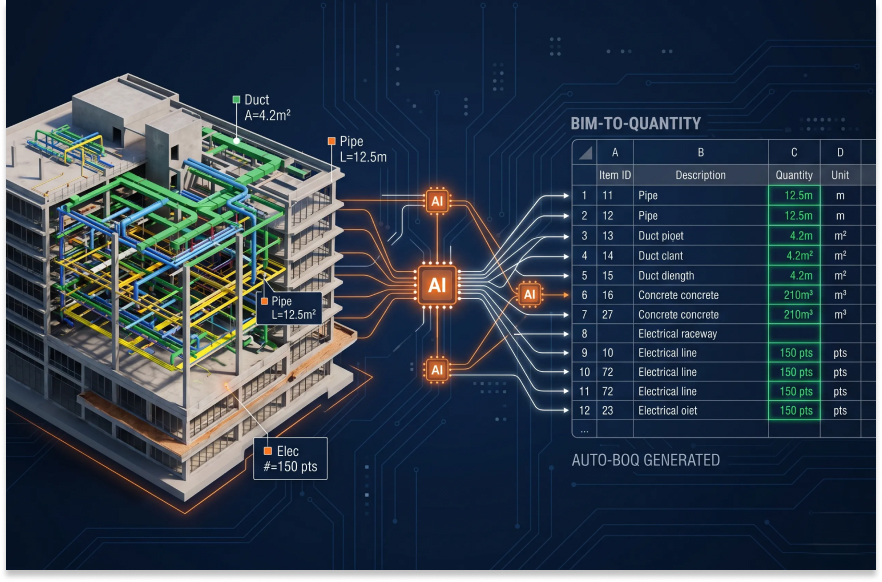
BIM-based design achieves 18-30% decreases in carbon footprint compared to conventional approaches, partly because BIM enables accurate material quantification that reduces over-ordering and construction waste (ScienceDirect, 2025).
Indoor Environmental Quality (IEQ) covers air quality, thermal comfort, acoustic performance, daylighting, and occupant access to views and natural light. For MEP engineers, IEQ means HVAC ventilation systems that deliver fresh air at the rates required by ASHRAE 62.1 or ISHRAE, acoustic attenuation in duct design, and lighting calculations that meet illuminance targets with energy-efficient fixtures.
Green building certification systems award credits for construction waste management, including diversion of demolition waste from landfills and sourcing strategies that minimize packaging. On LEED projects, waste diversion rates of 75-90% are commonly achieved when waste management planning is integrated from the pre-construction phase (SolarTech, 2026).
Green building certification is a third-party verification framework that scores a building's sustainability performance against defined criteria, awarding credits across energy, water, materials, site, and indoor environment categories.
For architects and MEP engineers practicing in India, three certification systems dominate:
LEED is an internationally recognized certification administered in India by the Indian Green Building Council (IGBC). In 2024, India certified 370 projects covering 8.5 million gross square meters to LEED specifications, with Grade A office spaces dominating registrations at 455 projects covering 185 million square feet (PS Market Research, 2026).
LEED awards points across categories including Sustainable Sites, Water Efficiency, Energy and Atmosphere, Materials and Resources, and Indoor Environmental Quality. Buildings earn Bronze, Silver, Gold, or Platinum certification depending on total points achieved. LEED-certified buildings command higher asset prices and face stronger tenant demand in India's commercial real estate market.
GRIHA is India's national green building rating system, developed by TERI (The Energy and Resources Institute) in collaboration with the Ministry of New and Renewable Energy. It's designed specifically for Indian climate conditions, building typologies, and material supply chains, making it more relevant for projects outside major metros where international supply chains for LEED-specified materials may not be accessible.
GRIHA-certified buildings receive a discount on property tax in several Indian states, and the Ministry of Housing and Urban Affairs offers additional FAR (Floor Area Ratio) benefits of 1-5% for GRIHA-certified projects above 3,000 sqm. The government of India also provides fast-track environmental clearances for GRIHA-certified buildings.
IGBC manages India's largest green building certification portfolio, with over 19,000 registered projects and 15.74 billion square feet of certified footprint as of 2026. IGBC-certified projects save 66.4 billion units of energy annually, conserve 199.3 billion litres of water, and reduce CO2 emissions by 53.1 million tonnes per year (IGBC, 2026).
| Certification | Administrator | Best For | Key Incentive in India |
|---|---|---|---|
| LEED | IGBC (USGBC-affiliated) | Commercial, Grade A offices, international clients | Higher asset value, tenant demand |
| GRIHA | TERI / MNRE | All building types, Indian climate conditions | Tax discounts, extra FAR, fast clearances |
| IGBC | CII | Large portfolio, all typologies | Energy and water savings credits |
| ECBC Compliance | Bureau of Energy Efficiency (BEE) | Mandatory for commercial buildings above threshold | Regulatory approval baseline |
MEP engineers are the primary technical contributors to a building's energy and water performance. Architects set the passive design intent. MEP engineers determine whether that intent becomes measurable performance.
The three MEP disciplines contribute to green performance in distinct ways:
Dr. Anand Krishnamurthy, a sustainability consultant and MEP engineer with 22 years across commercial and institutional green building projects, describes the challenge precisely: "The biggest gap between a building's intended green performance and its actual performance isn't technology. It's calculation accuracy at the design stage. If the load calculations are wrong, every downstream decision is wrong, including the certification."
The integration between HVAC load calculations, plumbing water demand calculations, and electrical load analysis is exactly what DesignDrafter's MEP design calculation platform automates. All three disciplines calculate within the same environment, aligned to ASHRAE, ECBC, ISHRAE, and IS standards by default. That means green building compliance is built into every calculation output rather than verified manually afterward.
For a broader understanding of how MEP systems connect to building performance, the DesignDrafter MEP in construction complete guide covers the full scope of what MEP contributes to sustainable building design.
Building design software enables green building design by automating energy performance calculations, connecting design decisions to compliance outputs, and providing the documented evidence that certification bodies require during the audit process.
ECBC (Energy Conservation Building Code) compliance is mandatory for commercial buildings in India above a certain threshold size. It sets performance benchmarks for the building envelope, HVAC systems, lighting, and renewable energy. Meeting ECBC requires accurate energy calculations that reference the code's requirements and demonstrate compliance at the system level.
DesignDrafter's HVAC calculation module automates ECBC-aligned cooling and heating load calculations, factoring in building orientation, solar heat gain, occupancy schedules, and ventilation requirements. The output is an ECBC-referenced calculation report that documents compliance for regulatory submission.
BIM-based workflows support green building certification by enabling accurate material quantification, energy simulation, clash detection between disciplines, and the coordinated documentation that certification bodies require. BIM-based design achieves 20-32% energy savings and 15-22% operational cost reductions compared to conventional design approaches (ScienceDirect, 2025).
DesignDrafter's BIM automation capabilities connect MEP calculation outputs to BIM-ready drawing formats, so the sized HVAC system, water system, and electrical layout all appear in the coordinated model without re-entry between calculation and drawing stages.
Passive design decisions, including building orientation, room layout, glazing placement, and shading device positions, are architectural decisions that directly affect MEP load calculations. Getting them right at concept stage prevents oversized HVAC systems from compensating for poor passive design choices.
DesignDrafter's AI floor plan generation produces build-ready layouts that apply orientation logic, room adjacency rules, and spatial efficiency criteria from the start. An architecturally optimized layout reduces the mechanical load that MEP engineers calculate, which reduces equipment sizes, which reduces energy consumption, which improves the project's green building score.
Accurate Bill of Quantities is essential for green building projects because certification bodies require documentation of material quantities, recycled content, and waste diversion rates. Manual BOQ processes introduce counting errors that create discrepancies between what was specified and what gets claimed in the certification submission.
DesignDrafter's quantity extraction module pulls material quantities directly from design data, producing structured BOQs that are accurate, discipline-specific, and ready for both procurement and green certification documentation.
After working through green building documentation for commercial projects across India, the same errors surface repeatedly.
Starting sustainability too late in the design process. Green building performance is largely determined in the first 20% of the design timeline. By the time working drawings begin, the passive design decisions, building orientation, envelope specification, and glazing ratios are locked in. MEP engineers who receive a completed architectural layout and are then asked to "make it ECBC compliant" are working against their own calculations.
Treating certification as a documentation exercise. Many teams confuse getting certified with designing a green building. Certification follows performance. If the calculations show the building doesn't meet the energy benchmark, no amount of documentation work will change that. The calculation has to be right first.
Running MEP calculations in disconnected tools. When HVAC load calculations, electrical load analysis, and plumbing water demand calculations happen in separate tools that don't talk to each other, the coordination required to produce a coherent energy compliance report is manual and error-prone. Integrated platforms like DesignDrafter solve this by keeping all MEP calculations in the same environment.
Ignoring equipment-level efficiency in load calculations. Selecting a chiller with a COP of 3.0 versus one with a COP of 5.5 for the same cooling load produces a dramatically different Energy Use Intensity. MEP engineers who stop at load calculation without optimizing equipment efficiency are leaving green building points on the table.
Not coordinating green material specifications with the BOQ. If green materials are specified in the design but the BOQ reflects conventional alternatives, procurement will default to the conventional option. Certification claims built on specified materials that weren't actually procured will fail during the audit.
The DesignDrafter architecture design vs. traditional methods guide shows exactly how these coordination gaps cost Indian AEC firms time and money across a typical project cycle.
Here's a step-by-step approach for architects and MEP engineers approaching a green building project in India:
For MEP consultants who want to understand how to structure this workflow in practice, the DesignDrafter MEP consultant solution page covers the full calculation-to-BIM-to-BOQ workflow in detail.
The core takeaway from this guide is simple: green building design is not a certification activity. It's a performance discipline, and its outcomes are determined by the quality of the calculations made in the first half of the design process.
India is the world's second-largest green building market, with IGBC registrations covering 15.74 billion square feet and growing. The Indian green building materials market is expanding at 11.3% CAGR. ECBC compliance is already mandatory for commercial buildings above threshold size, and GRIHA certification unlocks FAR benefits and fast-track environmental clearances that directly affect project economics. The regulatory and commercial case for green building design in India in 2026 has never been stronger.
For architects, that means passive design decisions, orientation, glazing, shading, and envelope specification, need to be made with energy performance data in hand, not estimated and revised later. For MEP engineers, it means HVAC load calculations aligned to ECBC and ASHRAE, electrical designs meeting LEED lighting power density requirements, and plumbing systems sized for water efficiency credits, all documented in code-referenced reports that certification bodies can audit.
The practical barrier for most Indian MEP consultancies and architectural firms isn't knowledge of what's required. It's having the right tools to produce calculation outputs that are accurate, code-referenced, connected to drawings, and ready for certification documentation without a separate manual reformatting exercise.
DesignDrafter addresses that gap directly. Its integrated MEP calculation modules for HVAC, electrical, plumbing, and fire fighting systems all align to ECBC, ASHRAE, ISHRAE, NBC, and IS standards by default. Its AI floor plan generation supports passive design optimization from the concept stage. Its BIM automation connects calculation outputs to coordinated drawings. Its quantity extraction module produces BOQs with the material specificity that green certification documentation requires.
If your firm is working on green building projects or preparing for LEED, GRIHA, or IGBC certification in 2026, start by running your next project's MEP calculations through DesignDrafter's design calculation module. See whether the output is code-referenced, submission-ready, and connected to your drawing workflow without manual reformatting. That single test will tell you whether your current tool is serving your green building practice or slowing it down.
References & sources
Citations that back the claims in this post.
Indian Green Building Council (IGBC)
igbc.in
GRIHA Council India
grihaindia.org
Bureau of Energy Efficiency (ECBC)
beeindia.gov.in
Founder
Manas Krishna is a Mechanical Engineer and infrastructure technology entrepreneur with 20+ years of experience in MEP (Mechanical, Electrical, and Plumbing) engineering, public health engineering, and transport infrastructure projects across India.
FAQ

Green building design is the practice of designing buildings to minimize environmental impact by optimizing energy use, water consumption, indoor air quality, and material sustainability across the building lifecycle. It differs from conventional construction because green building design integrates performance targets, code compliance requirements (like ECBC, LEED, and GRIHA), and environmental benchmarks from the earliest design decisions rather than treating them as regulatory afterthoughts. Buildings designed to green standards consume 30-40% less energy than conventional equivalents.
LEED is an internationally recognized certification aligned with USGBC standards and administered in India by IGBC, covering commercial and residential buildings using globally benchmarked criteria. GRIHA is India’s national green building rating system, developed by TERI for Indian climate conditions, building typologies, and local material supply chains. GRIHA certification unlocks property tax discounts and extra FAR of 1-5% from the Ministry of Housing and Urban Affairs. LEED tends to be preferred for Grade A commercial offices and projects targeting international tenants.
Green building design directly affects MEP calculations by requiring HVAC load calculations aligned to ECBC and ASHRAE energy benchmarks, lighting power density calculations meeting LEED or GRIHA targets, and plumbing systems sized for water efficiency credits. MEP engineers on green projects must also document equipment efficiency values (COP, EER for HVAC; luminous efficacy for lighting) and demonstrate compliance in code-referenced reports. Platforms like DesignDrafter apply ECBC and ASHRAE standards automatically to all MEP calculations, producing audit-ready outputs.
Architects use BIM platforms like Autodesk Revit and ArchiCAD for 3D design coordination, energy simulation tools like EnergyPlus and DesignBuilder for building performance modeling, and integrated platforms like DesignDrafter for floor plan generation, MEP calculations, and BOQ extraction aligned to Indian code standards. For green building certification in India, the most efficient workflow uses a platform that connects architectural layout generation to ECBC-compliant MEP calculations and BIM-ready outputs without requiring separate tools for each stage.
To make a building ECBC compliant in India, you need to meet the Bureau of Energy Efficiency’s performance benchmarks for the building envelope (U-values for walls, roof, and glazing), HVAC systems (COP and EER minimums), lighting (power density limits by occupancy type), and renewable energy provisions where applicable. This requires running HVAC load calculations, lighting calculations, and envelope thermal analysis referenced to ECBC parameters. Building design software like DesignDrafter applies ECBC standards automatically, producing compliance documentation ready for regulatory submission.
BIM is important for green building design because it enables accurate energy modeling, material quantification for recycled content and waste documentation, clash detection that prevents installed system performance gaps, and the coordinated documentation packages that LEED, GRIHA, and IGBC certification bodies require during audits. BIM-based design achieves 20-32% energy savings and 18-30% reductions in carbon footprint compared to conventional design approaches, according to ScienceDirect research (2025). BIM also allows architects and MEP engineers to test design alternatives and compare energy performance before committing to a final specification.
The Indian Green Building Council (IGBC) is India’s premier green building certification body, established in 2001 by the Confederation of Indian Industry (CII). As of 2026, IGBC has registered over 19,000 projects covering 15.74 billion square feet of green building footprint, making India the world’s second-largest green building market. IGBC-certified projects collectively save 66.4 billion units of energy and conserve 199.3 billion litres of water annually, while reducing CO2 emissions by 53.1 million tonnes per year.
Yes. Passive design decisions made by architects, including building orientation, window-to-wall ratios, shading devices, thermal mass, and natural ventilation strategies, directly reduce the mechanical cooling and heating loads that MEP engineers calculate. A building with optimized passive design requires a smaller, more efficient HVAC system, which reduces energy consumption, equipment costs, and the carbon footprint that green certification systems evaluate. MEP engineers who receive a poorly oriented layout with excessive glazing must compensate with larger equipment and higher energy use, making certification harder and more expensive to achieve.
The main green building certifications available in India in 2026 are IGBC (Indian Green Building Council), GRIHA (Green Rating for Integrated Habitat Assessment), LEED (Leadership in Energy and Environmental Design), and EDGE (Excellence in Design for Greater Efficiencies). ECBC compliance, while not a voluntary certification, is mandatory for commercial buildings above specific thresholds. GRIHA and IGBC are the most widely used nationally, while LEED is preferred for projects targeting international tenants or global ESG reporting requirements.
Green building design software helps with LEED and GRIHA certification by automating the calculations that generate certification evidence: energy performance against ECBC or ASHRAE 90.1, water consumption against fixture efficiency standards, and material quantities for recycled content documentation. Platforms like DesignDrafter produce code-referenced calculation reports that align with IGBC and GRIHA submission formats, extract BOQs with material specifications, and generate BIM-ready drawings that support the coordinated documentation packages certification auditors require. This eliminates the manual compilation work that typically adds weeks to a certification submission.
April 27 , 2026
March 25 , 2026
May 8 , 2026