There is a moment that almost every estimator, contractor, and MEP consultant knows intimately. You have just spent the better part of two weeks manually measuring drawings, filling spreadsheets, and cross-referencing material specs for a competitive bid. You submit it. And three days later you discover you missed an entire mechanical room on the fourth floor.
The project is already awarded. The budget is set. And the damage control begins.
This is not a story about carelessness. It is a story about what happens when highly skilled professionals are forced to use inadequate tools for a job that demands precision. Construction takeoffs have always been the foundation of every successful project, and yet for far too long the tools available to do them have lagged far behind the complexity of the projects they are supposed to support.
That gap is closing fast. Construction takeoff software has matured considerably over the past few years, and in 2026, the options available to contractors, estimators, design firms, and MEP consultants are genuinely impressive. But impressive does not automatically mean right for your workflow. Choosing the best construction takeoff software for your specific practice requires a clear understanding of what these tools actually do, how they differ from one another, and what capabilities your team genuinely needs versus what sounds good in a product demo.
This guide gives you exactly that. We will walk through what construction takeoff software is, why it matters, how to evaluate the different types available today, what features actually separate good tools from great ones, and how modern platforms like DesignDrafter's AI-powered quantity extraction module are redefining what takeoff software can look like when it is built around the real workflows of AEC professionals.
Before getting into comparisons and recommendations, it is worth being precise about terminology, because the terms "takeoff software" and "estimation software" are often used interchangeably when they actually describe different parts of the same workflow.
A construction takeoff, sometimes called a material takeoff or quantity takeoff (QTO), is the process of reviewing project drawings and documents to identify and measure every material, component, and system that needs to be procured and installed. The output is a structured list of quantities, dimensions, and item counts that becomes the foundation for cost estimation.
The takeoff comes first. The estimate comes after.
Construction takeoff software specifically handles the measurement and extraction phase: reading drawings, counting components, measuring dimensions, and organizing the results into structured outputs. Estimation software then takes those quantities and applies unit rates, labor costs, and overhead factors to produce a cost estimate.
Some platforms handle both functions. Others focus exclusively on the takeoff phase. Understanding this distinction will help you evaluate tools against your actual needs rather than features you may already have covered by another system in your stack.
Construction takeoffs are where most pre-construction errors originate, and the reason is structural rather than individual. When a human being has to manually measure hundreds of drawing sheets, count thousands of components, and maintain consistency across multiple drawing revisions, errors are not a sign of incompetence. They are an inevitable outcome of asking people to do what computers are fundamentally better suited for.
The cost of takeoff errors compounds quickly. An undercount in material quantities leads to budget shortfalls and emergency procurement at premium prices. An overcount leads to unnecessary material orders and capital tied up in unused stock. Inconsistencies between discipline-specific takeoffs, say, where the electrical estimate assumes one ceiling grid layout while the HVAC takeoff references a revised coordination drawing, create conflicts that surface during procurement or construction and are expensive to resolve.
Good construction takeoff software addresses exactly this structural problem.
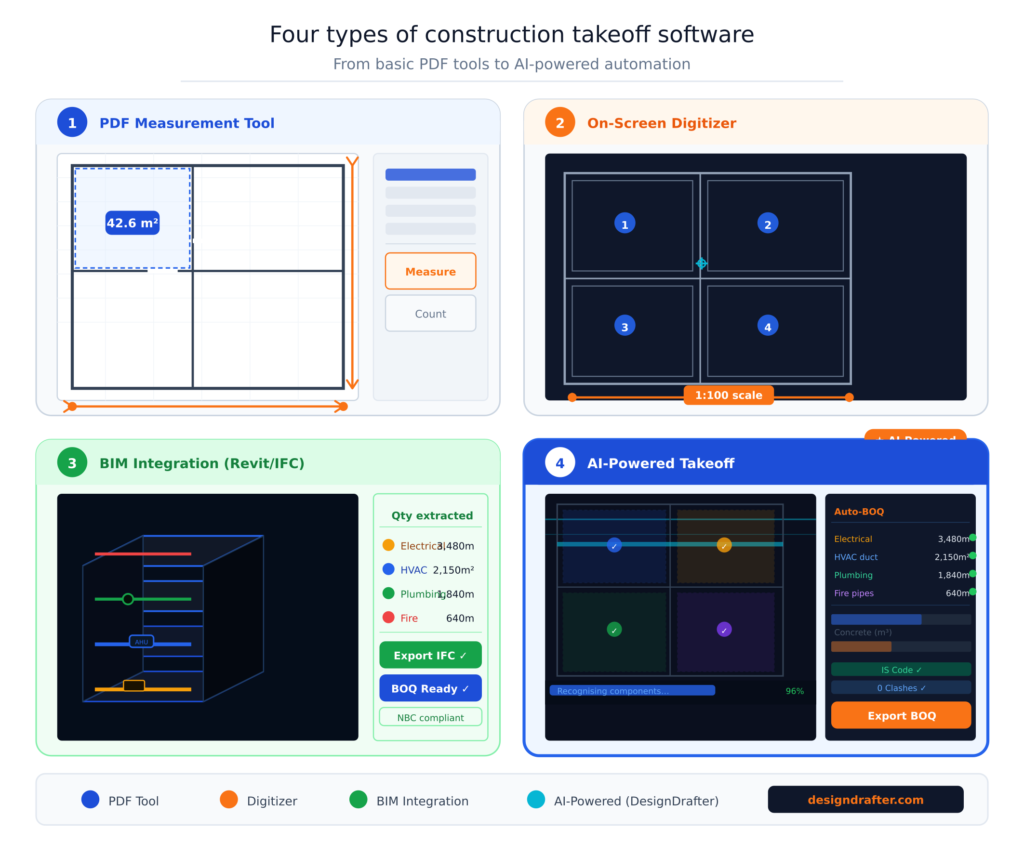
Not all takeoff software is built the same way, and the type you choose should match your project types, file formats, and workflow requirements. Here is how the current landscape breaks down.
These tools allow estimators to open PDF drawings in a digital environment and perform on-screen measurement and counting. They replace printed drawings and physical scale rulers with digital measurement tools, and they are significantly more efficient than purely manual methods.
The limitation is fundamental: PDF-based tools are passive. They do not read the drawing. They give you a better interface for reading the drawing yourself. Every measurement, every count, and every decision about what to include still requires human judgment and human action.
For smaller firms or projects with relatively simple scopes, PDF-based tools can represent a significant step up from spreadsheets. But for complex MEP projects, large commercial buildings, or high-volume estimating operations, the throughput ceiling of PDF-based tools becomes a constraint relatively quickly.
An evolution of the PDF approach, these platforms provide more sophisticated measurement engines, symbol recognition for common construction elements, and better integration with cost databases. Some allow limited automation of repetitive counting tasks through macros or scripted workflows.
They are more capable than basic PDF tools but still fundamentally dependent on manual input at each step. The accuracy is better, and the speed is improved, but the human is still doing most of the work.
BIM-native takeoff tools work directly within or alongside Building Information Modeling environments like Autodesk Revit. Because BIM models contain structured, object-based data with embedded attributes (material, dimensions, manufacturer specs, system classification), takeoff extraction from BIM models is dramatically more accurate and more automated than extraction from 2D drawings.
The catch is access. BIM-integrated takeoff tools are most powerful when the project documentation lives in a properly structured BIM model. For projects still documented in 2D CAD or PDF, the BIM advantage does not apply unless you first convert the drawings, which is itself a workflow step.
This is the category that has changed the most significantly in recent years and represents the direction the entire market is heading. AI-powered takeoff platforms use computer vision, pattern recognition, and machine learning to read construction drawings autonomously, identify components, measure dimensions, and compile structured quantity outputs with minimal human input.
Unlike PDF tools where the human does the reading, AI platforms actually read the drawing. They identify a 4-inch conduit the same way an experienced estimator would, not by the human telling it "this line represents a 4-inch conduit" but by recognizing the graphical and textual patterns that indicate what it is.
This is the category where DesignDrafter's Extract Quantity module operates, and it is the category most relevant for MEP consultants, design firms, and construction teams working on mid-to-large scale projects where manual methods are genuinely no longer sustainable.
When you are evaluating takeoff tools, the feature lists can seem overwhelming. Here is what actually matters when you strip away the marketing language.
Your tool needs to handle DWG, PDF, and BIM formats (Revit, IFC) at a minimum. Real-world projects rarely arrive in a single format. Legacy renovations may be documented in 2D CAD. New builds may be in Revit. And somewhere in the middle there will be a PDF set from a consultant who is still not on BIM. A tool that cannot handle this range will force workflow compromises that cost you time.
Generic shape-counting is not sufficient for MEP and architectural takeoffs. Your software needs to understand the difference between an FCU and an AHU, between a 20A socket and a 45A power outlet, between a sprinkler head and a smoke detector. Discipline-specific recognition is what makes a takeoff tool genuinely useful versus superficially impressive.
On complex MEP drawings, the ability to isolate specific drawing layers or building systems is essential. You should be able to run a takeoff on electrical systems only, or on a specific floor level, or on a particular drawing revision. Without this granularity, your extractions will include noise that your team then has to manually clean up.
No automated system should be a black box. The best takeoff platforms provide transparent outputs that show which elements were identified, how quantities were calculated, and where the system flagged uncertainty. Your team needs the ability to review, adjust, and approve the AI output rather than simply accepting it.
At DesignDrafter, the quantity extraction workflow is built with this principle: AI handles the heavy lifting, but estimators retain full editorial control over the final output.
The output of a takeoff needs to feed into your downstream tools. At a minimum, Excel and PDF export are non-negotiable. Integration with estimation and project management platforms is a significant bonus. Outputs should be structured, itemized, and formatted to match your firm's BOQ standards rather than a generic template.
For firms that use BIM, integration between the takeoff tool and the BIM environment creates a live connection: when the model updates, the takeoff can be refreshed rather than redone from scratch. This capability alone can save dozens of hours per project on fast-moving design programs.
For firms using DesignDrafter's CAD to Revit BIM automation, the workflow is even more streamlined: legacy CAD drawings are first converted to structured BIM models, and those models then feed directly into the quantity extraction engine. The takeoff is not a separate exercise; it is a downstream output of the design process.
Understanding takeoff software in isolation misses the bigger picture. Takeoffs do not happen in a vacuum. They are downstream of design and upstream of estimation, procurement, and construction. The more tightly your takeoff tool integrates with the rest of your project workflow, the more value it delivers.
In a traditional workflow, design and estimation are completely separate activities. Design happens in one set of tools; estimation happens in another. Documents are printed, exported, or emailed between teams, creating version control problems and information loss at every handoff.
In an integrated workflow, the design data directly informs the takeoff. When DesignDrafter's AI floor plan generator produces a structured architectural layout, that layout data is already structured in a way that supports quantity extraction. The design and the BOQ are connected, not separated.
The output of a good takeoff is not just a list of quantities. It is a structured, itemized Bill of Quantities that can be directly formatted for client proposals, procurement planning, and vendor negotiation. The quality of this output depends on how intelligently the takeoff was organized: by discipline, by floor, by zone, by system.
MEP consultants using DesignDrafter's quantity extraction module can generate BOQ-ready outputs that are immediately suitable for procurement, with item markups, specification details, and brand preferences applied directly within the platform.
For contractors and EPC firms, takeoff data does not stop being useful once the bid is won. Accurate quantity data forms the baseline against which procurement actuals and site consumption are tracked throughout construction. A good takeoff tool that produces well-structured, auditable outputs makes cost control during construction significantly more manageable.
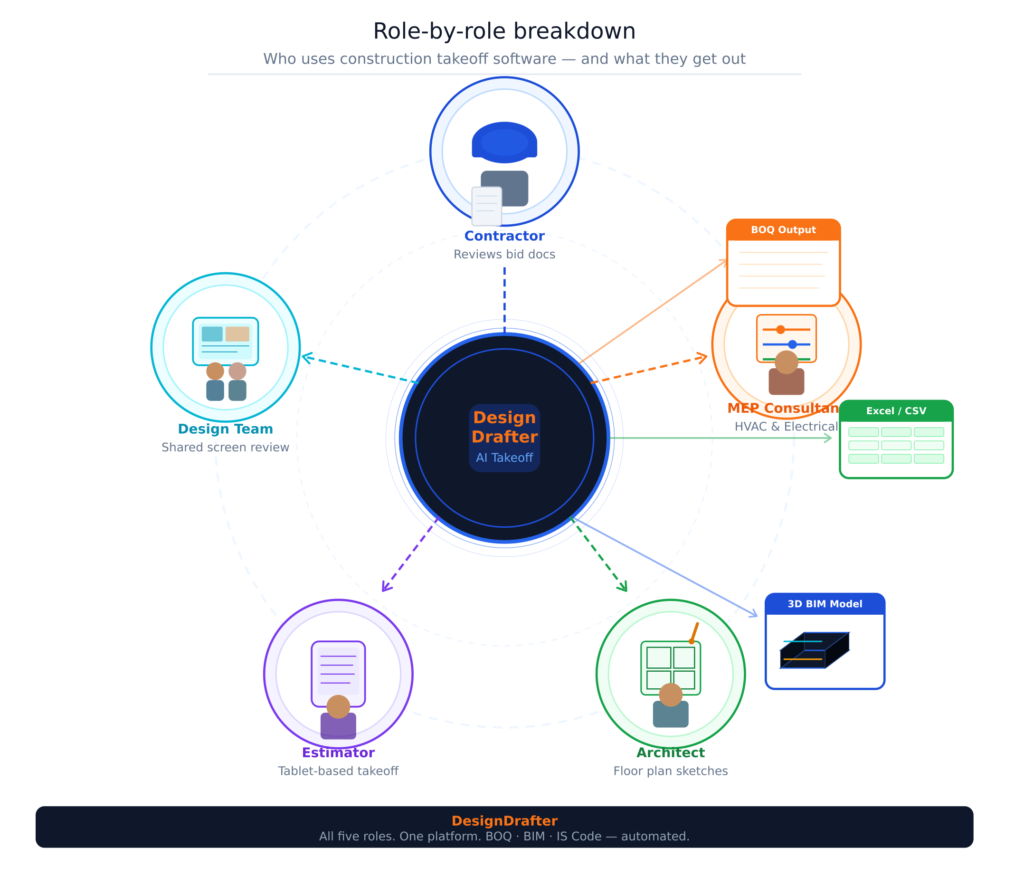
Different stakeholders use takeoff tools differently, and the best software for a large EPC contractor may not be the best solution for an independent MEP consultant. Here is how the needs vary by role.
For contractors, speed and accuracy in bid preparation is the primary driver. Competitive bidding windows are tight, project scopes are complex, and the cost of estimation errors falls directly on the contractor's bottom line. AI-powered takeoff tools that can process a full set of MEP drawings in hours rather than weeks are a genuine competitive advantage.
Contractors also need takeoff data that can be updated as drawings are revised during construction, and that can be verified against subcontractor bills and material deliveries. Structured, auditable BOQ outputs are essential.
MEP consultants work across multiple simultaneous projects and deal with the most quantity-intensive systems in any building: electrical, HVAC, plumbing, and fire protection. Manual takeoffs for a large commercial MEP project can consume two to four weeks of an experienced engineer's time. That is time that should be spent on design, coordination, and problem-solving.
For MEP consultants, discipline-specific accuracy is the non-negotiable requirement. A tool that counts generic elements is not useful. The need is for a system that understands MEP systems at the detail level: pipe diameters, duct types, panel board specifications, sprinkler spacing.
DesignDrafter's MEP-focused workflow is specifically designed for this audience, integrating design calculations, BIM coordination, and quantity extraction in a single platform.
Architects need takeoff data at different stages of the design process, from early-stage material feasibility assessments during schematic design to detailed quantity schedules at the construction documentation stage. The ability to generate preliminary takeoffs quickly, without a full documentation set, is particularly valuable during early design phases when decisions about materials and systems are still being made.
DesignDrafter's architect-focused solution supports this iterative approach, connecting layout generation directly with quantity extraction so early-stage design decisions can be validated against material implications in real time.
For independent professionals, takeoff software is fundamentally a throughput tool. More accurate takeoffs, produced faster, allow more projects to be handled simultaneously and more competitive pricing to be offered to clients. The ROI calculation for a solo quantity surveyor or small estimation firm is straightforward: reduced time per takeoff multiplied by additional project capacity equals measurable revenue growth.
Design firms managing multiple disciplines need takeoff tools that can handle coordination between architectural and MEP systems without creating siloed outputs. When the electrical takeoff and the HVAC takeoff are produced by different tools with different organizational structures, reconciling them for a unified BOQ becomes its own project.
An integrated platform that handles multi-discipline takeoffs within a shared project context eliminates this coordination overhead. DesignDrafter's design firms solution addresses exactly this: unified multi-discipline workflows where architectural and MEP data share project context and inform a single structured BOQ output.
Most takeoff software sits on the shelf next to your design tools. DesignDrafter is built on a different principle: that takeoff should be an outcome of the design process, not a separate exercise that happens after it.
When an MEP consultant uses DesignDrafter's design calculation modules to size an electrical system, that engineering data does not disappear when the calculation is complete. It flows through into the quantity extraction engine. The conduit sizes, cable specifications, panel board quantities, and fixture counts that come out of the design calculation become the seed data for the BOQ. There is no re-entry, no reconciliation, and no version mismatch between what was designed and what was quantified.
The same principle applies to BIM-integrated workflows. When a CAD drawing is converted to a Revit model through DesignDrafter's CAD to Revit conversion service, the resulting model is not just a visual representation. It is a structured, object-based BIM model with the intelligence needed to support automated quantity extraction. The model is the takeoff source, and the takeoff is the model output.
This end-to-end integration is what makes DesignDrafter different from standalone takeoff tools: it is not a tool for the estimation team to use after the design is done. It is a platform that connects design, calculation, and quantification into a single continuous workflow.
You can explore the platform with a free trial, no credit card required, to see exactly how this workflow performs on your project types.
The construction takeoff software market is moving fast, and understanding where it is going helps you make a future-proof decision today rather than one you will need to revisit in two years.
Real-time takeoff updates tied to design changes will become standard. As BIM adoption grows and AI-driven design tools become more common, the expectation will be that quantity data updates automatically when the model changes, not on a manual refresh cycle.
Multi-disciplinary automated extraction from a single unified model will replace the current practice of separate takeoffs by discipline. This requires platforms that understand architectural, structural, and MEP systems as a connected whole rather than as separate data streams.
AI-assisted specification writing will emerge alongside quantity extraction. The BOQ of the future will not just list quantities; it will suggest specifications, flag procurement options, and connect quantity data to real-time material pricing from supplier databases.
Integration with AI design agents that can execute both design and quantification tasks within a single conversational interface will reduce the technical barrier to entry for quantity extraction, allowing project managers and site engineers to generate takeoffs without specialist estimator support.
FAQ

Construction takeoff software is a digital tool that reads construction drawings, plans, and BIM models to automatically identify, measure, and count all the materials and components needed for a building project. The output is a structured Bill of Quantities (BOQ) that forms the basis for cost estimation, procurement planning, and project budgeting. Modern AI-powered platforms can process complex MEP drawings in a fraction of the time it takes to do the same work manually.
The best construction takeoff software for MEP projects needs to be capable of discipline-specific recognition (distinguishing between pipe diameters, duct types, electrical fixtures, etc.), support for DWG, PDF, Revit, and IFC formats, and integration with MEP design workflows. Platforms like DesignDrafter that are built specifically around MEP design and calculation workflows offer a significant advantage because the takeoff is connected to the engineering design data rather than being a separate downstream exercise.
Modern AI takeoff platforms achieve high accuracy on well-structured drawings by eliminating the fatigue and attention-related errors that affect human estimators. However, accuracy depends on drawing quality, symbol standardization, and whether the system has been trained on the document types you are using. The best platforms combine AI extraction with a human review step, where estimators can verify and adjust AI-generated quantities before finalizing the BOQ.
Yes. Most modern takeoff platforms support PDF input. However, there is a significant difference between PDF-based tools where humans manually measure and AI-powered tools that can read PDF drawings autonomously, identify components through computer vision, and extract quantities automatically. If your drawings are primarily in PDF format, AI-powered platforms that genuinely read PDFs (rather than just providing a digital interface for manual measurement) offer dramatically better throughput.
Construction takeoff software handles the measurement and quantity extraction phase: it reads drawings and counts materials. Estimation software then applies unit rates, labor costs, and overheads to those quantities to produce a cost estimate. Some platforms handle both functions in an integrated workflow. Others specialize in one phase and integrate with other tools for the next. For teams that already have a preferred estimation platform, a dedicated takeoff tool that exports in the right format may be the more practical choice.
Yes, and BIM-integrated takeoffs are generally more accurate and more useful than takeoffs from 2D drawings because BIM models contain structured object data with embedded attributes. Platforms like DesignDrafter support BIM-native takeoffs from Revit and IFC models, as well as CAD-to-BIM conversion workflows that enable even legacy 2D drawings to be processed through a BIM-quality extraction pipeline.
Absolutely. While large EPC firms and MEP consultancies have obvious use for automated takeoff tools, independent contractors and estimators often see the most dramatic ROI because the time savings per project translate directly into capacity to take on more work. Cloud-based takeoff platforms with subscription pricing make enterprise-grade takeoff capabilities accessible without large upfront investment.
For a project that might take an experienced estimator two to four weeks to quantify manually, AI-powered platforms can typically produce a draft takeoff in hours. This is not because accuracy is sacrificed but because the AI processes the entire document set simultaneously rather than sequentially. The human review step that follows the AI extraction typically adds a fraction of the time that pure manual estimation would require.
At minimum: PDF, DWG (AutoCAD), Revit (RVT), and IFC. Projects often involve a mix of formats from different consultants and disciplines, so multi-format support is not a nice-to-have. It is a practical requirement for any platform you intend to use on real project work.
No, and it is not designed to. Construction takeoff software replaces the repetitive, mechanical parts of estimation: measuring, counting, and organizing. The judgment-intensive parts of the work, including deciding how to interpret ambiguous drawings, evaluating design alternatives, managing risk in bid pricing, and building client relationships, remain firmly in human hands. Think of it as the difference between a calculator and a mathematician: the calculator handles the arithmetic so the mathematician can focus on the problem.