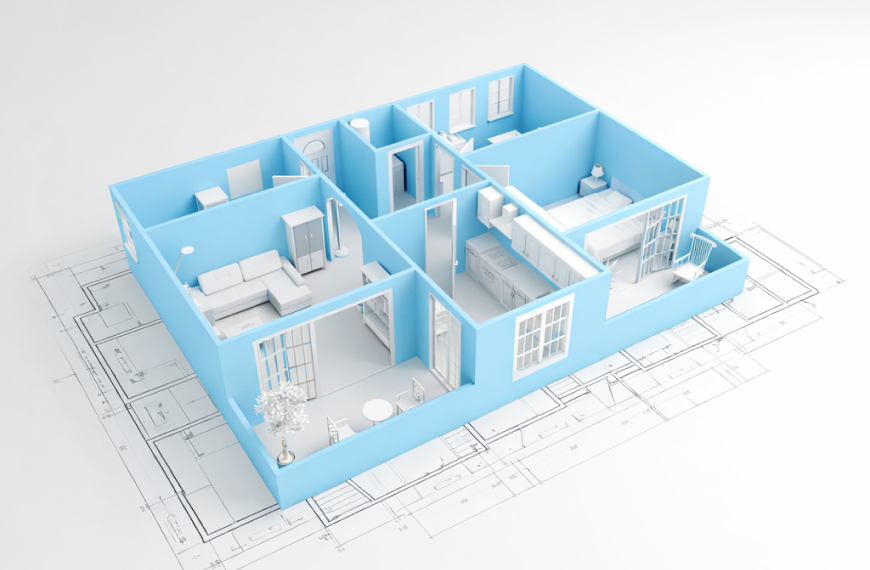
Architectural design has always required a careful balance of creativity, technical precision, and efficiency. But for decades, the process of creating floor plans remained stubbornly manual - requiring hours of drafting, dozens of revision cycles, and deep expertise with complex CAD software. That reality is changing fast. The AI floor plan generator has emerged as one of the most transformative tools in modern architecture, enabling designers to produce optimized, build-ready layouts in a fraction of the time it once took.
In this guide, we explore how AI floor plan generators work, why 2026 marks a critical inflection point for adoption, and how platforms like DesignDrafter's Floor Plan Studio are helping architects, engineers, and design firms work faster and smarter than ever before.
An AI floor plan generator is a software tool that uses artificial intelligence - typically a combination of generative design algorithms, machine learning, and parametric modeling - to automatically create building layouts based on user-defined inputs. Instead of manually drawing every wall, door, and corridor, you provide the system with parameters such as room count, total square footage, building type, adjacency preferences, and applicable design codes. The AI then explores thousands of possible configurations and returns optimized floor plans that satisfy your constraints.
This approach is fundamentally different from working with template libraries. Templates give you a fixed plan that you force your requirements into. An AI floor plan generator starts from your specific needs and builds the layout around them, often producing configurations that a human designer might not have considered.
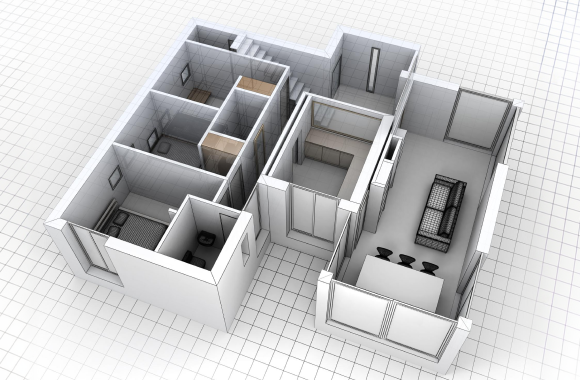
While AI-powered design tools have existed in various forms for several years, 2026 represents a genuine maturity milestone for the technology. Several converging trends are driving rapid adoption across the architecture, engineering, and construction (AEC) industry.
Rising Demand for Speed and Scalability
Real estate developers and large design firms are managing more projects simultaneously than ever before. Manual drafting simply cannot keep pace with the demand for rapid feasibility studies, test-fit layouts, and iterative client presentations. An AI floor plan generator enables teams to generate and compare dozens of layout variations in a single afternoon - work that previously took days or weeks.
MLS and Industry Standards Are Shifting
In real estate, floor plans are quickly moving from a "nice to have" to a standard requirement. Listings that include detailed floor plans see significantly higher engagement from buyers, and MLS platforms are increasingly building floor plan fields directly into their data structures. This market pressure is accelerating the adoption of AI tools that can produce professional-quality plans quickly and cost-effectively.
Integration with BIM and MEP Workflows
Modern AI floor plan generators no longer exist in isolation. The most advanced platforms now integrate directly with BIM automation workflows and MEP design calculation engines, creating a seamless pipeline from initial concept to construction-ready documentation. This integration eliminates costly handoff errors between design phases.
The process behind an AI floor plan generator involves three core stages, each powered by different AI capabilities.
Stage 1: Constraint Interpretation. The AI analyzes your inputs - room count, spatial relationships, total area, building footprint shape, code requirements, and design preferences. It converts these human-readable requirements into computational constraints that define the solution space.
Stage 2: Generative Layout Exploration. Using generative design algorithms, the system explores thousands of possible floor plan configurations that satisfy your constraints. It evaluates each option against metrics like space efficiency, natural light access, circulation quality, adjacency logic, and code compliance. Parametric modeling allows the system to adjust one element and automatically recalculate the rest of the layout.
Stage 3: Output and Refinement. The AI presents the top-ranked layout options as editable floor plans with accurate dimensions. You can then manually adjust rooms, swap spaces, resize areas, and iterate - treating the AI output as an intelligent first draft rather than a final deliverable.
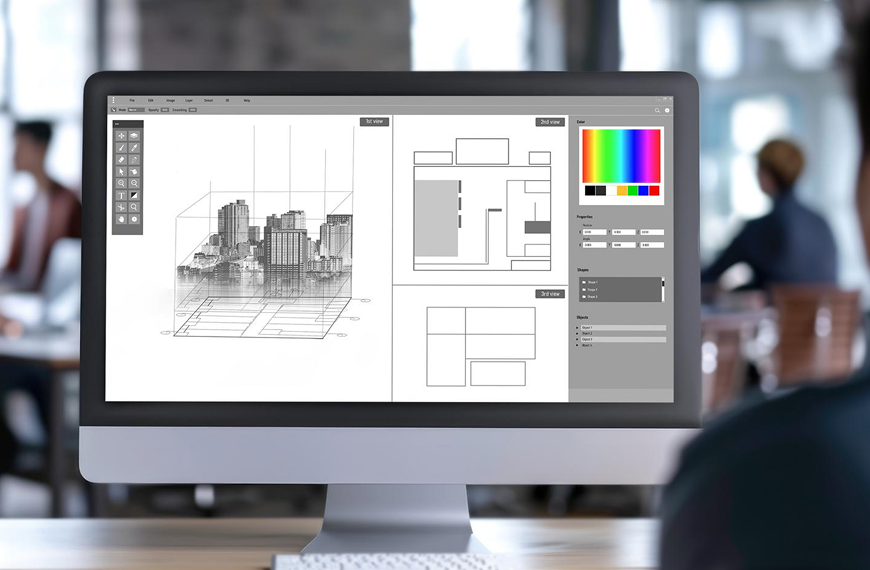
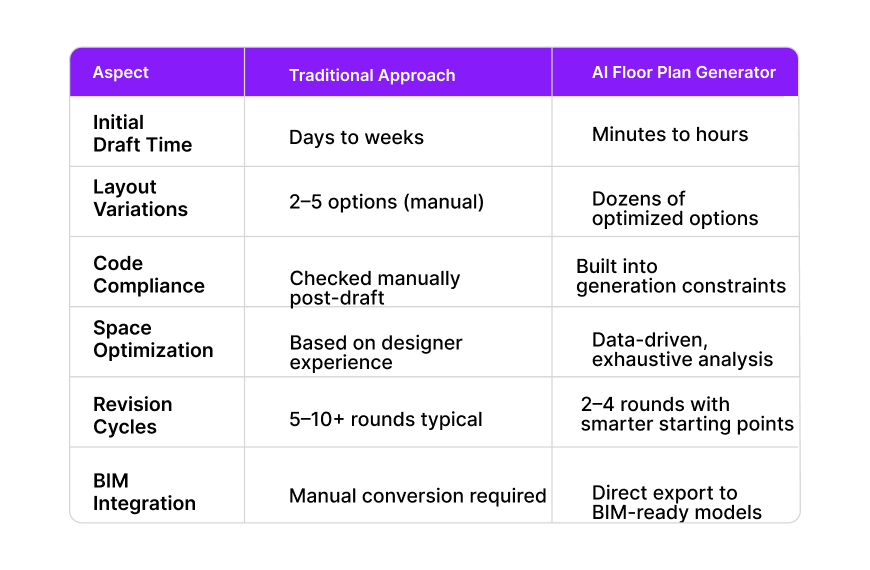
The shift toward AI floor plan generators is driven by practical advantages that compound across every phase of a project.
Dramatic time savings. What once required days of manual drafting can now be accomplished in minutes. This frees architects to spend more time on creative design decisions, client relationships, and the high-value problem-solving that truly requires human judgment.
Superior space optimization. AI evaluates thousands of layout permutations to maximize usable area, proper circulation, and functional adjacencies - a level of exhaustive analysis that is simply impractical to perform manually.
Fewer revision cycles. Because AI-generated layouts are data-driven and constraint-aware from the start, they tend to require fewer rounds of correction. Errors that traditionally surfaced during engineering review - like code violations or spatial conflicts - are caught during generation.
Scalability for large portfolios. For firms managing multiple projects simultaneously, an AI floor plan generator allows consistent quality across dozens of concurrent layouts. This is particularly valuable for real estate developers, contractors and EPC firms, and design firms working at scale.
Accessible collaboration. AI-generated 3D views and rendered visualizations help non-technical stakeholders - clients, investors, project owners - understand and approve designs faster, reducing the communication gap that often slows projects down.
While many AI floor plan generators focus narrowly on residential layout sketches or real estate photography workflows, DesignDrafter takes a fundamentally different approach. It is a comprehensive AI building design platform that treats floor plan generation as one part of a fully integrated design-to-construction pipeline.
AI Floor Plan Studio
DesignDrafter's Generate Floor Plan feature lets you define room requirements, area constraints, building type, and design rules on a single intelligent canvas. The AI generates structured, build-ready floor plans with proper space planning, adjacency logic, and code compliance. You can instantly refine arrangements, optimize space, and validate feasibility - then render interiors and facades to visualize design intent.
End-to-End Design Integration
What sets DesignDrafter apart is what happens after the floor plan is generated. From the same platform, you can run MEP and civil design calculations - lighting, HVAC, plumbing, fire protection, and structural analysis — all aligned with industry standards. You can convert layouts into BIM-ready models through smart drawing development, automatically generate quantity takeoffs for accurate BOQs, and even compare building products using detailed technical parameters.
Built for Professionals
DesignDrafter serves architects, MEP consultants, design firms, and contractors and EPC companies - offering role-specific solutions that address the distinct workflow challenges each professional faces. This is not a consumer sketch tool; it is enterprise-grade AI building design software.
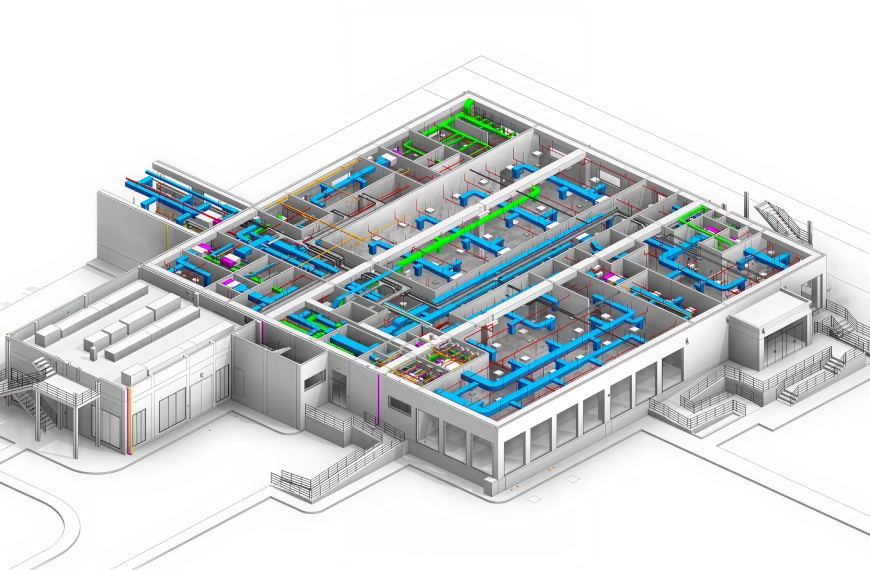
AI floor plan generators are proving their value across a wide range of project types and industry segments.
Residential design. Homeowners and residential architects use AI to explore layout options for new construction and renovations rapidly. The ability to generate and compare multiple configurations - before a single line is drawn in CAD - leads to better design outcomes and faster client approvals.
Commercial office planning. For corporate interiors and co-working spaces, AI excels at optimizing occupancy density, workstation placement, meeting room distribution, and circulation paths. It can model dozens of test-fit scenarios in the time it traditionally takes to produce one.
Healthcare and institutional facilities. Hospitals, schools, and government buildings have complex adjacency requirements, strict code compliance needs, and multi-stakeholder approval processes. AI-driven layout generation accelerates feasibility studies while ensuring regulatory requirements are embedded from day one.
Real estate development at scale. Developers managing large portfolios of residential or mixed-use projects benefit significantly from AI's ability to produce consistent, optimized layouts across multiple properties simultaneously, reducing per-project design costs and accelerating time to market.
The AI floor plan generator as it exists today is just the beginning. Several emerging trends point to an even more transformative future for AI in architecture.
Sustainability-driven design. Expect AI tools to increasingly incorporate energy modeling, carbon footprint analysis, and passive design strategies directly into the layout generation process - suggesting orientations, window placements, and material choices that minimize environmental impact from the earliest concept stage.
Direct integration with construction. As prefabrication and modular construction continue to gain market share, AI-generated floor plans will link directly to manufacturing specifications - further compressing the timeline from design to physical structure.
Personalized design intelligence. Future AI systems will learn from a firm's project history, client preferences, and regional building patterns to produce increasingly tailored recommendations that feel custom rather than generic.
Architects and design professionals who adopt these tools now will build a significant competitive advantage. Those who wait risk falling behind as the industry standard shifts toward AI-augmented workflows.
Ready to design Faster With AI?
Generate optimized, build-ready floor plans in minutes - not days. Try DesignDrafter's AI Floor Plan Studio free today.
July 4 , 2026
April 8 , 2026
May 12 , 2026