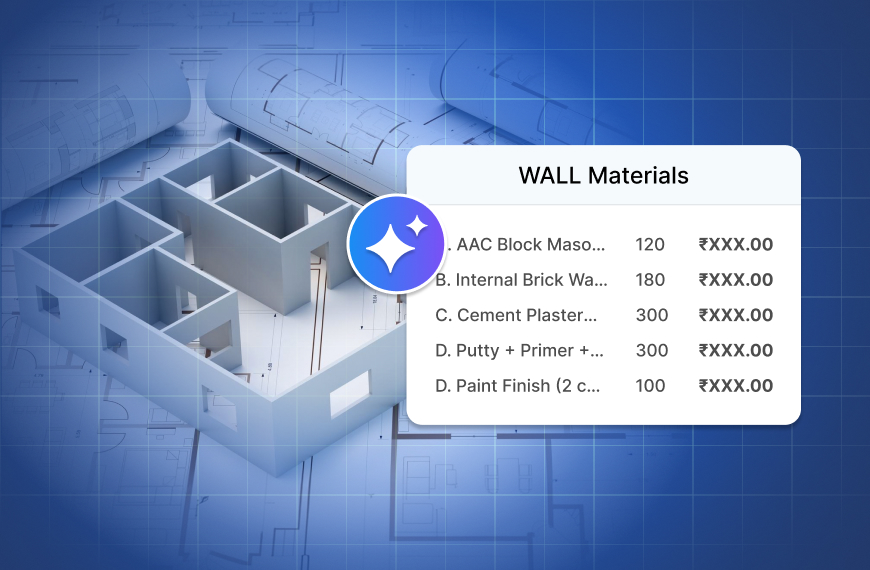
If you have ever spent an entire week hunched over CAD drawings, manually counting conduit runs, duct lengths, pipe fittings, and sprinkler heads - only to realize you missed an entire floor - you already know the pain that construction quantity takeoffs inflict on project teams worldwide.
Quantity estimation has always been the unglamorous backbone of every construction project. Get it right, and your budgets hold, your procurement timelines stay intact, and your clients trust you. Get it wrong, and the consequences ripple through every phase of the build - from cost overruns and material waste to delayed handovers and strained contractor relationships.
For decades, architects, MEP consultants, contractors, and estimators have relied on spreadsheets, printed drawings, colored highlighters, and sheer patience to quantify materials from construction documents. The process is slow. It is error-prone. And in a world where building projects are becoming more complex, more compressed in schedule, and more demanding in compliance requirements, the manual approach is no longer sustainable.
That is exactly where AI-powered quantity takeoff software enters the picture - and why it has become one of the most important technology shifts in the AEC (Architecture, Engineering, and Construction) industry today.
In this article, we are going to take a deep, honest look at what AI quantity takeoff tools actually do, how automated material extraction works in practice, why it matters for MEP and architectural projects, and how platforms like DesignDrafter are making this technology accessible to firms of every size.
Before we dive into the AI side of things, let us ground ourselves in the fundamentals - because understanding why quantity takeoffs matter is the first step to appreciating why automating them is such a game-changer.
A quantity takeoff (sometimes called a material takeoff or QTO) is the process of reviewing construction drawings, blueprints, and BIM models to identify and measure every material, component, and item required to complete a building project. The output of this process is typically a Bill of Quantities (BOQ) - a structured document that itemizes everything from concrete volumes and steel tonnage to the number of light fixtures, lengths of cable trays, duct dimensions, pipe diameters, and sprinkler counts.
This BOQ becomes the foundation for cost estimation, procurement planning, vendor negotiations, and project scheduling. Without an accurate quantity takeoff, every downstream decision is built on guesswork.
In MEP (Mechanical, Electrical, and Plumbing) projects specifically, the quantity takeoff process is particularly demanding. MEP systems are layered, interconnected, and discipline-specific. An electrical engineer needs to extract cable lengths, conduit sizes, panel board counts, and switch quantities. An HVAC designer needs duct runs, diffuser counts, and equipment specifications. A plumbing consultant needs pipe lengths by diameter, fixture counts, and valve types. A fire protection engineer needs sprinkler spacing, riser dimensions, and pump capacities.
When you multiply this complexity across a multi-story commercial building or a large residential township, you begin to understand why manual quantity takeoffs consume hundreds of hours and still produce error rates that many firms quietly accept as unavoidable.
Let us be candid about what manual quantity estimation actually looks like in most firms today.
An estimator receives a set of drawings - sometimes as PDFs, sometimes as DWG files, occasionally as part of a Revit model. They open the drawings, and then the painstaking work begins. They zoom into each sheet, identify components, measure dimensions using on-screen tools or physical scale rulers, and log every item into a spreadsheet. For a mid-size commercial project, this process can take anywhere from two to six weeks depending on the complexity of the MEP systems involved.
The challenges are well-documented across the industry. Human error in counting and measurement is practically inevitable when you are dealing with hundreds of drawing sheets. Inconsistencies between disciplines - where the electrical takeoff assumes one layout while the HVAC takeoff references a slightly different revision - create conflicts that surface only during procurement or, worse, during construction. Version control becomes a nightmare when drawings are revised mid-estimation. And the opportunity cost is enormous: senior engineers who should be designing and problem-solving are instead spending their time on repetitive counting tasks.
There is also a less-discussed problem - the knowledge bottleneck. In many firms, quantity takeoff expertise lives in the heads of a few experienced estimators. When those individuals leave, retire, or are unavailable, the firm's estimation capability takes a significant hit. There is no scalable system, no institutional memory, and no way to rapidly onboard new team members into the estimation workflow.
This is the landscape that AI-powered quantity takeoff software was designed to address.
When we talk about AI quantity takeoff tools, we are not talking about a simple "find and replace" function overlaid on a PDF viewer. Modern automated material extraction platforms use a combination of technologies that work together to replicate - and in many cases surpass - what a human estimator does.
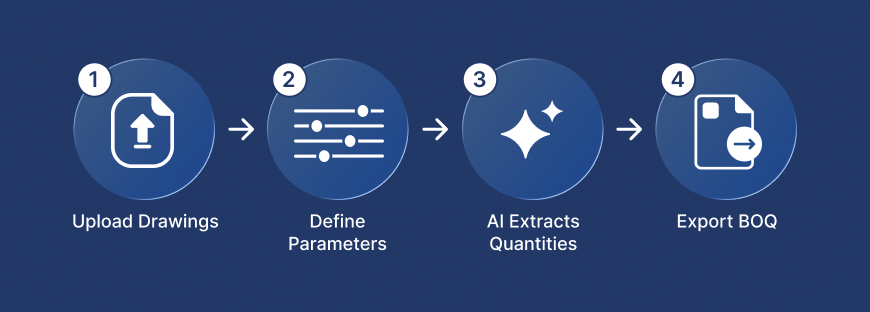
Here is a breakdown of how the process typically works, using DesignDrafter's Extract Quantity module as a representative example.
The process begins when you upload your 2D CAD drawings (in DWG or PDF format) or 3D BIM models (such as Revit or IFC files) into the platform. The system ingests these files and prepares them for analysis. This is a crucial differentiator from manual methods - the AI works directly from your existing project files, so there is no need to recreate drawings or convert them into a proprietary format.
Before the extraction begins, you configure the takeoff to match your project requirements. This includes setting measurement units (metric or imperial), selecting specific MEP disciplines or architectural categories, defining material classifications, and specifying which drawing layers or model elements should be included in the analysis. This customization ensures that the output aligns with your firm's standards and the project's specific needs.
This is where the heavy lifting happens. The AI engine analyzes the drawings or BIM model, identifies components based on their graphical representation and metadata, calculates dimensions and quantities, and compiles the results into a structured dataset. For MEP drawings, this means the system can distinguish between different pipe diameters, identify duct types, count electrical fixtures, and measure cable tray runs - all automatically. The technology relies on a combination of computer vision, pattern recognition, and BIM data parsing to achieve this level of accuracy.
Importantly, the system also gives users the ability to manually review and modify extracted quantities. No AI system is perfect, and real-world drawings often contain ambiguities, non-standard symbols, or revision marks that require human judgment. The best automated takeoff platforms acknowledge this reality and build human oversight into the workflow rather than pretending full automation is always sufficient.
Once the takeoff is complete, you export the results as detailed Bills of Quantities, cost estimates, or procurement sheets. Common export formats include Excel spreadsheets and PDF reports. These outputs are structured, itemized, and ready to feed directly into your estimation, procurement, or project management systems.
The impact of automating quantity takeoffs extends far beyond saving time - although the time savings alone are substantial. Let us look at the specific ways this technology transforms project workflows.
When a human estimator manually counts 2,400 sprinkler heads across 30 floors of a commercial tower, errors are statistically likely. Even a 2-3% error rate can translate into significant cost discrepancies. AI-powered extraction eliminates the fatigue factor and delivers consistent accuracy across the entire document set.
What used to take weeks can now be accomplished in hours. For competitive bidding scenarios, this speed advantage is not just convenient - it is strategically critical. Firms that can produce accurate estimates faster win more bids and start projects sooner.
A growing firm no longer needs to hire additional estimators for every new project. The AI handles the volume, while your experienced professionals focus on reviewing results, managing client relationships, and making design decisions.
When every takeoff follows the same AI-driven process, the output is standardized. This makes it easier to compare estimates across projects, benchmark costs, and maintain quality control - especially for firms managing multiple simultaneous projects.
Platforms like DesignDrafter are built to work with the tools that MEP and architecture professionals already use. Support for DWG, PDF, Revit, and IFC files means you do not need to change your design tools to benefit from automated takeoffs. The platform fits into your existing workflow rather than demanding you restructure around it.
This technology is not a one-size-fits-all solution, but its applicability is remarkably broad across the AEC industry.

Architects benefit when they need preliminary quantity estimates during the design phase to validate budgets and material feasibility before handing off to engineering teams.
MEP Consultants gain the most significant efficiency improvements because MEP systems are inherently complex, layered, and quantity-intensive. Automating the extraction of electrical, HVAC, plumbing, and fire protection quantities eliminates one of the most time-consuming aspects of MEP project delivery.
Contractors and EPC firms use automated takeoffs to produce fast, accurate bid estimates, manage procurement planning, and verify subcontractor quantities during project execution.
Design firms with high project volumes can standardize their estimation processes, reduce dependency on individual estimators, and deliver more consistent client proposals.
Independent estimators and quantity surveyors can dramatically increase their throughput without compromising accuracy, allowing them to serve more clients and compete more effectively.
One of the most significant advancements in automated quantity extraction is the deep integration with Building Information Modeling (BIM) workflows. BIM models - particularly those built in Revit or exported as IFC files - contain rich metadata about every building component: material type, dimensions, manufacturer specifications, system classification, and spatial relationships.
When an AI quantity takeoff platform can read and interpret this BIM data directly, the extraction goes far beyond simple geometry measurement. The system can pull specification data, link quantities to specific building systems, and generate BOQs that are organized by discipline, floor, zone, or any other classification scheme your project requires.
This BIM-integrated approach also supports coordination between disciplines. When the architectural model updates, the quantity takeoff can be refreshed to reflect the changes - reducing the risk of estimation discrepancies caused by working from outdated drawings.
DesignDrafter's platform supports this BIM-integrated workflow, accepting Revit and IFC files alongside traditional DWG and PDF formats. This flexibility is essential for firms that work across a range of project types, from legacy renovations documented in 2D CAD to new constructions built entirely in BIM.
If you are evaluating automated takeoff software for your practice, here are the key capabilities that separate truly useful tools from superficial automation.
Multi-format file support is non-negotiable. Your tool should handle DWG, PDF, Revit, and IFC files at a minimum, because real-world projects involve a mix of document formats.
Discipline-specific extraction matters enormously. A tool that can only count generic shapes is not useful for MEP work. You need a platform that understands the difference between a sprinkler head and a smoke detector, between a 4-inch pipe and a 6-inch pipe, between a supply duct and a return duct.
Manual override and editing capabilities are essential. As mentioned earlier, no AI is infallible. The ability to review, adjust, and supplement AI-extracted quantities is what makes the tool practical for professional use.
Structured export formats ensure that the takeoff output integrates smoothly with your downstream workflows - whether that is cost estimation in Excel, procurement management, or project scheduling.
Transparent processing - the ability to see which drawing elements the AI identified and how quantities were calculated - builds confidence in the results and makes quality assurance efficient.
Automated quantity takeoffs are just one piece of a much larger transformation happening across the architecture, engineering, and construction industry. AI is reshaping how buildings are designed, calculated, documented, and delivered.
Platforms that combine AI-powered floor plan generation, automated MEP design calculations, BIM automation, smart drawing development, and quantity extraction into a single integrated environment represent the next evolution of building design technology. Rather than cobbling together disconnected tools for each task, firms can work within a unified platform where design decisions, engineering calculations, and material quantities are all connected and mutually informed.
This integrated approach reduces errors, eliminates redundant data entry, and creates a continuous digital thread from concept design through to construction documentation and procurement.
The construction industry is not known for rapid technology adoption, and that is understandable - when you are building structures that must stand for decades and protect human life, caution is a virtue. But the firms that recognize the difference between prudent caution and resistance to progress will be the ones that thrive in the coming years.
AI-powered quantity takeoff software is not about replacing the expertise of experienced estimators and engineers. It is about amplifying that expertise - freeing professionals from repetitive, error-prone tasks so they can focus on the judgment, creativity, and problem-solving that actually requires human intelligence.
Whether you are an architect validating material feasibility during early design, an MEP consultant producing detailed system takeoffs, a contractor preparing competitive bid estimates, or a design firm seeking to standardize your estimation process - automated material extraction technology is ready to transform how you work.
May 29 , 2026

May 8 , 2026

April 8 , 2026