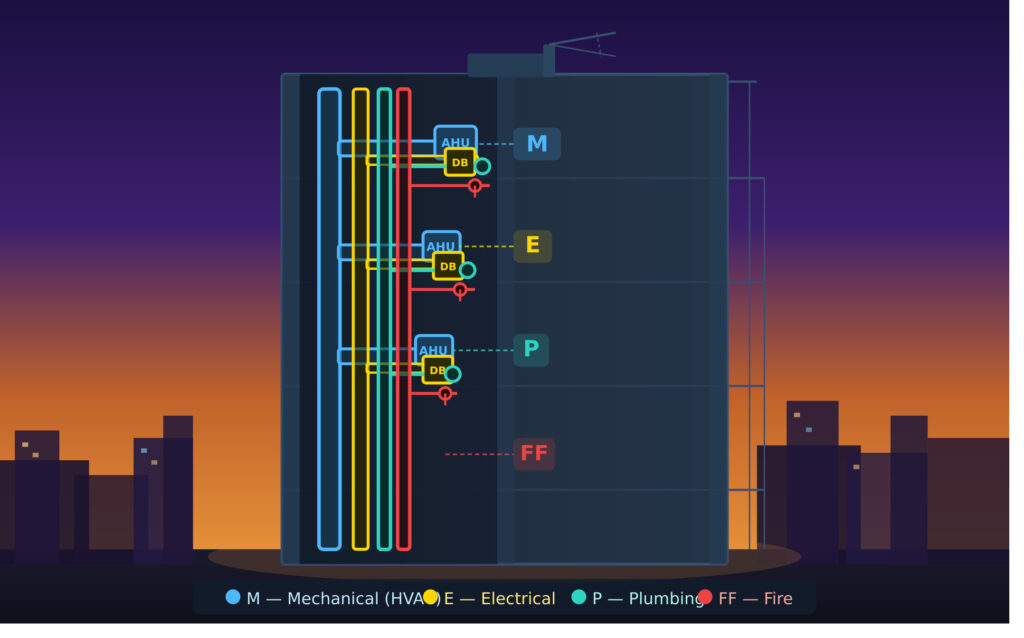
Every building you walk into, whether it is an office tower in Mumbai, a hospital in Bengaluru, or a residential complex in Delhi, quietly runs on three systems working together behind the walls, beneath the floors, and above the ceilings. You may never see them, but the moment any one of them fails, you feel it immediately. The lights go out. The water stops. The air gets uncomfortably warm.
These are MEP systems, and they are the lifeblood of every modern building.
Yet despite being one of the most critical aspects of any construction project, MEP remains one of the least understood areas, especially among architects, project managers, and even junior engineers who work alongside MEP teams every day without fully grasping how it all comes together.
This guide is written to change that. Whether you are an architect trying to coordinate better with your MEP consultants, an engineer looking to understand the full scope of MEP design, or a student entering the AEC industry, this is the most comprehensive, practical, and up-to-date breakdown of MEP in construction you will find anywhere.
MEP stands for Mechanical, Electrical, and Plumbing. In construction and building engineering, it refers to the three core technical systems that make a building functional, safe, comfortable, and compliant with building codes.
While architects design how a building looks and feels, and structural engineers ensure it stands safely, MEP engineers design how the building works on the inside. They are responsible for the systems that regulate air, power, water, and safety across every floor, every room, and every corner of the structure.
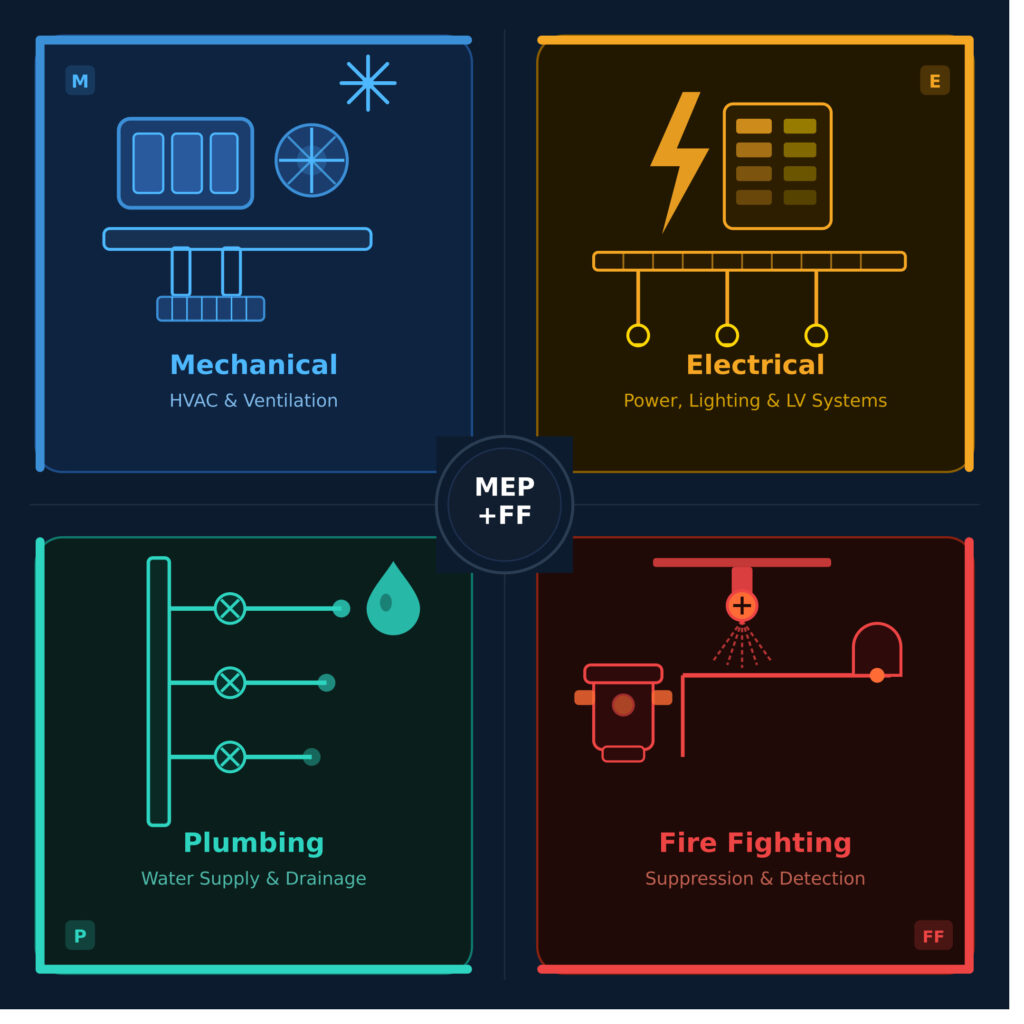
Some firms and standards also extend the acronym to MEPF (adding Fire Protection) or even MEPFP. In the Indian context, it is most commonly referred to as MEPFF, which stands for Mechanical, Electrical, Plumbing, and Fire Fighting. This is the full form you will encounter most frequently on Indian construction projects, and it is the version this guide will follow throughout.
So when someone on a project says "the MEP team needs this drawing by Friday," they are referring to the engineers handling all of these combined building services together. If you are new to this space, the DesignDrafter platform for MEP Consultants is a good starting point to see how modern firms are structuring their MEP workflows.
Here is something most people outside the engineering world do not realize. MEP systems typically account for 30% to 50% of the total construction cost of a commercial building. For hospitals, data centers, and luxury hotels, that number can climb even higher.
Despite this, MEP coordination is often started too late, managed reactively, and consistently underestimated in terms of its complexity. The result is what the construction industry calls rework, which refers to expensive changes made to already-installed systems because MEP drawings were not properly coordinated with architectural and structural designs from the beginning.
According to multiple industry studies, rework costs construction projects globally an estimated $625 billion per year. A significant portion of that comes directly from poor MEP coordination.
This is not a technical footnote buried in an engineering report. It is a business problem that affects every stakeholder on a project, from the developer paying for the rework to the engineer losing sleep over clashes discovered in the ceiling plenum at a late stage of construction.
Understanding MEP properly is the first step toward building smarter and delivering projects that do not bleed money on site.
The mechanical systems in a building are primarily concerned with Heating, Ventilation, and Air Conditioning, which is why the terms "Mechanical" and "HVAC" are often used interchangeably in project conversations across the industry.
The scope of a mechanical engineer on a building project typically covers several interconnected areas.
HVAC System Design involves calculating heating and cooling loads for each zone or room in the building, selecting the right air handling units (AHUs), fan coil units (FCUs), chillers, cooling towers, and boilers, and designing duct networks that distribute conditioned air throughout the structure efficiently and uniformly.
Ventilation and Indoor Air Quality covers the design of fresh air supply systems, exhaust systems for toilets and kitchens, pressurization systems for staircases, and smoke control systems that are critical for life safety compliance during a fire emergency.
Mechanical Equipment Rooms require careful coordination of plant room layouts, equipment clearances, vibration isolation details, and acoustic treatment to ensure that mechanical equipment does not create disturbance for the building's occupants during normal operation.
In the Indian context, HVAC design must comply with standards including ASHRAE 90.1 for energy efficiency, ECBC (Energy Conservation Building Code) guidelines issued by BEE, and ISHRAE standards for equipment selection and system performance benchmarking. You can explore how DesignDrafter's HVAC Design Calculation module automates this entire process in alignment with these standards.
For most office buildings and commercial complexes, mechanical systems represent the single largest MEP cost component. Getting HVAC calculations right from the start is not just an engineering exercise. It is a significant financial decision with long-term consequences for the building owner.
Electrical systems in a building go far beyond installing switches and light fittings. The electrical scope on a modern building project is deeply technical, highly code-driven, and touches nearly every aspect of how the building operates day to day.
Power Distribution includes the design of the incoming HT/LT supply, main LV panels, distribution boards, bus ducts, cable trays, and the entire cable routing network that delivers power to every outlet, piece of equipment, and connected system in the building.
Lighting Design covers lux level calculations for each space, the selection and placement of luminaires to meet IS/IEC standards, emergency and exit lighting, and increasingly, smart lighting controls integrated with building management systems for energy efficiency.
Load Analysis and Electrical Load Calculations involve computing the connected load, demand load, and diversity factors to correctly size transformers, DG sets, cables, and switchgear. This ensures the system is safe, efficient, and capable of supporting future expansion without requiring a complete redesign. For a detailed walkthrough of this process, read our complete step-by-step guide to electrical load calculation for buildings.
Low Voltage (LV) Systems form a large and growing part of the electrical scope on modern buildings, covering structured cabling for data and voice networks, CCTV and security systems, access control, public address systems, nurse call systems in healthcare facilities, and building automation systems (BMS/BAS) that tie everything together under centralized control.
Earthing and Lightning Protection are critical safety systems that are often treated as afterthoughts during project planning but are absolutely non-negotiable from a code compliance standpoint on any building project in India.
Electrical calculations on Indian projects must align with IS 3043 for earthing, IS 1646 for fire safety in electrical installations, IEC 60364 for low voltage systems, and the relevant provisions of the National Building Code, all of which require detailed, documented calculation sheets for regulatory submission and approval. DesignDrafter's Electrical Design Calculation module handles this entire documentation workflow automatically.
Plumbing is one of those disciplines that everyone takes for granted until something goes wrong. And when plumbing goes wrong in a building, it tends to go spectacularly wrong, creating hygiene hazards, structural damage, and regulatory violations that are expensive and disruptive to fix.
The plumbing scope in MEP covers two broad domains: water supply and drainage. Both must be designed with precision and care.
Water Supply Systems include the design of cold and hot water distribution from storage tanks or the municipal supply connection to every fixture across the building, covering bathrooms, kitchens, utility areas, and equipment rooms, with correct pipe sizing, pressure calculations, and flow rate analysis for each branch of the network.
Drainage and Sanitation covers above-ground drainage from fixtures to soil stacks, waste water drainage design, vent pipe sizing to prevent siphonage and odor, and the connection to the building's underground drainage network for eventual disposal.
Stormwater Management involves rainwater downpipes, surface drainage channels, and on many Indian commercial projects, rainwater harvesting systems that are now a mandatory requirement under local municipal regulations and green building rating systems including IGBC and GRIHA.
Hot Water Systems cover the design of solar water heater arrays, heat pump water heaters, or centralized hot water circulation systems for large-scale hospitality, healthcare, or residential projects where centralized systems offer the best combination of energy efficiency and reliability.
Plumbing design in India is governed by IS 1172 (code of basic requirements for water supply), National Building Code Part 9, and increasingly, the Uniform Plumbing Code India (UPCI) for newer projects that seek alignment with international standards. DesignDrafter's Plumbing Design Calculation module automates pipe sizing, pressure calculations, and standards-aligned documentation for all of these system types.
While technically classified as an extension of plumbing in some international frameworks, fire fighting systems are treated as a completely separate MEP discipline in India, and rightfully so. No building occupancy certificate is issued without an approved fire NOC, and no fire NOC comes without properly designed, installed, and tested fire fighting systems across the entire building.
Wet Riser and Sprinkler Systems form the backbone of active fire protection in multi-storey buildings. Their design requires hydraulic calculations covering pipe sizing, operating pressure requirements, pump selection, and underground reservoir sizing to meet the firefighting water demand defined by the applicable standards.
Hydrant Systems must be designed to serve the entire building footprint, with hydrant points located and spaced per NBC and local fire authority requirements, and with pump rooms designed to deliver adequate flow and pressure at the most hydraulically disadvantaged point in the network.
Gas-Based Suppression Systems such as FM200, CO2, and Novec 1230 are required in server rooms, electrical substations, and high-value storage areas. These systems involve a completely different design methodology, equipment specification, and regulatory approval pathway compared to water-based systems.
Smoke Detection and Alarm Systems, while often handled by the ELV team under the electrical scope, must be fully coordinated with the fire fighting design to ensure that the overall fire safety system for the building is integrated, code-compliant, and capable of functioning as a single coordinated response during an emergency.
In India, fire fighting systems must comply with NBC 2016 Part 4, IS 15105, TAC (Tariff Advisory Committee) guidelines, and NFPA standards, which are increasingly required for international-grade commercial projects and those targeting LEED or IGBC certification. See how DesignDrafter's Fire Fighting Design Calculation module handles hydraulic calculations and code compliance documentation automatically.
Understanding what MEP covers is one thing. Understanding how MEP design actually unfolds on a real project, from the client's initial brief to the final coordinated construction drawings, is where the real complexity and value of this discipline becomes visible.
At the earliest stage of a project, the MEP consultant prepares a Basis of Design document. This is a technical brief that defines the design criteria, applicable codes and standards, system selection philosophy, and key assumptions for each MEP discipline.
This document is critical because it formally aligns the client, the architect, and the MEP team on what systems will be designed, why those systems were selected, and what performance benchmarks they will be held to throughout the project. A project that begins without a clear and agreed Basis of Design almost inevitably faces disputes, scope gaps, and costly misalignments later in the delivery process.
The MEP team develops schematic layouts, which include early-stage single-line diagrams, equipment room size requirements, riser diagrams, and preliminary duct and pipe routing concepts based on the architectural layouts available at this stage.
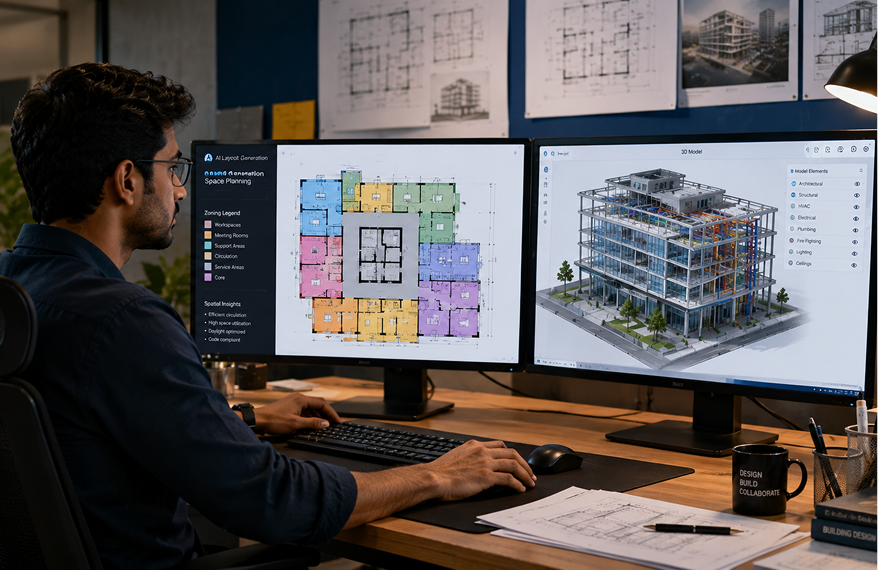
It is important for the architectural layouts to be reasonably stable before MEP schematic design begins in earnest, because room sizes, building orientation, floor-to-floor heights, and core arrangements all directly affect how MEP systems are sized, routed, and accommodated within the building fabric. This is also the stage where AI-powered floor plan generation can significantly accelerate the architectural input that MEP teams depend on.
This is the technical heart of the MEP engineering process. Every system receives a full engineering treatment: HVAC room-by-room load calculations, electrical load analysis and equipment schedules, plumbing flow rate and pipe sizing calculations, fire system hydraulic calculations, and all associated technical documentation.
These calculations form the engineering proof that the systems will perform as intended under real operating conditions. They are required for regulatory submissions, client technical approvals, and insurance underwriting, and they become the reference document against which the installed systems are eventually commissioned and tested.
This stage is also the most time-intensive part of MEP work and, traditionally, the most error-prone, because it involves enormous amounts of manual calculation, spreadsheet-based documentation, and multiple rounds of cross-checking across disciplines. Our complete guide to AI-powered MEP design calculations explains exactly how this calculation stage can be automated across all four disciplines.
Once detailed design is complete, the MEP team develops construction drawings covering floor plans with duct routes, pipe runs, cable trays, and equipment placements, along with sections, enlarged details, and equipment schedules.
These drawings must be fully coordinated, meaning that electrical, mechanical, and plumbing layouts must be layered together and carefully checked against the structural and architectural drawings to identify and resolve clashes before any work begins on site.
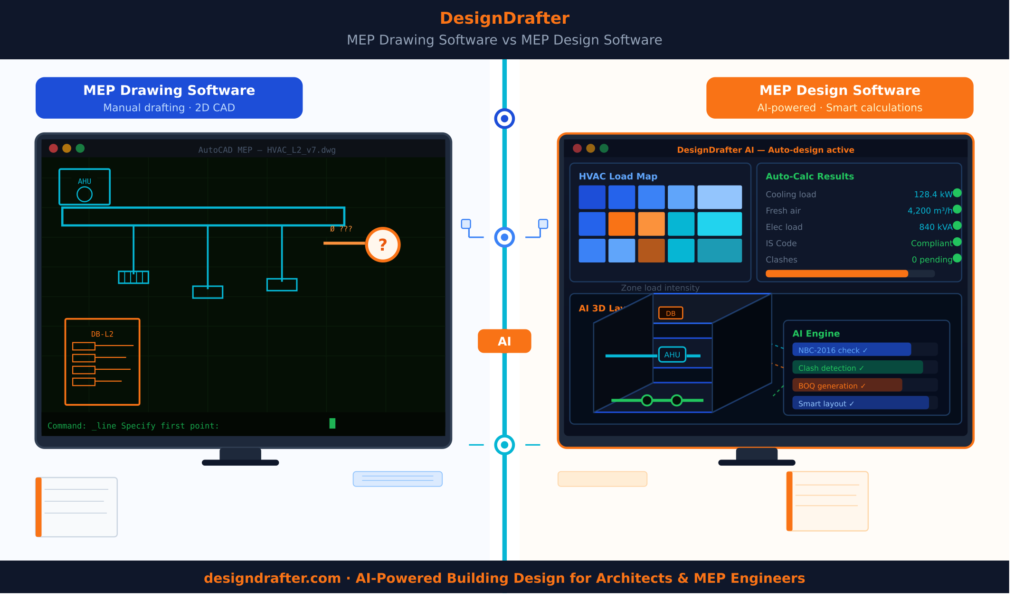
Traditionally, this coordination was done manually, which is painfully slow and almost guaranteed to miss conflicts. Today, BIM-based coordination and automation using intelligent tools allows clash detection to happen automatically in three dimensions, saving significant amounts of time and preventing costly rework during construction.
MEP consultants also support the procurement process by preparing Bills of Quantities for each discipline, reviewing contractor submissions and technical proposals, and responding to Requests for Information during the construction phase. During site execution, consultants review shop drawings submitted by the contractor, approve material submittals, and conduct site inspections to ensure that MEP systems are installed in strict accordance with the approved design intent and relevant standards. At this stage, automated quantity takeoff tools can generate accurate, structured BOQs directly from coordinated MEP drawings.
If you have worked on any mid-to-large-scale construction project, you know that MEP coordination is often the most contested, delayed, and rework-heavy part of the entire process. Understanding why this happens consistently is the first step toward preventing it.
Interdisciplinary Clashes are the most common and costly problem. HVAC ducts, electrical cable trays, plumbing pipes, and sprinkler lines all compete for the same ceiling plenum space, and when no one checks the combined picture early enough, the conflicts are discovered on site at a stage where fixing them requires demolishing and reinstalling already-completed work. This is precisely the problem that AI clash detection in MEP coordination is designed to solve.
Late Involvement of MEP Consultants is a structural problem on many Indian projects. Architects frequently finalize ceiling heights, column positions, and core layouts before the MEP team has had a chance to confirm whether their systems will actually fit within the available space. The result is a cascade of last-minute revisions, reduced ceiling heights that compromise occupant comfort, and compromised system performance that the building owner lives with for decades.
Disconnected Drawing Sets mean that the architect's reflected ceiling plan, the HVAC layout, the electrical conduit plan, and the plumbing isometric are all maintained as separate 2D CAD files with no automated way of checking them against each other. Coordination happens, when it happens at all, during site meetings that are scheduled too late to avoid the rework. The CAD to BIM conversion workflow addresses this directly by unifying all disciplines into a single coordinated model.
Manual Calculation Errors compound the problem at the design stage. When HVAC loads are calculated on spreadsheets, electrical panels are sized manually, and plumbing pipe diameters are looked up from printed tables, human error is inevitable. Errors in calculations translate directly into errors in drawings, which in turn produce errors in construction that must eventually be corrected at significant cost.
Poorly Documented BOQs create procurement problems, budget overruns, and contractor disputes when the quantities extracted from MEP drawings do not accurately reflect the actual scope of work required to complete the installation on site. Read our detailed guide on AI quantity takeoff software to understand how automated extraction eliminates these problems.
The traditional MEP design process built on manual calculations, 2D CAD drawings, spreadsheet-based BOQs, and reactive coordination is being fundamentally transformed by AI and intelligent automation. This is not a future prediction. It is happening right now on real projects, and the firms that are adopting these tools are delivering work faster, with fewer errors, and at significantly lower coordination costs than those still relying on legacy workflows.
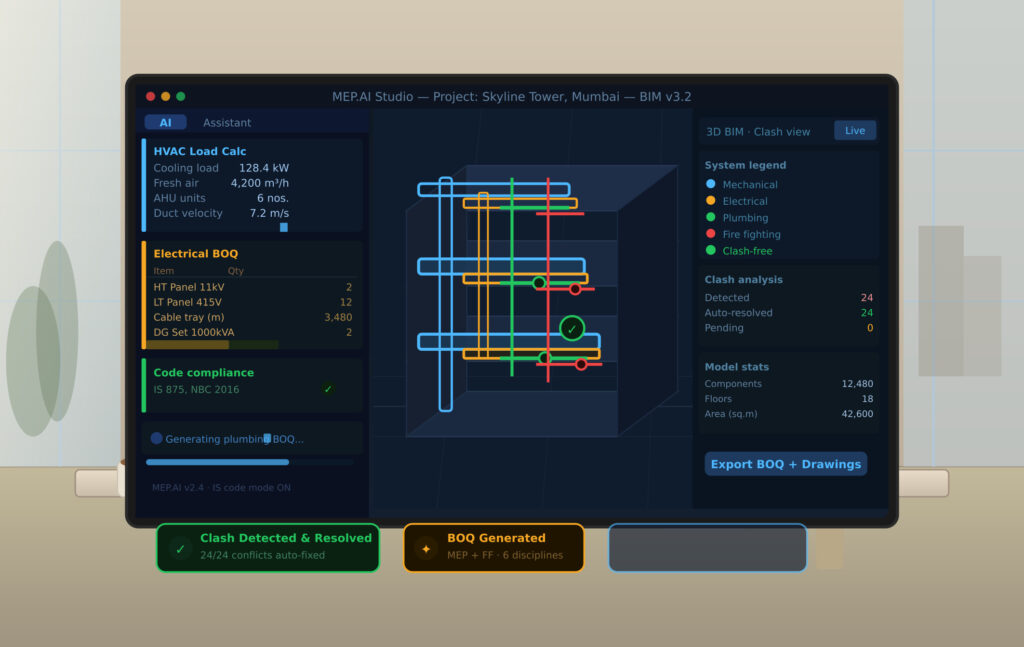
Platforms like DesignDrafter now automate the entire MEP calculation workflow end to end. Electrical load calculations that used to take a senior engineer two to three full working days can be generated in minutes. HVAC room-by-room load calculations, plumbing pipe sizing, and fire system hydraulic calculations are all automated, validated against the relevant Indian and international standards including IS, ASHRAE, ECBC, NBC, and NFPA, and packaged into structured, submission-ready reports that can go directly to the client or the regulatory authority.
This is not about replacing engineers. It is about giving engineers the ability to accomplish in one hour what used to take a full week, and to spend their expertise on design judgment and value engineering rather than mechanical number-crunching that a well-trained algorithm can handle faster and with fewer errors.
Once calculations are complete, the next bottleneck in traditional workflows is translating those outputs into coordinated construction drawings. DesignDrafter's Building Design Calculation engine can now read calculation outputs and automatically place MEP elements including duct runs, pipe routes, cable trays, and sprinkler heads onto coordinated floor plans. This dramatically compresses the time between completing the engineering calculations and having a construction-ready drawing set ready for review.
Many Indian MEP firms are still working with legacy 2D CAD drawings, not by choice, but because converting those drawings to BIM models manually takes weeks of repetitive, low-value work. AI-driven CAD to Revit conversion now automates this conversion process by intelligently reading 2D MEP layouts and rebuilding them as fully coordinated 3D BIM objects, complete with Cobie data fills, clash resolution, annotation, and sheet creation. Our in-depth guide on CAD to Revit conversion and BIM automation covers this workflow in full detail.
Rather than waiting for the weekly coordination meeting to discover that an HVAC duct clashes with a structural beam at the same elevation as a sprinkler branch line, AI-powered clash detection tools run continuously and flag conflicts in real time, suggesting re-routing solutions that can be reviewed and approved before any physical work begins. This approach saves days of site rework per floor on a typical multi-storey project.
Automated quantity takeoff tools extract MEP quantities directly from coordinated drawings and models and generate structured, brand-specified Bills of Quantities that are ready for procurement and tendering. This eliminates the manual counting, missed line items, and pricing errors that are endemic in traditional MEP quantity estimation workflows. For a deeper look at how this technology is transforming construction estimation, read our guide on quantity extraction and smart BOQ automation in 2026.
Beyond individual automation tools, DesignDrafter's AI Design Agent acts as an intelligent co-pilot that understands complete MEP workflows, remembers project context, and executes complex multi-discipline tasks across layouts, calculations, BOQs, and documentation in a single coordinated session. Learn more about how AI design agents are transforming MEP and architectural workflows in our dedicated guide.
One consistent source of confusion for professionals entering the Indian AEC market, or for international teams working on Indian projects for the first time, is the difference in terminology between how MEP is described globally versus how it is used in the Indian construction industry.
In India, the more complete and practically accurate acronym is MEPFF or MEP+FF, where FF stands for Fire Fighting. This distinction matters because, unlike in some Western markets where fire suppression is treated as a subset of the plumbing discipline, Indian building regulations, NBC norms, and fire NOC requirements treat fire fighting as a completely standalone discipline with its own design standards, calculation methodology, submission requirements, and dedicated approval authorities at the state and municipal level.
When an Indian developer or project manager says they need an MEP consultant for their project, they almost always mean a firm that is capable of covering all four disciplines: Mechanical (HVAC), Electrical, Plumbing, and Fire Fighting. Firms that only handle three of the four must subcontract the fourth, which adds coordination complexity, accountability gaps, and communication overhead that frequently leads to delays and disputes on site. DesignDrafter's solutions for MEP Consultants and solutions for Design Firms are built to cover all four disciplines within a single unified platform.
For any MEP professional working in India, familiarity with the following standards is not optional. It is a baseline professional requirement.
National Building Code (NBC) 2016 is the overarching regulatory document that governs all MEP disciplines in Indian construction, covering electrical systems in Part 8, air conditioning and heating in Part 8, fire and life safety in Part 4, and plumbing and drainage in Part 9.
IS Standards cover a wide range of specific technical requirements across all MEP disciplines. The most commonly referenced include IS 732 for electrical wiring in buildings, IS 1646 for fire safety in electrical installations, IS 1172 for basic water supply requirements, and IS 3043 for earthing systems, among many others.
ASHRAE Standards, particularly ASHRAE 90.1 for energy efficiency in buildings and ASHRAE 62.1 for ventilation and acceptable indoor air quality, are widely adopted on commercial projects in India, especially those targeting green building certification or international-grade performance standards.
ECBC (Energy Conservation Building Code), maintained by the Bureau of Energy Efficiency, sets mandatory energy performance benchmarks for commercial buildings and directly influences HVAC system selection, glazing specifications, and lighting power density decisions across the MEP design process.
NFPA Standards, especially NFPA 13 for automatic sprinkler systems and NFPA 72 for fire alarm and detection systems, are increasingly referenced alongside NBC for institutional, hospitality, and premium commercial buildings in India, particularly those developed by international investors or brands with global design standards.
IGBC and GRIHA green building rating systems each have MEP-specific prerequisites and credit categories that influence system selection, energy modelling requirements, and design documentation for projects seeking formal green certification.
All of these standards are built into DesignDrafter's Building Design Calculation platform so that engineers do not have to manually verify compliance at every step of the calculation process.
Whether you are a developer evaluating MEP firms to engage on your next project, or an engineer choosing a design platform for your practice, the following factors are the ones that genuinely separate good options from great ones.
Multi-Discipline Coverage is the non-negotiable starting point. An MEP partner, whether a consultant firm or a software platform, should cover all four disciplines in an integrated and coordinated way. Siloed tools for individual disciplines create exactly the coordination problems that proper MEP practice is supposed to solve in the first place. DesignDrafter covers Electrical, HVAC, Plumbing, and Fire Fighting within the same workspace.
Code Compliance Built In matters enormously in the Indian context. If your HVAC calculation tool does not account for ECBC requirements, or your electrical design software does not reference IS standards by default, you will spend a disproportionate amount of time manually verifying compliance, which defeats the purpose of using a purpose-built tool.
Calculation-to-Drawing Integration is the workflow bottleneck that separates genuinely useful MEP platforms from sophisticated but disconnected spreadsheets. The best MEP design platforms connect calculation outputs directly to drawing generation so that duct sizes derived from HVAC load calculations automatically inform the duct sizing in the layout drawings, without requiring manual re-entry of data across separate tools.
BIM and CAD Interoperability is no longer optional for any MEP platform that wants to be taken seriously on professional projects. Native Revit integration, Revit plugin support, and CAD to BIM conversion capabilities are increasingly essential requirements for any MEP firm that wants to remain competitive in the Indian market as BIM adoption continues to accelerate. For more context on this transition, read our post on BIM automation in 2026.
BOQ and Estimation Integration closes the loop between engineering design and project procurement. A platform that generates MEP quantities directly from the design data, rather than requiring a completely separate manual takeoff exercise, is a meaningful competitive advantage for any firm looking to win more work, deliver faster, and reduce post-contract surprises. Explore DesignDrafter's Quantity Takeoff module to see how this works in practice.
Architecture gives a building its form. Structure gives it strength. But MEP gives it life.
Every air-conditioned conference room that holds precisely at 23 degrees during a summer afternoon in Chennai. Every hospital ICU where uninterrupted power supply and precisely controlled air quality can mean the difference between recovery and tragedy. Every high-rise apartment where water reaches the 28th-floor bathroom at the right pressure without anyone on the lower floors noticing a thing. These outcomes do not happen by accident. They are the product of thousands of hours of calculation, coordination, design, and engineering judgment by MEP professionals who rarely receive the recognition they deserve for the critical work they do.
As the Indian AEC industry moves toward tighter delivery timelines, higher-quality performance standards, and increasingly complex building typologies, MEP engineering is no longer something any project team can afford to treat as a background task or a late addition to the project programme. It needs to be in the room from day one. And ideally, it needs to be backed by tools that automate the repetitive, time-consuming work so that engineers can direct their expertise toward the decisions that genuinely require human judgment and experience.
If you are an architect, MEP consultant, or project engineer looking to streamline your MEP workflows from calculations to coordinated drawings to automated BOQs, DesignDrafter was built precisely for this purpose. It is the only AI-powered building design platform built for the Indian AEC market, with local code compliance, multi-discipline integration, and a design-to-delivery workflow that does not require you to switch between five different tools to complete a single project.
Ready to see how AI can transform your MEP design workflow? Try DesignDrafter free today. No credit card required. Generate HVAC calculations, electrical load analysis, and coordinated MEP drawings in a fraction of the traditional time, fully aligned with Indian building codes and standards.
FAQ

MEP stands for Mechanical, Electrical, and Plumbing. In the Indian construction context, it is commonly expanded to MEP+FF or MEPFF, which adds Fire Fighting as a fourth and equally important discipline.
An MEP engineer is typically an individual with technical training who performs design calculations, prepares drawings, and coordinates MEP systems on a project. An MEP consultant is a firm or individual engaged by a developer or project owner to provide MEP design services on a formal contractual basis. The consultant may employ multiple MEP engineers internally to carry out the technical work across all four disciplines.
MEP systems typically represent 30% to 50% of the total construction cost on commercial buildings. For specialized building types such as hospitals, data centers, and five-star hotels, MEP costs can exceed 50% of the total project value when all systems and specialist fit-out are included.
On most projects, the MEP consultant is responsible for producing coordinated drawings across all MEP disciplines. However, the main contractor and, increasingly, dedicated BIM coordination consultants also play a significant role in checking MEP coordination against structural and architectural drawings, particularly as the project moves from design into construction.
The most commonly used tools include Autodesk Revit for BIM modeling and coordination, AutoCAD MEP for 2D layout work, Carrier HAP and Trace 700 for HVAC load calculations, and increasingly, AI-powered platforms like DesignDrafter that automate MEP calculations, drawing generation, and BOQ extraction within a single unified workflow built specifically for Indian building codes and project requirements.
Yes, for any multi-storey residential building or group housing development, MEP design covering electrical, plumbing, and fire fighting is required for regulatory approval, fire NOC, and occupancy certificate issuance. Even individual residential villas are increasingly required to provide documented MEP designs for electricity board connections and RERA compliance in many Indian states.
May 25 , 2026
July 30 , 2026
May 7 , 2026