In Short
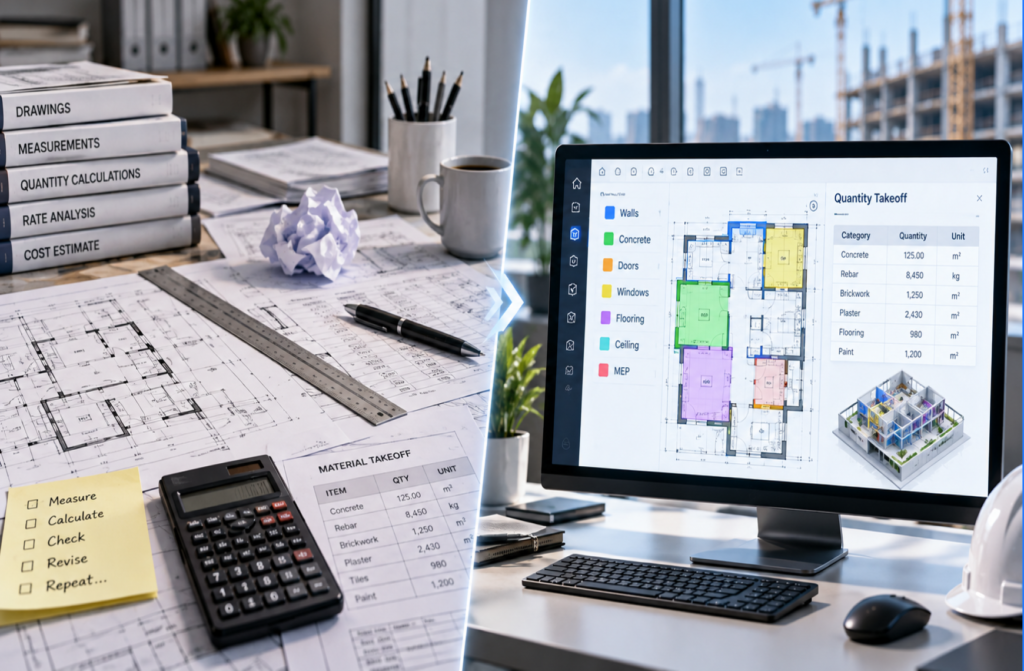
Manual quantity takeoff can take 15 to 20 hours per project with an accuracy range of plus or minus 3 to 5%. Automated quantity takeoff software performs the same task in under an hour, typically within 1 to 2% accuracy, cutting measurement time by 75 to 90%. The real change isn't just speed, it's that estimators spend their time reviewing and pricing instead of measuring. Quantity takeoff software in India also needs local units, IS-code specifications, and GST-ready cost output to be genuinely useful. DesignDrafter builds all of this into its quantity extraction tools for Indian architecture and MEP firms.
Quantity takeoff software replaces hours of manual counting and measuring with a few minutes of automated extraction from your drawings. The real difference between manual estimation vs automated takeoff isn't just speed. It's where the errors happen, and how much of your estimator's day gets spent on typing numbers instead of checking them.
If you've run both processes side by side, you already know manual takeoff isn't bad because people are careless. It's slow because a mid-sized project can take 15 to 20 hours of manual measurement, and every extra hour is another chance for a small mistake to slip through. In my years reviewing estimates for architecture and MEP teams, the projects that lose money rarely lose it on design. They lose it on a takeoff error nobody caught until the bid was already submitted. A good takeoff tool doesn't remove the estimator from the process. It just removes the part of the job that was never a good use of their time.
Quantity takeoff software is a tool that reads architectural or structural drawings and automatically calculates material quantities, area, and counts that would otherwise be measured by hand. It matters because takeoff accuracy is the foundation every cost estimate is built on, and a small quantity error compounds into a much bigger pricing error by the time a bid goes out. RIB Software's overview of quantity takeoff methods makes a similar point: the takeoff stage sets the ceiling on how accurate everything after it can be.
Instead of an estimator scrolling through a PDF with a digital ruler, the software reads the drawing layers directly and pulls out wall lengths, floor areas, door and window counts, and material volumes. That's the basic shift. What changes downstream is how much of the estimator's day is left for actually pricing the job well, rather than just measuring it.
The honest answer is that automated takeoff doesn't just save time, it changes where mistakes happen. Manual takeoff errors usually come from fatigue and repetition. Automated takeoff errors, when they happen, usually come from a drawing that wasn't set up cleanly, which is a much easier thing to catch.
| Manual Takeoff | Automated Takeoff | |
| Time for a mid-sized project | 15-20 hours | Under an hour in most cases |
| Typical accuracy | Around plus or minus 3-5% | Around plus or minus 1-2% |
| Where revisions happen | Full re-measurement | Automatic recalculation |
| Estimator's main task | Measuring | Reviewing and pricing |
These figures line up with what estimating platforms like Palcode.ai and Virtual Estimate have reported from real project comparisons: software-based takeoff can cut measurement time by 75 to 90%, while manual methods stay stuck with a much wider error margin simply because every recheck means starting over by hand.
Quantity takeoff software in India has to handle a few things that generic international tools often miss: local units like square feet and cubic meters used side by side, IS-code material specifications, and GST-ready cost breakups for the final estimate. A tool built without this in mind ends up needing manual correction anyway, which erases most of the time saved.
This is one of the bigger gaps I've seen firms run into when they try an international takeoff tool for an Indian project. The measurements come out fine, but the material categories and rate structures don't match how Indian contractors actually price a job, so someone still has to rebuild the estimate by hand. A quantity takeoff software in India built around local material rates and IS specifications avoids that extra rework entirely.
If you're comparing tools, a few things separate the useful ones from the ones that just look impressive in a demo:
This is the standard we built DesignDrafter's design calculation and quantity extraction tools around. The goal was never to replace the estimator's judgment, just to hand them a verified starting number instead of a blank spreadsheet. For firms handling MEP scope alongside architectural quantities, the same extraction logic carries through to our MEP consultants workflow, so mechanical and plumbing quantities stay consistent with the architectural drawing set they came from.
A few patterns show up again and again in firms that haven't moved off manual estimation yet:
Manual estimation vs automated takeoff isn't really a debate about whether software is more accurate than a person. It's about what the estimator's time actually gets spent on. Automated quantity takeoff software hands over the repetitive measuring work so the estimator can focus on pricing, judgment, and catching the kind of mistakes a tool can't.
For firms in India specifically, the added value is in getting a tool that already speaks the language of local units, material rates, and IS specifications, rather than one that needs manual correction after every run. That's the gap DesignDrafter's quantity takeoff software was built to close.
If your team is still spending full days on manual measurement, it's worth testing an automated run on a real project and comparing the numbers yourself. Check pricing or visit the DesignDrafter homepage to see how it fits into your current estimating workflow.
Founder
Manas Krishna is a Mechanical Engineer and infrastructure technology entrepreneur with 20+ years of experience in MEP (Mechanical, Electrical, and Plumbing) engineering, public health engineering, and transport infrastructure projects across India.
FAQ

Quantity takeoff software is used to automatically calculate material quantities, areas, and counts from architectural or structural drawings. It replaces manual measurement with automated extraction, giving estimators a verified starting point for pricing a project instead of a blank spreadsheet.
Automated takeoff is generally more accurate, typically landing around plus or minus 1-2% versus 3-5% or wider for manual methods. The difference comes from consistency: software applies the same measurement logic every time, while manual counts vary with fatigue, repetition, and how late in the day the estimator is working.
Yes, in practice. Quantity takeoff software in India needs to handle local units, IS-code material specifications, and GST-ready cost breakups. Tools built only for international markets often measure correctly but need manual rework to match local pricing and material categories.
Start with one active project and run both methods side by side before fully switching over. Compare the quantities, check the accuracy against your team’s manual numbers, and confirm the software handles your local units and material categories before relying on it for a live bid.
This usually happens because of how the drawing itself was set up rather than a flaw in the software. Overlapping layers, unlabeled rooms, or inconsistent wall types can throw off automated readings, so it’s worth checking the source drawing before assuming the tool made an error.
It depends on bid volume more than firm size. If your team is spending 15 or more hours per project on manual measurement, automated takeoff usually pays for itself quickly by freeing that time for pricing accuracy and taking on more bids instead.
Takeoff software calculates quantities, how much material and area a drawing represents. Estimating software takes those quantities and applies pricing, labor, and overhead to produce a final cost. Many platforms combine both, but they solve two distinct steps in the same process.
No. Automated takeoff removes the manual measurement step, not the judgment involved in pricing, negotiating rates, or accounting for site-specific conditions. Estimators still review, adjust, and finalize the numbers the software produces before anything goes into an actual bid.
DesignDrafter is built specifically for this, combining automated quantity extraction with Indian material rates, units, and MEP-consistent output. It’s designed for architecture and MEP firms that want verified quantities without rebuilding the estimate by hand afterward, on every single project.
Based on industry-reported comparisons, automated takeoff can cut measurement time by 75 to 90% compared to manual methods on a similar project. The exact savings depend on drawing complexity and how well the source file is set up before the software reads it.
May 4 , 2026

April 16 , 2026

September 15 , 2026