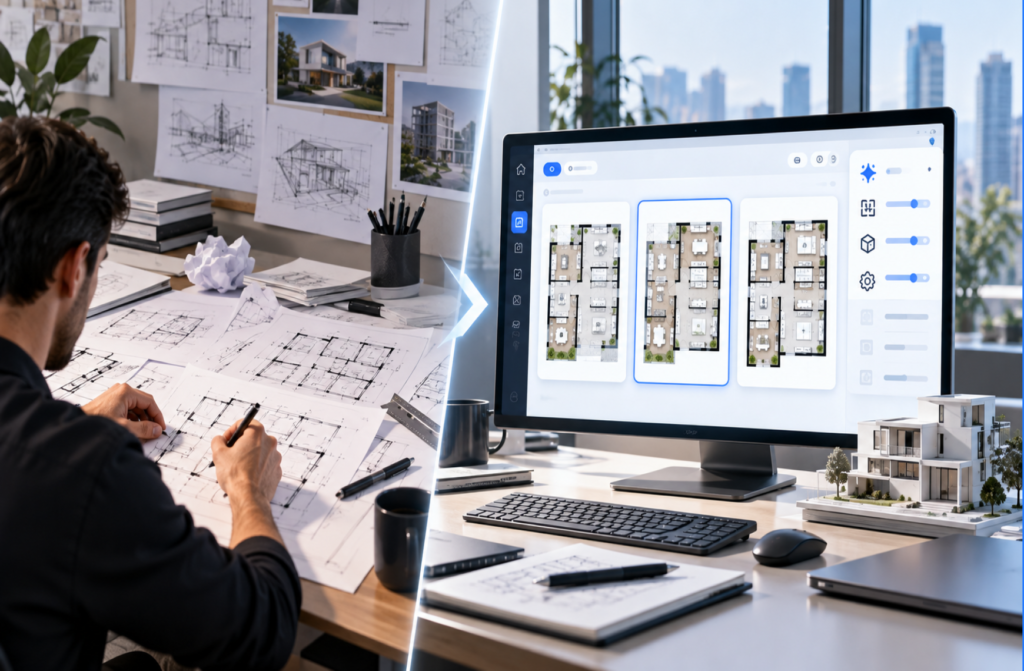
In Short
Architecture firms are cutting concept design time roughly in half by using AI floor plan generators to produce multiple layout options upfront, then applying human judgment only to the strongest ones. A 2026 survey of nearly 800 architects found 60% of firms now use AI, and 86% of users report measurable time savings, with concept design as the biggest gain area. Mid-sized firms report saving 10 to 15 or more hours weekly. AI handles the repetitive generation work, not final design decisions. DesignDrafter's AI design agent applies this approach with compliance built into every generated layout.
Architecture firms are cutting concept design time roughly in half by letting an AI floor plan generator handle the first round of layouts, then spending human hours on refinement instead of blank-page drafting. That single shift, generate first, refine second, is behind most of the time savings firms report right now.
It's not a small trend either. A 2026 survey of nearly 800 architects and designers by Chaos and Architizer found that 60% of architecture firms now use AI in some part of their workflow, up sharply from just a few years ago, and 86% of those users report measurable time savings. If you run a firm and you're still treating concept design as a purely manual phase, you're leaving hours on the table every single week. In my decade working alongside architecture practices on their digital workflows, the firms making the fastest progress aren't the ones chasing every new AI tool. They're the ones who figured out exactly where AI for architecture firms actually pays off, which turns out to be concept design far more than any other stage.
AI for architecture firms at the concept stage means software that takes plot dimensions, room programs, and site constraints and generates a workable first-pass layout in minutes. It matters because concept design has always been the slowest, most iteration-heavy part of a project, and it's exactly where automation removes the most repetitive work.
This isn't rendering software or a rendering plug-in, and it's worth separating the two. AI concept design tools generate the actual layout logic (room adjacencies, circulation, structural grid) while rendering tools just make an existing design look polished. The Chaos and Architizer report found that 48% of designers say concept design and ideation is where AI delivers the biggest efficiency gains, ahead of image enhancement, material selection, or any later-stage task. That tracks with what I've seen directly: the earlier in a project AI gets involved, the more hours it saves, because early iteration is where a firm burns the most billable time without producing a deliverable a client can actually see.
Concept design is slow because it's inherently iterative. A junior architect might draft, discard, and redraft a dozen layout options before one satisfies the brief, the site, and the budget, and each pass takes hours even for an experienced team.
Every constraint, room count, orientation, structural grid, parking ratio, plot shape, has to be checked against every other constraint by hand. Change one wall and three adjacent rooms need rechecking. This is exactly the kind of repetitive, rules-based work that floor plan automation is built for, and it's also why firms that skip AI at this stage tend to spend disproportionate time on work that never reaches a client presentation. A junior team might spend three to five days getting to a first concept a partner is happy to show. With architectural layout automation doing the first pass, that same milestone often lands in a single day, with the remaining time spent on judgment calls rather than mechanical redrafting.
Firms cut concept design time by using AI to generate multiple layout options upfront, then applying human judgment only to the options worth developing further, instead of manually drafting every option from scratch.
Here's roughly how the time breaks down between a traditional workflow and one built around an AI floor plan generator, based on patterns reported across the 2026 Chaos and Architizer survey and firm workflows I've reviewed directly:
| Concept Design Task | Traditional Workflow | AI-Assisted Workflow | Typical Time Saved |
|---|---|---|---|
| Generating initial layout options | 2-3 days | 2-4 hours | ~70% |
| Testing room adjacency and circulation | 1-2 days | Same-day iteration | ~60% |
| Checking basic compliance (setbacks, FSI) | 0.5-1 day | Minutes, if built into the tool | ~80% |
| Preparing partner/client presentation set | 1 day | Half a day | ~50% |
The survey backs this up at the firm level too: 59% of AI users save at least 5 hours a week, and mid-sized firms with 50 to 99 employees see the largest gains, with 30% reporting 10 to 15 or more hours saved weekly. Cutting concept design time in half isn't marketing language here. It's roughly what firms of that size are already reporting.
Most firms that get real time savings from floor plan automation follow a version of this sequence:
The time saved isn't in step five, where human judgment still matters most. It's in steps one through four, which is exactly the part traditional workflows spend the most hours on for the least differentiated output.
Not every AI concept design tool delivers on the time savings it promises, and firms that skip due diligence often end up with layouts that still need heavy manual rework. A few recurring issues to check for before committing:
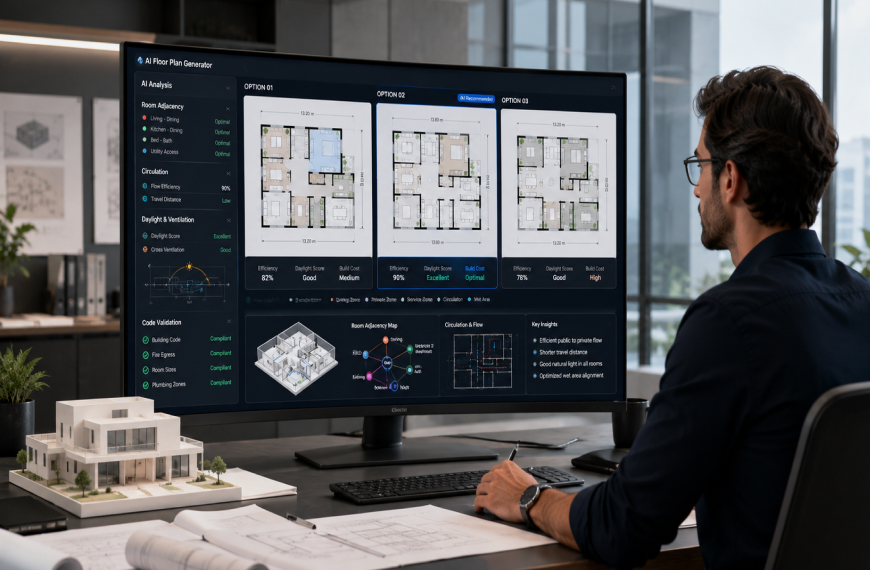
DesignDrafter was built around this exact gap: giving firms floor plan automation that produces a genuinely usable first-pass concept, not just a rough sketch that needs redrawing. The platform's AI design agent generates layout options based on plot data and room programs while applying local compliance logic during generation, so the shortlisting step in a firm's workflow starts from options that are actually buildable.
From working with architecture practices adopting this kind of tool, the firms that see the fastest time savings are the ones that treat AI as the first-pass generator and keep their own team focused on judgment calls, client fit, and detailing. That's the model DesignDrafter's architects solution is built around, and it's covered in more depth in our breakdown of AI floor plan generators for Indian architects, which looks at how different tools handle this handoff between generation and refinement.
AI floor plan generation is replacing the repetitive, rules-based part of concept design, not the architect's judgment. Firms still decide which layout fits the brief, the client, and the site; AI just removes the hours spent manually generating and testing options before that decision gets made.
The ArchDaily coverage of architect expectations for AI in 2026 echoes this alongside the Chaos and Architizer data: 70% of architects say AI-generated output reflects their design intent, but still needs professional review and refinement before it goes anywhere near a client. That's a meaningful number because it shows firms aren't treating AI output as final. They're treating it as a fast first draft, which is precisely the role concept design has always needed filled fastest. Interestingly, the same report found ethical concerns about AI in architecture dropped from 74% in 2024 to just 26% in 2026, largely because firms that actually used these tools found the fear didn't match the reality of working alongside them.
Architecture firms cutting concept design time in half aren't relying on AI to make final design decisions. They are using AI floor plan generators to handle the repetitive, rules-based work of generating and testing layout options, then applying their own judgment to the results that actually matter.
The data backs this up clearly: 60% of firms already use AI, 86% of those users report measurable time savings, and concept design is where 48% of designers say the gains are biggest. Architectural layout automation and floor plan automation aren't replacing architects. They're removing the busywork that used to eat the first week of every project.
If your firm is still spending days on manual first-pass layouts, that's the easiest place to start. Try DesignDrafter's AI floor plan generator on a real project brief and see how much of that concept design timeline you can hand off, or check current pricing to see what fits your firm's workflow.
Founder
Manas Krishna is a Mechanical Engineer and infrastructure technology entrepreneur with 20+ years of experience in MEP (Mechanical, Electrical, and Plumbing) engineering, public health engineering, and transport infrastructure projects across India.
FAQ

AI concept design is the use of software to generate early-stage floor plan layouts and design options based on plot data, room requirements, and site constraints. It replaces the manual first-draft phase of a project, letting architects start from generated options rather than a blank page.
According to a 2026 survey of nearly 800 architects by Chaos and Architizer, 59% of AI users save at least 5 hours a week, and mid-sized firms of 50 to 99 employees report the largest gains, with 30% saving 10 to 15 or more hours weekly, largely at the concept design stage.
Neither replaces the other entirely. Architectural layout automation is faster for generating and testing multiple options early on, while manual drafting still handles the aesthetic and client-specific judgment calls. Most firms get the best results combining both rather than picking one.
Start with the concept stage alone, since that’s where AI delivers the most measurable time savings without disrupting later project phases. Generate multiple layout options with the tool, have your team shortlist and refine manually, then integrate detailing and documentation workflows once the concept process is proven out.
This usually happens when the tool’s output still needs a heavy manual compliance or quality check, which cancels out the time saved during generation. Confirm the generator applies your local building rules and produces genuinely refinable layouts, not just a fixed image.
Given that 60% of firms already use AI in some part of their workflow as of 2026, waiting mostly means falling behind on efficiency rather than avoiding risk. Starting with concept design specifically, the stage with the clearest reported time savings, is a lower-risk way to adopt it.
Yes. DesignDrafter’s AI design agent is built to generate compliant, refinable concept layouts from plot and room data, aimed specifically at firms that want to cut concept design time without sacrificing output quality, local compliance accuracy, or the client’s trust in the final result.
Track the hours your team spends between project kickoff and a partner-approved concept before and after adopting the tool. If that window shrinks by roughly half without an increase in manual rework afterward, the tool is delivering the time savings it claims.

May 9 , 2026
July 22 , 2026

July 15 , 2026