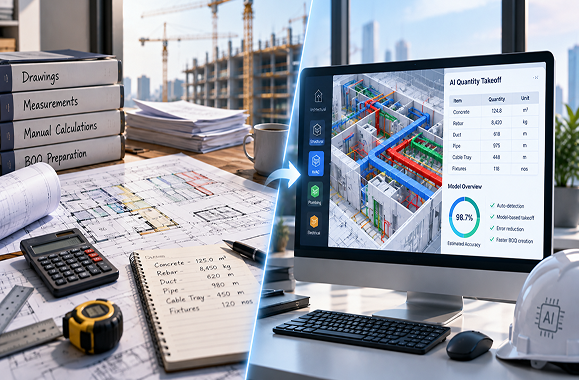
In Short
A manual BOQ still has a place, especially on small, simple scopes where an experienced estimator can measure everything accurately in an hour or two. But once a project gets large, repetitive, or subject to frequent design changes, the accuracy math favors AI quantity takeoff software. The 95 to 98 percent range it typically delivers isn't just faster than manual work, it's measurably more reliable across a full drawing set.
Good AI quantity takeoff software now lands within 1 to 3 percent of actual quantities on most line items, while a manual BOQ typically runs 5 to 15 percent off depending on who prepared it and how complex the drawing set is. That gap is the whole story behind this benchmark.
I have spent years checking BOQs against site measurements for clients, and the pattern is consistent. Manual takeoff isn't bad because estimators are careless. It's slow, repetitive, and every extra hour spent scrolling through drawings adds a chance to miss a wall, misread a scale, or copy a number wrong. AI BOQ software doesn't get tired on page 40 of a drawing set. That's the real source of the accuracy difference, not some magic algorithm.
AI quantity takeoff software reads drawings or BIM models and calculates quantities automatically instead of a person measuring each item by hand. Accuracy on well-prepared drawings usually falls between 95 and 98 percent, according to figures reported across AI takeoff platforms.
That accuracy isn't uniform across every task though. Linear measurements like wall length or pipe runs tend to score highest, often 97 to 99 percent. Counting discrete items such as doors or fittings runs a little lower, closer to 94 to 97 percent. Complex assemblies, where multiple systems overlap, are the hardest for any tool, human or software, landing around 90 to 95 percent. Automated quantity takeoff is strong, not flawless, and knowing where it's weaker matters more than knowing the headline number.
The accuracy gap mostly comes from fatigue and inconsistency, not skill. A manual BOQ depends on one person staying sharp through hundreds of measurements, and small errors compound across a large drawing set in a way automated tools simply do not experience.
Manual takeoff error rates commonly sit between 5 and 15 percent, and on a large project that's not a small number. Take a 10 million dollar project with 1 million rupees or dollars worth of materials in scope. A 10 percent error there is 100,000 in materials alone, which can eat an entire project's margin on its own. A peer-reviewed study on BIM-based takeoff systems found one validated case where automated analysis caught a 39 percent inconsistency in wall material quantities that a manual 2D-based method had missed completely. That's not a rounding error. That's the kind of gap that changes a budget.
Here's a simple side-by-side based on how these two approaches typically perform on a mid-sized project:
| Factor | Manual BOQ | AI Takeoff Software |
| Typical accuracy | 85 to 95 percent | 95 to 98 percent |
| Time on a mid-sized project | 15 to 20 hours | Under 1 hour |
| Consistency across a large drawing set | Drops as fatigue sets in | Stays constant |
| Best suited for | Small, simple scopes | Any scope, especially large or repetitive ones |
Time savings from switching to automated takeoff commonly run 75 to 90 percent, with several industry reports converging around 80 percent. That's the headline most firms care about, but the accuracy improvement is the part that actually protects the budget.
Automated quantity takeoff reads every element in a drawing or model the same way every time, so it doesn't skip items or lose count the way a tired estimator might late in a long BOQ. That consistency is where most of its accuracy advantage comes from.
It also helps that a model-based system can flag a design change immediately. If a beam size shifts or a wall gets removed, the tool recalculates the affected quantities right away instead of waiting for the next manual pass. A manual BOQ update after a design change often means re-checking the whole drawing again, and that's exactly the kind of repeat work where copy errors creep in. You can see how DesignDrafter's design calculation tools carry these updates through the rest of a project once the initial takeoff changes.
Don't take any AI construction estimation tool's accuracy claim at face value. Run this quick check before trusting it on a real project.
This takes an hour or two the first time and saves far more than that once you trust the output.
A few habits show up again and again in manual BOQs that come in less accurate than they should be.
A manual BOQ still has a place, especially on small, simple scopes where an experienced estimator can measure everything accurately in an hour or two. But once a project gets large, repetitive, or subject to frequent design changes, the accuracy math favors AI quantity takeoff software. The 95 to 98 percent range it typically delivers isn't just faster than manual work, it's measurably more reliable across a full drawing set.
If you want to see how this holds up on your own drawings, try DesignDrafter's quantity extraction tool on a project you've already estimated manually and compare the two side by side. You can also read our breakdown of manual estimation vs automated takeoff for more on how the two approaches differ day to day, or check pricing to see what fits your team. Visit the DesignDrafter homepage to see the full platform.
Founder
Manas Krishna is a Mechanical Engineer and infrastructure technology entrepreneur with 20+ years of experience in MEP (Mechanical, Electrical, and Plumbing) engineering, public health engineering, and transport infrastructure projects across India.
FAQ

AI BOQ software is a tool that reads architectural or BIM drawings and automatically generates a bill of quantities, replacing manual line-by-line measurement. It calculates areas, lengths, and counts directly from the drawing data, typically finishing in minutes what a manual takeoff takes hours to complete.
Automated quantity takeoff typically reaches 95 to 98 percent accuracy, while manual estimating commonly runs 5 to 15 percent off depending on drawing complexity and estimator fatigue. The gap tends to widen on larger, more repetitive drawing sets where manual errors compound over hundreds of measurements.
For large or complex projects, AI takeoff is generally more reliable simply because it doesn’t lose consistency across hundreds of measurements. That said, a manual review of the AI output on a few key items is still worth doing before finalizing a big budget.
Start by running the AI tool alongside your existing manual process on one project, then compare results line by line. Once you trust the accuracy on your typical drawing types, shift full projects over while keeping spot checks in place for unusual scopes.
This usually means a scale mismatch, a missing or hidden layer in the drawing, or a genuinely outdated manual figure. Check the drawing revision first, since a manual BOQ based on an older file will disagree with an AI takeoff run on the current one.
It can be, mainly for the time saved rather than the accuracy gain, since small scopes are easier for a person to measure accurately anyway. The bigger payoff shows up on projects with repetitive elements or frequent design revisions that would otherwise mean redoing the takeoff by hand.
Most manual BOQ errors come from fatigue over a long drawing set, outdated revisions, and early rounding that compounds across hundreds of line items. Very few come from an estimator not understanding the drawing, it’s usually a volume and consistency problem, not a skill problem.
Yes, though accuracy varies slightly by discipline. Linear items like pipe or duct runs score highest, while complex MEP assemblies with overlapping systems tend to sit at the lower end of the accuracy range, closer to 90 to 95 percent instead of the high 90s.
No. AI takeoff handles the repetitive measurement work, but someone still needs to review the output, apply rates, and account for site conditions the drawing doesn’t show. It changes what an estimator spends time on, not whether one is needed.
Re-run it every time a drawing revision changes quantities meaningfully, not just at major milestones. This is one area where automated quantity takeoff has a clear edge, since it recalculates affected items in minutes instead of requiring a full manual recheck.
May 25 , 2026
July 30 , 2026
July 14 , 2026