In Short
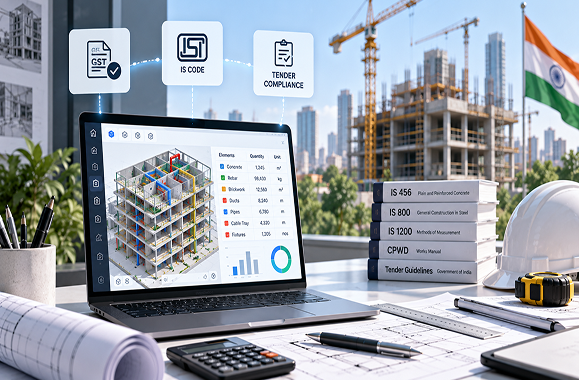
The best construction takeoff software India teams use for tenders applies GST correctly by material category, follows IS 1200 measurement rules, and exports BOQs in CPWD and state PWD formats. Works contract services carry a flat 18 percent GST, while cement sits at 28 percent and most other materials at 18 percent, so a single BOQ often spans two tax rates. IS 1200 covers close to 30 parts of measurement standards across every trade. Tender BOQs are commonly rejected for format mismatches rather than pricing issues. DesignDrafter builds GST, IS Code, and tender format compliance directly into its quantity extraction tools.
The best construction takeoff software India teams use in 2026 does three things well. It applies GST correctly by material category, it measures quantities the way IS Code expects, and it produces a BOQ a government or private tender will actually accept. Most tools only manage one or two of these. That gap is what this comparison looks at.
A lot of BOQ software India teams rely on was built for general estimation, not for the specific mix of tax rules, measurement standards, and tender formats that Indian projects run on. That mismatch shows up late, usually when a bid gets rejected on a technicality or an invoice gets flagged during a GST audit. In my years reviewing estimation workflows for contractors and consultants, the software choice rarely fails on the big things. It fails on the small compliance details nobody checked until it was too late.
This comparison walks through what tender ready actually means, why GST and IS Code compliance need to sit inside the takeoff process rather than after it, and how a few well known tools in this space stack up against each other on those three points.
Tender ready quantity takeoff software produces a BOQ that matches the item codes, units, and rate references your tendering authority expects, without manual reformatting. It also needs to hold up under a GST audit and follow IS Code measurement rules, since a tender BOQ that fails any of these can be rejected outright or renegotiated after the fact.
Most software gets partway there. It might generate accurate quantities but export them in a generic format that still needs hours of manual rework before a CPWD or state PWD tender will accept it. Or it measures correctly but has no GST logic built in, leaving your billing team to apply tax rates by hand for every line item. True tender readiness means all three pieces work together in the same document, not as separate manual steps bolted onto each other.
Think of a mid sized civil contractor bidding on a state PWD road project. Their estimator can produce accurate cubic metres of concrete and tonnes of steel in an afternoon using almost any takeoff tool. The part that actually takes time, and where bids get delayed or rejected, is reformatting that output to match the PWD's specific BOQ template, applying the right GST split across materials and labour, and making sure every item code lines up with the schedule of rates the tender references. That reformatting step is exactly what tender ready software is supposed to remove.
GST compliance matters because construction materials in India do not sit under one tax rate. Works contract services are taxed at a flat 18 percent under GST 2.0, but the materials inside that same BOQ can span multiple slabs, and getting this wrong on a large tender means real money at audit time.
Cement and ready mix concrete sit at 28 percent GST, while steel, bricks, tiles, sand, and plumbing supplies mostly sit at 18 percent, according to current GST rate guidance for construction materials. A single BOQ line for concrete work can quietly mix a 28 percent material cost with an 18 percent service cost if your estimation software does not separate them out.
Here is a simple example. Say a BOQ item for RCC slab work is valued at 10 lakh rupees, split roughly 60 percent material and 40 percent labour and service. If the software applies one flat rate across that entire line, the tax shown on the invoice will not match what a GST officer expects to see when they check the material versus service breakup. Splitting it correctly, 28 percent on the cement heavy material portion and 18 percent on the works contract service portion, is a small calculation but an easy one to get wrong by hand across dozens of BOQ lines on a large project.
Add the compliance basics on top, correct HSN code 9954 for construction services, the right GSTIN references, and IGST versus CGST and SGST depending on whether the project crosses state lines, and it becomes clear why GST estimation software needs to be built for this from the start rather than patched on afterward. The full GST on works contract rules for 2026 confirm the flat 18 percent rate on works contract services itself, separate from the material rates above.
IS Code quantity takeoff means measuring earthwork, concrete, masonry, steel, and finishing items using the units and precision rules set out in IS 1200, so quantities match the billing format a tender or contractor expects. Skipping this standard is one of the most common reasons two teams arrive at different quantities for the same drawing.
IS 1200 is published across close to 30 parts, covering everything from earthwork and formwork to steel work, plastering, and painting. It sets simple rules that are easy to skip under deadline pressure. Single items get counted in numbers, linear work gets measured in running metres, surfaces in square metres, and volumes in cubic metres, each rounded to a set precision such as the nearest 0.01 square metre for area or 0.01 cubic metre for volume. Software that hardcodes these units and rounding rules into its takeoff logic produces quantities that match what a tender scrutiny committee or a client's quantity surveyor expects. Software that leaves this to the user is only as accurate as whoever is measuring that day.
This matters more than it sounds like on paper. Two estimators measuring the same brickwork drawing can land on different totals if one uses square metres and the other uses cubic metres without realizing the code specifies volume for that item. On a small job that gap might be a rounding error. On a large tender it can be the difference between a bid that matches the client's own quantity surveyor's numbers and one that gets sent back for reconciliation before payment is even discussed.
A BOQ that gets the numbers right but misses the format, tax split, or measurement standard does not just cause paperwork delays. It changes the outcome of the bid itself.
A technical scrutiny committee reviewing a CPWD or state PWD tender checks the BOQ format against a standard template before it even looks at the price. A mismatch here can get a bid disqualified before pricing is compared, regardless of how competitive the rate was. On the tax side, an incorrect GST split does not usually block a bid, but it creates a problem later, at the input tax credit stage or during a routine GST audit, when the material and service portions on file do not match what was actually invoiced. And on measurement, a quantity that does not match IS 1200 units can trigger a reconciliation process with the client's own quantity surveyor, which slows down running bill payments on an active project. None of these are dramatic failures on their own. Together, they are why compliance needs to be built into the takeoff step, not checked afterward.
None of these tools are identical once you look past the marketing page, and the differences show up fastest on the tax and format side rather than the raw measurement side, since most established software measures reasonably well. Here is how a few well known options in the Indian market handle these three areas, based on their published features and documentation:
| Software | GST Ready Billing | IS Code Measurement | Tender BOQ Export |
| DesignDrafter | Built in, by material category | Yes, IS 1200 aligned | Yes, CPWD and state PWD formats |
| ibeam.ai | Limited, no India tax logic | Partial | Generic export only |
| CostX (Exactal) | Manual tax setup required | Yes, configurable | Yes, with setup |
| Generic Excel BOQ templates | Fully manual | Depends on the user | Manual reformatting needed |
DesignDrafter is the only option here built around Indian tax and code requirements from the ground up rather than added as a workaround. ibeam.ai remains a capable takeoff tool but has no India specific tax logic, consistent with its lack of local market localization. CostX can get you there but expects your team to configure the tax and format rules manually. Plain Excel templates work for small jobs but put the entire compliance burden on whoever built the sheet.
A CPWD BOQ and DSR rate analysis guide is a useful reference for what a scrutiny committee actually checks line by line. Before you commit to a tool, run through this short checklist on a real project file, not a demo:
These mistakes come up often enough in reviewed BOQs that they are worth checking for directly:
DesignDrafter's quantity extraction tools were built specifically around this gap, applying GST by material category and following IS 1200 measurement rules as part of the takeoff itself, not as a manual step after. The platform's design calculation features carry that same logic through to structural quantities, so the numbers stay consistent from concept through to the tender document. We cover the broader manual versus automated question in our quantity takeoff software comparison, which is a useful companion read if you are still deciding whether to automate this process at all. You can see the platform itself on the DesignDrafter homepage.
For a firm bidding on CPWD or state tenders regularly, the time saved is not just in generating quantities faster. It is in not having to redo a BOQ after a tender scrutiny committee flags a format or tax error, which is a slower and more expensive fix than getting it right the first time. That redo cycle, correcting quantities, resplitting GST, and reformatting for resubmission, often takes longer than the original takeoff did, which is exactly the cost this kind of software is meant to remove.
Construction takeoff software India teams choose should not force a trade off between speed and compliance. GST estimation software, IS Code quantity takeoff, and tender ready BOQ export are not three separate features to shop for. They are one requirement, and the tools that treat them as one are the ones that hold up when a bid actually gets scrutinized. If you are comparing options for your next tender, test the checklist above on your own project data before you decide, and see current pricing if DesignDrafter looks like a fit.
Founder
Manas Krishna is a Mechanical Engineer and infrastructure technology entrepreneur with 20+ years of experience in MEP (Mechanical, Electrical, and Plumbing) engineering, public health engineering, and transport infrastructure projects across India.
FAQ

Quantity takeoff software measures materials and work items from drawings to produce a bill of quantities, used for cost estimation, tendering, and billing. In India, it also needs to apply the correct GST rate and follow IS Code measurement rules to be usable for a real tender submission.
Works contract services in India are taxed at a flat 18 percent under GST 2.0. Materials within the same project can fall under different slabs, with cement and ready mix concrete at 28 percent and most other materials like steel, bricks, and tiles at 18 percent.
Dedicated BOQ software is generally better for tenders since it applies GST and IS Code rules automatically and can export tender ready formats. Excel templates work for small jobs but put the full compliance burden on whoever built the sheet, which raises the risk of errors on larger bids.
Measure each trade using the specific unit IS 1200 assigns to it, such as running metres for linear work or cubic metres for concrete volume, and round to the precision the code specifies. Software built around IS 1200 does this automatically rather than leaving it to manual judgment.
Tender BOQs are commonly rejected for format mismatches against the required CPWD or PWD template, incorrect measurement units, or missing GST and HSN code details. Checking the export format against a real tender template before submission catches most of these issues early.
Yes, if the software specifically builds in Indian GST and IS Code logic rather than treating them as optional add-ons. Generic international takeoff tools often lack this compliance layer, which shifts the work back to your team regardless of how fast the initial takeoff runs.
GST estimation software applies India specific tax rates by material category, tracks HSN codes, and separates works contract service tax from material tax automatically. Regular estimation software usually leaves all of this to be applied manually after the quantities are generated.
Yes. DesignDrafter’s quantity extraction tools apply GST by material category, follow IS 1200 measurement standards, and export BOQs in CPWD and state PWD tender formats, aimed at contractors and consultants who need submission ready documents rather than raw quantity data to rework manually.
IS 1200 is published across close to 30 parts, each covering a different trade such as earthwork, steel work, or painting. This matters because a takeoff tool needs to apply the correct part’s unit and rounding rules to every trade, not one generic standard across the whole project.
Missing or incorrect HSN codes can delay input tax credit claims and create problems during a GST audit, even if the underlying quantities and costs are accurate. Construction services generally fall under HSN code 9954, and this should appear on every relevant invoice line.

April 16 , 2026
May 6 , 2026

September 22 , 2026