The building design industry has always demanded a careful balance between speed, technical accuracy, and cross-discipline coordination. For decades, architects and MEP engineers have relied on separate software tools, manual checklists, and rounds of back-and-forth communication to move a project from concept to construction-ready documentation. That workflow is now changing at its core.
An AI design agent is a purpose-built, intelligent software system that understands the full context of a building design project and can independently execute complex engineering tasks. Unlike a standard AI assistant that responds to one-off questions, an AI design agent for building engineering operates as a genuine copilot. It remembers your project parameters, interprets design rules, coordinates between disciplines, and executes multi-step workflows from floor plan generation and MEP design calculations through to quantity takeoff extraction and documentation preparation.
Think of it this way. A regular AI tool might answer the question "What is the recommended duct size for this HVAC zone?" An AI design agent, on the other hand, takes the full project context into account, runs the HVAC sizing calculation across every zone, validates the results against ASHRAE and ISHRAE standards, generates the layout drawing, extracts the bill of quantities, and prepares the documentation package, all within a single, connected workflow. The difference is not incremental. It is foundational.
The term "agent" matters here because it signals autonomy. These systems do not simply assist. They execute. They handle the repetitive, time-consuming, and error-prone stages of building design so that architects and engineers can focus on creative problem-solving and high-level decision-making.
Every architect, MEP consultant, or design firm working on mid-to-large-scale projects understands a painful truth. The majority of project time is not spent on creative design. It is spent on calculations, coordination, documentation, revisions, and error correction. Research from McKinsey has consistently highlighted that the construction and design industry lags behind other sectors in productivity growth, with a significant portion of project budgets lost to rework and coordination failures.
The consequences are serious. Manual MEP design calculations are prone to human error, especially when engineers must handle electrical load analysis, HVAC sizing, plumbing system design, and fire safety compliance across dozens or hundreds of rooms in a single building. When one calculation changes, every downstream document, from the layout drawing to the quantity schedule, must be updated. The cascading effect of a single revision can cost days of rework.
Multi-discipline coordination adds another layer of complexity. Architectural floor plans must align with structural requirements. MEP routing must avoid clashes with beams, columns, and other services. Every design decision ripples across the project. In traditional workflows, catching these coordination failures requires manual review meetings, overlay checks, and extensive communication between teams.
This is exactly where AI design agents solve a fundamental workflow problem. Rather than automating one narrow task, they sit at the center of the project and orchestrate the entire design process. An intelligent AI copilot for engineers can run design calculations, produce coordinated layouts, flag compliance gaps, extract quantities, and maintain documentation consistency across every revision, without waiting for human intervention at each step.
The need is not theoretical. Firms that fail to adopt AI-powered building design automation software risk falling behind on project timelines, losing competitive bids, and accumulating costly rework expenses.
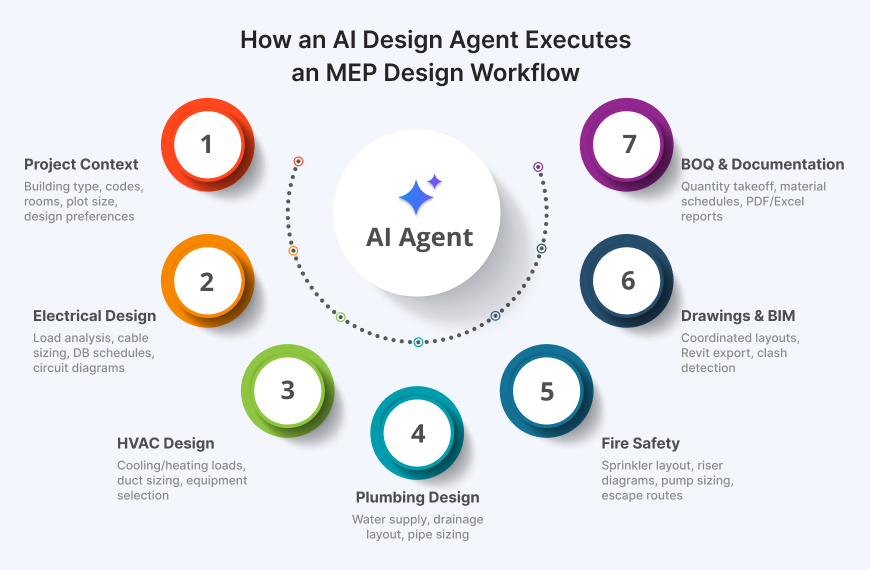
Understanding the mechanics behind an AI design agent helps clarify why this technology delivers results that isolated AI tools cannot.
At the foundation, an AI design agent for building design combines several layers of intelligence. The first layer is contextual memory. When you define a project inside the agent, specifying the building type, plot dimensions, number of floors, room requirements, local codes, and design preferences, the agent retains this context permanently. Every subsequent task the agent performs draws on this stored understanding. You never need to re-explain your project parameters.
The second layer is task orchestration. A single instruction, such as "generate the electrical design for Building A, Floors 1 through 5," triggers a sequence of interconnected operations. The agent interprets the floor plan layout, identifies room types, applies lighting load calculations per IS/IEC standards, runs cable sizing, generates distribution board schedules, produces circuit diagrams, creates coordinated 2D drawings, and extracts the electrical BOQ. These are not separate requests. The agent executes the full chain. This is the same kind of end-to-end intelligence that powers the DesignDrafter AI Design Agent.
The third layer is standards validation. Building codes and engineering standards differ by region, building type, and discipline. A capable AI design agent has these standards embedded in its logic. Whether the project requires compliance with ASHRAE, NBC, NFPA, IS:1172, ECBC, or ISHRAE, the agent validates every calculation output against the relevant standard before finalizing the documentation. This eliminates the risk of non-compliant designs reaching the approval stage.
The fourth layer is iterative learning. As you work with the agent across multiple projects, its understanding of your firm's design preferences, preferred product brands, documentation formats, and workflow patterns deepens. This makes every subsequent project faster and more aligned with your standards.
The capabilities of AI design agents have expanded significantly. Here is what the best platforms offer today across architectural and MEP engineering disciplines.
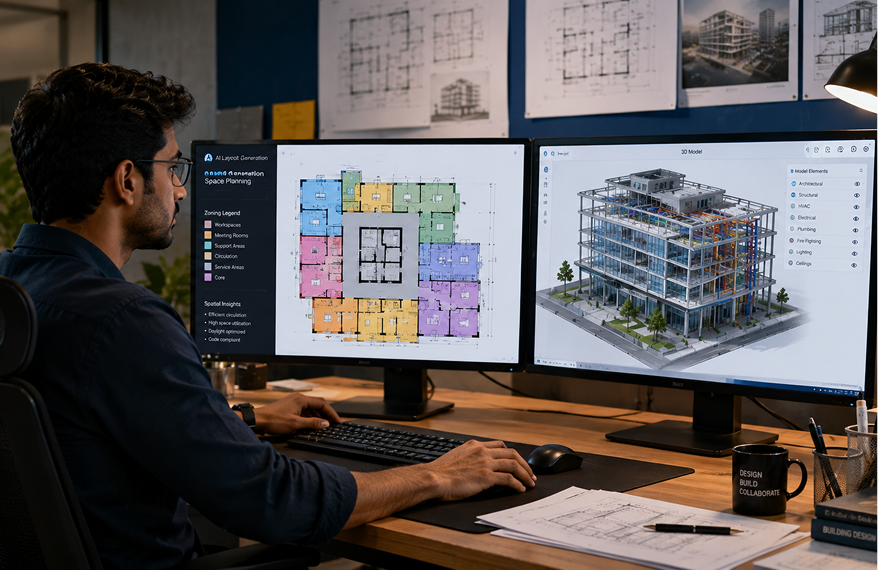
AI design agents generate intelligent, build-ready floor plans from structured inputs such as room count, area constraints, adjacency rules, and building type. The agent explores multiple layout options, optimizes space planning, and validates code compliance automatically. Architects can iterate on designs in real time, testing alternatives and refining arrangements on a single interactive canvas. Interior rendering and facade visualization features allow teams to present design intent to clients directly from the generated plan. DesignDrafter's AI Floor Plan Generator is a leading example of this capability in action.
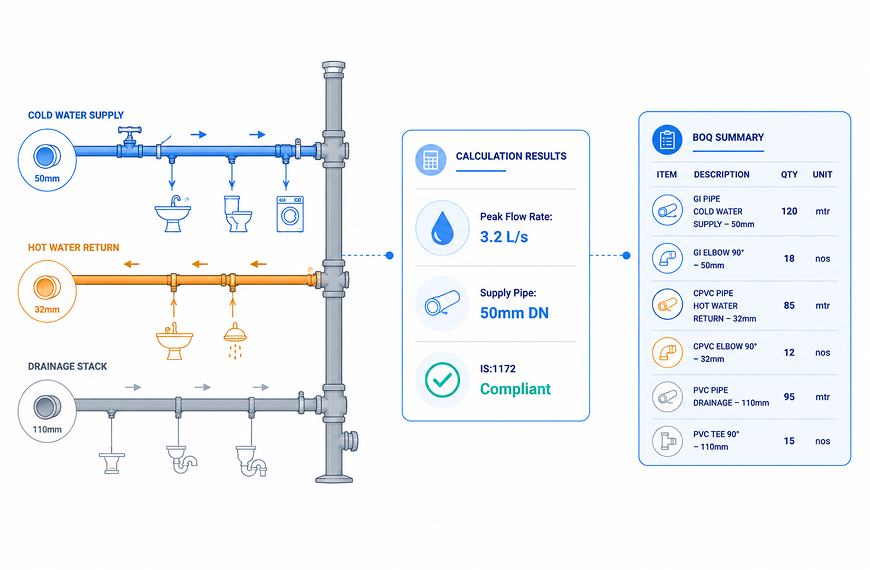
This is where AI agents deliver the most dramatic time savings. A single agent can perform electrical load calculations, HVAC cooling and heating load analysis, plumbing water supply and drainage sizing, and fire safety system design. Each calculation module runs against the relevant engineering standards, producing validated outputs that are ready for submission. The agent handles room-by-room and zone-based analysis, accounts for diversity factors, and generates structured reports in PDF and Excel formats. Learn how this works across all four MEP disciplines in this complete guide to AI-powered MEP design calculations.
Once calculations are complete, the AI design agent converts the validated design data into coordinated MEP and architectural drawings. These layouts include equipment placement, ductwork routing, piping networks, cable tray paths, and fixture schedules. The generated drawings are BIM-ready, meaning they can be directly imported into Revit or other BIM authoring tools. For teams already working in Revit, the agent can convert legacy 2D CAD files into intelligent 3D Revit models, complete with annotations, sheet creation, and clash resolution. DesignDrafter's Smart BIM Automation and Drawing Development module handles this entire workflow within a single platform.
AI design agents extract accurate material quantities directly from the design data and layout drawings. The output is structured, BOQ-ready, and includes item markups, brand specifications, and editable line items. This eliminates the manual takeoff process, which is traditionally one of the most time-consuming and error-prone stages of project estimation. For a deeper look at how this works, read the AI Quantity Takeoff Software guide or explore the DesignDrafter Quantity Takeoff module.
Building product selection is another area where AI agents add value. The agent can compare MEP equipment, lighting fixtures, HVAC units, panels, and other building products side by side using detailed technical parameters. This enables engineers to make data-driven procurement decisions with confidence, rather than relying on incomplete spec sheets or vendor sales pitches. The DesignDrafter Product Comparison tool allows teams to evaluate and select products within the same platform they use for design and documentation.
Throughout every task, the AI design agent continuously validates outputs against industry codes. Electrical designs are checked against IS/IEC standards. HVAC outputs are validated per ASHRAE and ECBC. Fire safety layouts are verified against NBC and NFPA. Plumbing systems are checked against IS:1172 and UPCI. This built-in compliance layer ensures that every design package is audit-ready before it leaves the platform.
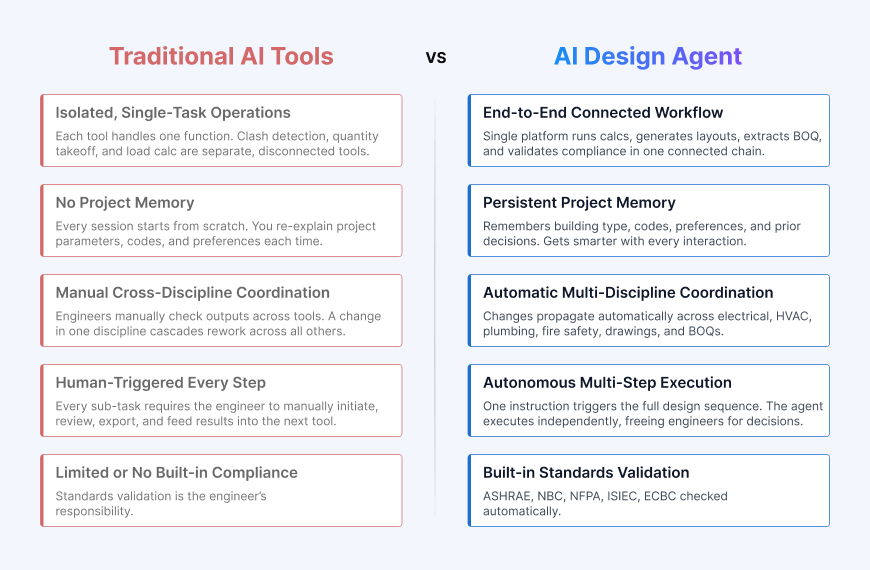
It is important to distinguish between an AI design agent and the simpler AI tools that have existed in the AEC industry for several years. Traditional AI tools operate in isolation. An AI-powered clash detection tool, for example, scans a BIM model for conflicts and flags them. That is valuable, but it requires a human engineer to resolve each conflict manually, update the model, and re-run the check. Similarly, an AI quantity takeoff tool might extract material counts from a drawing, but it has no awareness of the design calculations that produced that drawing.
An AI design agent operates differently because it connects every stage of the workflow. The calculations inform the layouts. The layouts feed the BOQ. The BOQ reflects the validated design. Every output is inherently coordinated because a single intelligent system produced the entire chain. This end-to-end connectivity is what eliminates the rework cycles that plague traditional workflows. For more context on how BIM automation is reducing manual rework in 2026, see our detailed analysis.
Another critical distinction is project memory. Traditional tools treat every session as independent. You upload a file, get an output, and start fresh next time. An AI design agent remembers your project context across sessions. It knows which building you are working on, what changes were made in the last revision, which standards apply, and what your preferred equipment brands are. This continuity makes the agent more efficient with every interaction.
Finally, AI design agents operate with a level of autonomy that traditional tools do not. You can instruct the agent to "complete the MEP design for Floor 3" and step away. The agent will execute the full sequence of calculations, layout generation, validation, and documentation without requiring constant input. This frees engineers to focus on design review, client communication, and strategic project decisions rather than manual execution.
To understand the practical impact, consider how AI design agents apply to specific project scenarios.
For a residential tower project, an architectural firm uses the AI design agent to generate optimized floor plans for 20 stories based on unit mix requirements, common area specifications, and local zoning rules. The agent produces multiple layout options in minutes, each validated for code compliance and space efficiency. The team selects a preferred layout, and the agent immediately generates 3D interior renderings and elevation views for client presentation. For more on how this technology is changing architectural practice, see how AI floor plan generators are revolutionizing architectural design in 2026.
For a commercial office complex, an MEP consultancy uses the AI design agent to perform the full suite of engineering calculations. Electrical load analysis covers lighting, power distribution, and emergency systems. HVAC design accounts for zone-based cooling loads, fresh air requirements, and energy code compliance. Plumbing sizing includes domestic water supply, drainage, and rainwater harvesting. Fire safety design covers sprinkler layout, riser diagrams, and pump sizing. The agent completes all four disciplines in a fraction of the time a manual process would require, and the outputs are already coordinated.
For a healthcare facility, a design firm uses the AI design agent to convert legacy 2D CAD drawings into 3D BIM-ready Revit models. The conversion process preserves layer structures, maps CAD elements to Revit families, and generates annotated sheets. The resulting model is immediately ready for multi-discipline coordination and clash detection, saving weeks of manual remodeling effort.
For a contractor estimating a bid, the AI design agent extracts precise quantities from the project layouts, generates structured BOQ reports, and compares product specifications across multiple vendors. The estimation team receives a complete, auditable quantity package without spending days on manual takeoffs.
Not every platform that claims AI capabilities qualifies as a true AI design agent. When evaluating options, consider the following criteria.
Look for end-to-end workflow coverage. The agent should handle floor plan generation, design calculations, drawing development, BIM conversion, quantity takeoff, and product comparison within a single platform. If you need to switch between five different tools to complete a project, you are not using an agent. You are using a collection of disconnected utilities.
Verify standards compliance coverage. The agent must support the codes and standards relevant to your market. For firms operating in India, this means IS, NBC, ASHRAE, ISHRAE, ECBC, and NFPA support. For international teams, look for multi-standard validation that covers regional variations.
Test project memory and context retention. Give the agent a project brief and return to it in a subsequent session. Does the agent remember your building parameters, design preferences, and previous outputs? True project memory is what separates agents from basic AI assistants.
Evaluate export and integration capabilities. The agent should produce outputs that integrate cleanly with your existing tools. Revit file export, PDF and Excel report generation, and DXF/DWG compatibility are baseline requirements for professional use.
Assess autonomy and execution depth. The best AI design agents can execute multi-step workflows from a single instruction. If the tool requires you to manually trigger every sub-task, it is functioning as a sophisticated calculator rather than an autonomous agent.
AI design agents represent the beginning of a larger transformation in how buildings are designed, engineered, and delivered. As these systems mature, several developments will shape the next phase.
Multi-project intelligence will allow agents to learn patterns across a firm's entire portfolio, identifying design efficiencies and suggesting optimizations based on historical project data. A firm that has completed hundreds of residential projects will benefit from an agent that understands their preferred layouts, calculation approaches, and documentation standards without being told.
Real-time collaboration features will enable AI design agents to work alongside multiple team members simultaneously, with each engineer or architect interacting with the same shared project context. Changes made by one discipline will instantly propagate through the calculations, layouts, and BOQs managed by the agent.
Deeper integration with construction management platforms will extend the AI design agent's value beyond the design phase. Agents will be able to feed validated designs directly into project scheduling, procurement, and site management systems, creating a continuous digital thread from concept to construction.
Regulatory intelligence will become more sophisticated, with agents automatically tracking code updates and flagging existing designs that may be affected by standard revisions. This proactive compliance monitoring will reduce the risk of costly redesigns during the approval process.
AI design agents are not just another software feature added to the AEC technology stack. They represent a fundamental shift in how building design workflows are structured and executed. By combining contextual project memory, multi-discipline calculation capability, automated drawing development, BIM integration, quantity extraction, and standards validation into a single intelligent system, AI design agents eliminate the fragmented, manual, error-prone processes that have defined building engineering for decades.
For architects, MEP consultants, design firms, and contractors looking to reduce project timelines, eliminate costly rework, and deliver code-compliant designs with confidence, adopting an AI-powered design agent is no longer optional. It is a competitive necessity in 2026.
Platforms like DesignDrafter are already delivering this capability, with an AI Design Agent that acts as an intelligent copilot for complex building design tasks. From generating optimized floor plans and performing validated MEP calculations to automating CAD-to-Revit conversion and extracting precise quantity takeoffs, the platform offers end-to-end building design automation within a single, unified workspace. Try DesignDrafter for free and see the difference an AI design agent makes for your next project.
FAQ

An AI design agent is an intelligent software system that understands the full context of a building design project and can autonomously execute multi-step engineering tasks. Unlike standard AI tools that handle isolated functions such as clash detection or quantity extraction, an AI design agent connects every stage of the workflow. It performs calculations, generates layouts, validates code compliance, extracts BOQs, and prepares documentation within a single coordinated system. The key difference is end-to-end execution with project memory, rather than one-off task assistance.
A capable AI design agent covers all major MEP disciplines, including electrical load calculations and distribution board design, HVAC cooling and heating load analysis with zone-based sizing, plumbing water supply and drainage system design, and fire safety system planning including sprinkler layout and riser diagrams. The agent validates each discipline against the relevant engineering standards such as IS/IEC, ASHRAE, NBC, NFPA, ECBC, and IS:1172. Learn more in the complete guide to AI-powered MEP design calculations.
Yes. Advanced AI design agents generate intelligent, code-compliant floor plans from structured inputs like room count, area constraints, and building type. They also convert 2D CAD drawings into 3D BIM-ready Revit models with automated annotations, sheet creation, and clash resolution. This eliminates the manual remodeling process and significantly reduces the time between concept design and BIM coordination.
AI design agents reduce rework by maintaining a single source of truth for every project. Because the calculations, layouts, BOQs, and documentation are all produced by the same system, every output is inherently coordinated. Built-in standards validation catches compliance errors before they reach the approval stage. When a design revision occurs, the agent propagates the change across all connected outputs automatically, eliminating the cascading rework that manual processes create. Read more about how BIM automation is eliminating manual rework in 2026.
AI design agents are designed to scale across firm sizes. A solo MEP consultant can use the agent to handle the full suite of calculations and documentation for a single project, dramatically reducing delivery time. A large design firm can leverage the agent across multiple concurrent projects, with project memory and team collaboration features ensuring consistency and efficiency at scale. Explore pricing plans to find the right fit for your team size and project volume.
July 13 , 2026
May 25 , 2026
April 8 , 2026