In Short
rom sprinkler hydraulics and fire pump sizing to NBC and NFPA compliance, this complete guide covers everything MEP engineers need to know about fire fighting system design in India in 2026, including how MEP design calculation software automates the full workflow.
Fire protection engineering is the discipline of designing, calculating, and documenting fire suppression and detection systems to protect building occupants and assets. In practice, it covers everything from sprinkler hydraulic calculations and hydrant system layouts to fire pump sizing and smoke control, all governed by standards like NBC, NFPA, and IS:15105. If you're an MEP engineer or fire safety consultant working on buildings in India in 2026, this guide gives you a complete picture of how fire fighting system design works, what calculations it involves, and how modern MEP design calculation software automates the process.
The global fire protection systems market was valued at USD 86.7 billion in 2026 and is projected to reach USD 160.9 billion by 2035 at a CAGR of 7.1% (Global Market Insights, 2026). India's share alone is forecast to grow by USD 1.81 billion between 2024 and 2029 at a CAGR of 5.8% (Technavio, 2026). Those numbers reflect one hard reality: fire safety is no longer a checkbox at the end of a building project. It's an engineering discipline that has to be integrated from day one, and the MEP team is responsible for getting it right.
Fire protection engineering is the application of science and engineering principles to protect people and property from fire by reducing the probability of fire ignition, limiting fire spread, and enabling safe evacuation and suppression. It is a core MEP discipline because fire fighting systems share space, water supply, structural penetrations, and coordination boundaries with HVAC, electrical, and plumbing systems throughout the building.
In the Indian AEC context, fire protection engineering covers four interconnected areas:
In my decade working with MEP consultancies across India and the Gulf, the most common project failure in fire systems isn't a calculation error. It's a coordination failure: fire pipes clashing with HVAC ducts, sprinkler heads obstructed by ceiling fixtures, or pump rooms undersized because the fire engineer worked in isolation from the rest of the MEP team. Integrated MEP platforms fix this because all disciplines share the same model and calculation environment.
Buildings are getting taller, denser, and more complex. High-rise residential towers, data centers, hospitals, and mixed-use commercial complexes all present fire safety challenges that simply didn't exist at scale a decade ago.
Early detection and automated suppression can reduce fire-related losses by up to 70% according to global fire safety data (Global Fire Safety Industry Report, MMR Statistics, 2026). Yet in India, a significant share of commercial buildings still carry fire NOC approvals based on outdated or manually prepared documentation that doesn't reflect the actual installed system.
More than 50,000 buildings in India are projected to have AI and IoT-based fire protection systems installed by 2028 (IMARC Group, 2026). Smart fire detection systems using IoT sensors, cloud-connected monitoring, and AI-driven hazard prediction are moving from premium installations to standard specification on commercial projects. The fire protection engineer who understands both the engineering fundamentals and the technology platforms has a significant advantage.
The National Building Code (NBC) 2016, NFPA standards, and IS:15105 together form the primary regulatory framework for fire fighting system design in India. These aren't static documents either. The 2026 edition of NFPA 1700 significantly expanded search and rescue guidance, and the 2024 International Fire Code now requires automatic suppression in assembly occupancies above 300 persons, many of which were previously exempt (International Code Council, 2024).
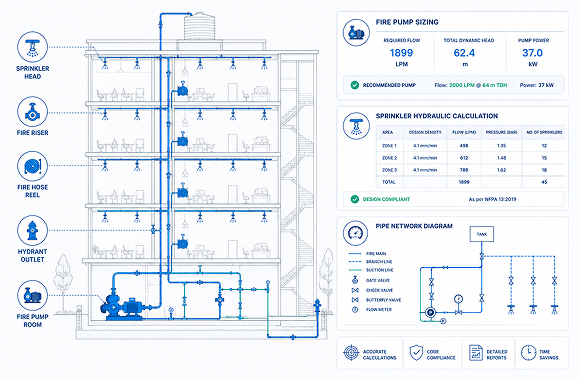
Sprinkler systems are the primary active suppression method in commercial and institutional buildings. Each sprinkler head activates individually at a specified temperature (typically 68°C for standard heads), delivering water at a calculated flow rate to the affected zone. Design involves hazard classification (Light, Ordinary, or Extra Hazard per NFPA 13 or IS:15105), sprinkler head spacing, flow rate calculation per head, pipe sizing using hydraulic calculation methods (Hazen-Williams), and verification of available water supply against system demand.
Per NFPA 13, sprinkler head spacing in Light Hazard occupancies must not exceed 20.9 square meters per head. Ordinary Hazard Group 1 reduces this to 12.1 square meters. Getting these numbers wrong in the design phase means either under-protection or a rework request from the fire authority at inspection.
Fire hydrant systems provide firefighters with accessible, pressurized water supply at strategic perimeter and internal locations. Design calculations cover hydrant flow demand (typically 1,800-2,700 LPM for commercial buildings per NBC norms), pipe sizing to deliver that demand without excessive pressure loss, hydrant spacing (maximum 45 meters apart in most NBC applications), and standpipe sizing for multi-story buildings where floor-by-floor access is required.
In high-rise buildings, gravity tanks and pressurized systems must be calculated to maintain minimum residual pressure (typically 3.5 bar at the highest hydrant) throughout the building height, accounting for friction losses in risers and horizontal mains.
Fire pumps are the hydraulic heart of a fire fighting system. Sizing a fire pump incorrectly is one of the most consequential errors in fire protection engineering: an undersized pump fails to deliver required flow and pressure during a real event; an oversized pump wastes capital and may cause overpressure conditions in the piping network.
Per NFPA 20, every fire pump installation requires:
Pump capacity is expressed in GPM (gallons per minute) or LPM (litres per minute) at a rated pressure. The design point must sit on the pump's performance curve between 100% and 150% of rated capacity, where the head-flow relationship is predictable.
Clean agent systems (FM-200, Novec 1230, CO2, and Inergen) suppress fires in enclosed spaces where water damage would destroy valuable equipment or irreplaceable assets. Data centers, server rooms, control rooms, UPS rooms, and archives are the most common applications.
Design involves calculating the enclosure volume, determining the required agent concentration (typically 7-8% by volume for FM-200 per NFPA 2001), sizing the agent storage cylinders, and calculating the nozzle discharge pattern. These systems must discharge within 10 seconds of activation and maintain concentration for a minimum 10-minute hold time to ensure full suppression.
The fire alarm system is the notification backbone of every fire protection strategy. It connects heat detectors, smoke detectors, manual call points, and suppression system triggers to a central Fire Alarm Control Panel (FACP) that manages zone-by-zone alerting, suppression activation, elevator recall, and stairwell pressurization.
In addressable systems (now standard on most commercial projects), each device has a unique address. The FACP can identify exactly which device triggered, which zone it's in, and what sequence of responses to initiate. This matters enormously for large buildings where a general alarm across all zones causes unnecessary panic and evacuation disruption.
Fire fighting design calculations are the numerical backbone of a compliant fire protection engineering submission. They translate building parameters, occupancy types, and applicable code requirements into specific equipment sizes, pipe diameters, flow rates, and pressure demands.
The key calculations every MEP engineer working on fire systems must produce:
Doing all of this manually for a mid-size commercial building takes a skilled fire engineer several days. MEP design calculation software like DesignDrafter automates the hydraulic calculations, pump sizing, sprinkler spacing verification, and documentation generation, cutting that timeline to hours and producing code-referenced reports ready for submission.
MEP design calculation software automates fire protection engineering by replacing manual hydraulic iteration with algorithm-driven calculation engines that apply code standards automatically and connect outputs to drawing and procurement workflows.
DesignDrafter's Fire Fighting Design Calculation module handles the full fire system scope:
Sprinkler system calculations per NFPA 13, NBC, and IS:15105. The platform determines sprinkler head spacing and flow rate based on occupancy classification and ceiling height, calculates minimum pressure requirements at each head, and optimizes the sprinkler network across the building footprint for residential, commercial, and industrial applications.
Fire pump sizing per NFPA 20 and local fire codes. DesignDrafter calculates required pump capacity in GPM/LPM and pressure in PSI/kPa, then recommends the correct pump type (electric, diesel, or jockey) based on system demand and code requirements.
Hydrant system design. The platform computes hydrant flow demand for perimeter and internal coverage, verifies adequate pressure to support manual firefighting operations, and sizes standpipe systems in multi-story buildings for reliable floor-by-floor access.
Pipe sizing and hydraulic verification. Pipe diameters across the full network are sized from flow rates, velocity limits, and pressure loss calculations, with the hydraulic balance verified automatically across all branches.
All outputs comply with NBC, NFPA, and IS:15105 by default. Engineers don't configure compliance manually; it's built into the calculation logic. The platform also integrates fire fighting calculations with HVAC, electrical, and plumbing calculations in the same workflow, which is exactly what's needed for MEP coordination at the design stage.
Keith Stakes, a deputy fire chief and fire protection engineer with the UL Research Institutes' Fire Safety Research Institute, summarizes the direction of the field: "The most effective fireground operations begin with life safety decisions that are informed at the design stage, not improvised during an emergency."
When I work with MEP consultancies evaluating fire fighting software, the question I always ask first is: does the tool produce a report a fire authority can actually verify, or just a set of numbers your team produced? The gap between those two outputs is the gap between a compliant submission and a resubmission.
For EPC contractors managing design-and-build projects, fire system quantities (pipe lengths, sprinkler head counts, pump specifications) feed directly into procurement. DesignDrafter's BOQ extraction pulls those quantities from the fire design outputs automatically, eliminating the manual counting step that typically happens between design completion and tender preparation.
India's fire protection engineering framework draws from three primary code families, and understanding which applies when is not optional.
National Building Code (NBC) 2016 is the overarching code for building design and construction in India. Part 4 of NBC covers fire and life safety requirements, including mandatory fire protection provisions by building height, occupancy type, and use. NBC requirements are enforced by local fire authorities and municipal bodies, and NBC compliance is required for fire NOC approvals.
IS:15105 is the Bureau of Indian Standards specification for fire suppression systems (sprinkler systems specifically). It aligns closely with NFPA 13 but includes adaptations for Indian water supply conditions, material specifications, and installation practices. For sprinkler system design submitted to Indian fire authorities, IS:15105 compliance is typically mandatory alongside NBC.
NFPA standards are widely referenced in India, particularly for projects involving international clients, certifications, or specifications that require global benchmarking. NFPA 13 (sprinklers), NFPA 14 (standpipes), NFPA 20 (fire pumps), and NFPA 72 (fire alarms) are the most commonly applied NFPA standards in Indian commercial and industrial projects.
The practical challenge is that NBC, IS:15105, and NFPA don't always align perfectly. Where conflicts exist, the more stringent requirement typically governs, and the fire authority's interpretation of "more stringent" can vary by jurisdiction. Software that applies all three frameworks in parallel (as DesignDrafter does) reduces the risk of submitting calculations that satisfy one standard but fail another.
The DesignDrafter architecture design and traditional methods guide covers how multi-standard compliance is handled across disciplines in modern Indian AEC workflows.
After reviewing fire NOC rejections and rework notices across dozens of projects, the same errors come up repeatedly:
Engineers calculate storage for sprinklers and hydrants separately, then size the tank for the larger of the two demands rather than the combined simultaneous demand. NBC requires combined simultaneous demand for buildings where both systems operate concurrently, which is most commercial projects above a certain height threshold.
Every 10 meters of height adds approximately 1 bar of pressure loss in a vertical pipe. In a 15-story building, the pressure required at the pump discharge to maintain 3.5 bar at the highest hydrant is substantially higher than designers working from memory (rather than calculation) typically estimate.
This is a coordination issue, not a calculation issue. When fire engineers design sprinkler layouts independently from HVAC duct routing and electrical tray placements, heads frequently end up obstructed in the built condition. Platforms that coordinate all MEP disciplines in the same environment catch these clashes at the model stage, not on site.
NFPA and NBC have different minimum flow rates for hydrant systems, different tank sizing methodologies, and different standpipe pressure requirements. Defaulting to NFPA without checking NBC equivalents is a common source of fire NOC rejections in India.
Many fire authority inspectors specifically check for jockey pump specification, sizing, and controls in pump room submissions. Leaving it out or specifying it generically delays NOC approvals.
The DesignDrafter MEP consultant solution page outlines how automated calculations and compliance checking reduce these errors systematically across all MEP disciplines, including fire fighting.
Fire protection engineering is one of the most technically demanding and consequential parts of any MEP scope. A well-designed fire fighting system protects lives, satisfies fire authorities, and avoids the costly rework that comes from coordination failures or calculation errors discovered at inspection.
The global fire protection systems market is growing at 7.1% CAGR toward USD 160.9 billion by 2035, driven by stricter building codes, rapid urbanization in Asia-Pacific, and the integration of IoT-enabled smart detection into standard building specifications. India's market alone is growing by USD 1.81 billion through 2029. That growth means more fire protection engineering work, more complex building types, and more demanding fire authorities.
For MEP engineers and fire safety consultants in India, the core takeaway is this: fire fighting system design is too calculation-intensive and too code-sensitive to do reliably with spreadsheets and disconnected tools. Accurate hydraulic calculations, compliant documentation, and coordinated drawings require a platform that applies NBC, NFPA, and IS:15105 simultaneously, connects fire outputs to the broader MEP model, and produces reports that fire authorities can verify without asking for rework.
DesignDrafter's Fire Fighting Design Calculation module does exactly that. It automates sprinkler sizing, fire pump selection, hydrant system design, and pipe hydraulics within a single AI-powered platform built for Indian standards. The outputs feed directly into BOQ generation and BIM coordination, closing the loop between design and procurement.
If your current fire protection workflow involves manual hydraulic calculations or separately prepared spreadsheets that don't connect to your drawing or quantity takeoff process, the next step is to test what an integrated workflow actually looks like. Start with a free trial at designdrafter.com, explore the fire fighting calculation module at designdrafter.com/design-calculation, or review how the full MEP platform works for consultants at designdrafter.com/mep-consultants-solution.
The engineers producing the most accurate, fastest, and most defensible fire protection submissions in India right now aren't working harder. They're working with better tools.
Founder
Manas Krishna is a Mechanical Engineer and infrastructure technology entrepreneur with 20+ years of experience in MEP (Mechanical, Electrical, and Plumbing) engineering, public health engineering, and transport infrastructure projects across India.
FAQ

Fire protection engineering is the discipline of designing, calculating, and documenting building fire safety systems to protect lives and property. It covers active systems (sprinklers, hydrants, fire pumps, clean agents), passive protection (fire-rated construction), fire detection and alarm systems, and smoke control. In India, fire protection engineering is governed by NBC 2016, IS:15105, and NFPA standards. The global fire protection systems market reached USD 86.7 billion in 2026.
Fire fighting system design in India is primarily governed by three standards: the National Building Code (NBC) 2016 for overall fire and life safety requirements, IS:15105 for sprinkler system installation and design, and NFPA standards (NFPA 13, 14, 20, and 72) for detailed system design. Where these standards conflict, the more stringent requirement typically governs. Fire NOC approval from local fire authorities requires compliance with NBC as a minimum.
The core fire fighting design calculations are hydraulic calculations (flow and pressure at each sprinkler head and hydrant), fire water storage sizing (combined simultaneous demand for sprinklers and hydrants), fire pump sizing (capacity in LPM and pressure in kPa per NFPA 20), pipe sizing (diameter selection based on flow, velocity, and pressure loss), and sprinkler head spacing verification by occupancy hazard classification. These calculations must reference the applicable standard in the submitted report.
Fire protection engineering software automates hydraulic calculations by applying Hazen-Williams pressure loss equations across the pipe network, sizing sprinkler heads and pipes against code-specified flow and pressure criteria, and generating submission-ready reports referenced to applicable standards. Platforms like DesignDrafter apply NBC, NFPA, and IS:15105 simultaneously, automate fire pump selection per NFPA 20, and connect fire outputs to BOQ extraction and MEP coordination workflows.
Active fire protection includes systems that mechanically respond to a fire: sprinklers, hydrants, fire pumps, suppression agents, and alarm systems. Passive fire protection uses building construction features to contain fire and limit spread without mechanical action, including fire-rated walls, compartmentation, fire doors, and intumescent seals. Both categories are required in commercial buildings in India under NBC 2016. Active systems suppress; passive systems contain. Together they define the building’s overall fire resistance strategy.
Fire pump sizing requires calculating the system demand (total flow rate at rated pressure for the most demanding zone), applying NFPA 20 requirements for the duty point to fall between 100% and 150% of rated capacity on the pump curve, specifying a diesel backup pump sized to the same demand with 8-hour fuel autonomy, and adding a jockey pump for pressure maintenance. Pump capacity is expressed in LPM at a rated pressure in kPa. MEP design calculation software automates this sizing and recommends electric, diesel, or jockey pump specifications.
The most common causes of fire NOC rejections in India are: undersized fire water storage tanks (calculated for peak demand only rather than combined simultaneous demand), missing jockey pump specifications, sprinkler head obstructions from HVAC or electrical installations discovered at inspection, use of NFPA flow rates without checking equivalent NBC requirements, and calculation reports that reference outdated code editions. Software that applies current NBC, NFPA, and IS:15105 requirements simultaneously reduces these rejection causes significantly.
An integrated MEP design calculation platform is the better choice for most Indian MEP consultancies and fire safety engineers. Dedicated fire protection tools (like FireACad or Elite Fire) handle hydraulic calculations well but don’t coordinate with HVAC, electrical, or plumbing designs, which means coordination clashes still require separate resolution. Integrated platforms like DesignDrafter handle fire calculations within the same environment as all other MEP disciplines, connecting fire outputs to BOQ generation and BIM workflows automatically.
Fire fighting system design integrates with MEP BIM coordination through shared model environments where fire pipe routing, sprinkler head placement, and pump room layouts are developed alongside HVAC ductwork, electrical trays, and plumbing systems. Clash detection tools identify conflicts before construction. DesignDrafter connects fire fighting design calculations directly to BIM-compatible drawing outputs, enabling fire system sizing to propagate into the coordinated MEP model without manual re-entry between calculation and drawing stages.
Fire water tank capacity in India is calculated as the combined simultaneous demand of all active fire systems (sprinklers and hydrants) operating concurrently, multiplied by the required duration per NBC norms (typically 60-120 minutes depending on building type and height). For a standard commercial building, this often yields tank capacities of 100,000-200,000 litres or more. The calculation must account for the most hydraulically demanding zone, not an average demand across zones, to satisfy NBC Part 4 requirements.
September 22 , 2026
March 12 , 2026

September 15 , 2026