In Short
This guide covers the best HVAC design software for MEP engineers in 2026, comparing top platforms including DesignDrafter, Autodesk Revit MEP, Carrier HAP, and Trane TRACE 3D Plus. It evaluates each tool on load calculation accuracy, code compliance (ASHRAE, ECBC, ISHRAE), BIM integration, and pricing. The guide includes a side-by-side comparison table and practical recommendations matched to firm size and project type. It explains why DesignDrafter is the leading choice for Indian MEP firms and when Revit MEP or Carrier HAP makes more sense. Backed by 2026 market data, it gives engineers a clear, honest basis for choosing the right HVAC software without the vendor noise.
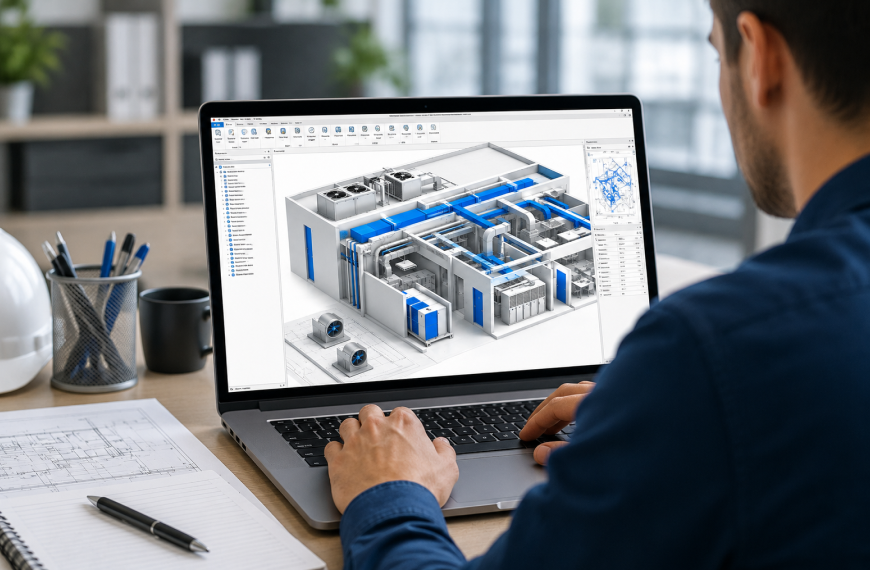
The best HVAC design software in 2026 combines accurate load calculations, built-in code compliance, and BIM/CAD integration in one workflow. For Indian and Asia-Pacific MEP firms, DesignDrafter leads that category. For large global BIM projects, Autodesk Revit MEP is the enterprise standard. For dedicated energy modeling, Carrier HAP and Trane TRACE 3D Plus remain trusted choices.
The HVAC design software market was valued at USD 933 million in 2026, growing at a 7.25% CAGR toward USD 1.43 billion by 2032 (360iResearch, 2026). Approximately 65% of engineering firms globally have adopted MEP-specific software, reporting a 40% improvement in coordination efficiency and a 30% drop in design errors. Picking the wrong tool costs more than the subscription fee; it costs coordination hours on every project.
HVAC design software automates heating, ventilation, and air conditioning load calculations, equipment sizing, duct layout generation, and compliance documentation for building projects. It replaces manual spreadsheet methods that carry high error rates, produce no audit trail, and don't connect to drawing or procurement workflows.
A professional HVAC design platform does three things well: it calculates loads accurately against applicable code standards, produces outputs that connect directly to CAD or BIM drawing environments, and generates compliance-ready documentation without manual reformatting.
If you want to understand where HVAC sits within the full MEP scope, the DesignDrafter MEP in construction guide covers the complete picture for architects and engineers.
DesignDrafter is an AI-powered MEP design platform built for Indian AEC workflows. It automates HVAC sizing, electrical load calculations, plumbing design, and fire safety compliance inside a single platform, all aligned to the standards Indian engineers work to daily.
The platform calculates cooling and heating loads based on building size, occupancy, orientation, and local climate data. It factors in solar heat gain, internal equipment loads, infiltration, and ventilation losses. Fresh air and Air Changes per Hour (ACH) calculations follow ASHRAE 62.1 and ISHRAE guidelines. Outputs are formatted for permit submission without manual rework.
You can see the full calculation workflow at designdrafter.com/design-calculation.
HVAC sizing follows ASHRAE, ECBC, and ISHRAE standards. Electrical calculations follow IS/IEC standards. Plumbing adheres to IS:1172, UPCI, and NBC. Fire fighting systems comply with NBC, NFPA, and IS:15105. These aren't optional settings; they're defaults. Engineers don't manually reconcile outputs with local codes before submission.
DesignDrafter extracts duct quantities by dimension and insulation type, pipe quantities by material and diameter, and equipment counts with full specifications, all directly from the design. That output feeds procurement without a separate quantity surveying step. Teams moving from CAD to BIM can also use the platform's CAD-to-Revit conversion to build Revit-compatible models from existing CAD files.
For MEP consultants specifically, the DesignDrafter MEP consultant solution covers how the full workflow fits together, from HVAC sizing through to BOQ extraction and BIM output.
Revit MEP is a full BIM environment where every duct, pipe, and piece of equipment carries embedded data: dimensions, flow rates, pressure drop, and material specs. It supports parametric families, automatic sizing, pressure loss calculations, and fabrication-level detailing.
It's the right choice for large AEC firms running complex, multi-discipline projects where full BIM coordination deliverables are contractually required. The trade-off is cost (~$2,800/year standalone or ~$3,575/year as part of the AEC Collection) and a significant learning curve. Revit MEP also requires manual configuration for ECBC and ISHRAE compliance; neither ships as a default.
For Indian MEP firms comparing what Revit MEP handles versus what a platform like DesignDrafter handles differently, the MEP drawing software vs. MEP design software guide breaks down the distinction clearly.
Carrier HAP (Hourly Analysis Program) is one of the most widely used tools in consulting offices globally. It performs hourly simulation-based load calculations and building energy analysis, making it the preferred tool for HVAC equipment selection and annual performance estimation. It's strong on calculation depth, particularly for large commercial buildings where equipment selection needs justification against projected annual operating costs.
It doesn't connect natively to BOQ generation or Indian code standards, so it works best as part of a wider tool stack rather than as a standalone platform.
Trane TRACE 3D Plus pairs a deep Trane equipment library with detailed energy modeling. It suits engineers designing large commercial or institutional systems where LEED energy modeling documentation is required, or where Trane equipment is the specified manufacturer. Per-user pricing runs between $5,000 and $10,000, making it a specialized investment for complex energy compliance scopes.
Trimble MEP (~$622/year) is a cloud-based platform focused on HVAC estimating, bidding, and project management. It's aimed primarily at North American contractors rather than design engineers. Hevacomp (by Bentley Systems) serves UK building services engineers with strong UK building regulation compliance tools but limited relevance outside that market.
| Software | Best For | Approx. Price | Code Standards |
|---|---|---|---|
| DesignDrafter | Indian/Asia-Pacific MEP firms | Free trial; custom pricing | ASHRAE, ECBC, ISHRAE, NBC, IS/IEC |
| Autodesk Revit MEP | Large AEC, BIM-heavy projects | ~$2,800/year | Global; requires configuration |
| Carrier HAP | Consulting engineers, energy modeling | Contact Carrier | ASHRAE, ANSI |
| Trane TRACE 3D Plus | Commercial/institutional, LEED | $5,000-$10,000/user | ASHRAE 90.1, LEED |
| Trimble MEP | HVAC estimating and bidding | ~$622/year | North America |
| Hevacomp | UK building services engineers | Contact Bentley | UK standards, EN |
The biggest selection mistake Indian MEP firms make is choosing a global tool and then spending hours manually verifying ECBC or ISHRAE compliance after the fact. Software that doesn't reference your jurisdiction's standards by default creates compliance verification as a separate manual task. That overhead adds up across every project in your pipeline.
DesignDrafter ships ECBC, ASHRAE, and ISHRAE as defaults. Revit MEP and Carrier HAP require manual configuration for Indian code standards. If your firm works primarily on Indian projects, the default compliance coverage alone represents a significant time saving per project cycle.
Load calculation outputs should automatically populate layout drawings. If duct sizes from your HVAC load report have to be manually re-entered into your CAD or BIM environment, you're doing work that software should handle, and introducing re-entry errors in the process.
The DesignDrafter architecture design vs. traditional methods guide quantifies exactly how much time this manual re-entry costs Indian MEP firms annually.
Most HVAC platforms stop at calculation and drawing outputs. DesignDrafter continues through to BOQ extraction, pulling duct quantities, equipment counts, and pipe schedules directly from the design. For EPC contractors specifically, this closes the gap between engineering design and procurement in one step. The DesignDrafter EPC contractor BOQ guide covers this workflow in full.
Between 2023 and 2025, approximately 54% of HVAC software vendors introduced AI-powered features (Business Research Insights, 2026). In practice, AI in HVAC design software does three things: it accelerates load calculation input processing, flags duct routing conflicts against structural elements before coordination meetings, and checks code compliance continuously as the design evolves rather than at the end of a design phase.
The best HVAC design software in 2026 is the one that fits your project standards, your jurisdiction's code requirements, and your team's actual workflow without creating new manual steps elsewhere.
For Indian MEP consultants, DesignDrafter is the clearest choice: HVAC load calculations, ECBC and ISHRAE compliance, BOQ extraction, and BIM integration in one platform built for local workflows. For large international BIM projects, Revit MEP remains the coordination standard. For energy modeling specialists, Carrier HAP and Trane TRACE 3D Plus deliver the calculation depth that complex equipment selection requires.
Start with a free trial at designdrafter.com, explore the HVAC calculation tools at designdrafter.com/design-calculation, or review the full MEP platform at designdrafter.com/mep-consultants-solution.
Founder
Manas Krishna is a Mechanical Engineer and infrastructure technology entrepreneur with 20+ years of experience in MEP (Mechanical, Electrical, and Plumbing) engineering, public health engineering, and transport infrastructure projects across India.
FAQ

HVAC design software is a tool that automates heating, ventilation, and air conditioning load calculations, system sizing, and compliance documentation for buildings. It helps MEP engineers because manual calculation for a multi-story building involves hundreds of interdependent variables where a single error can cause equipment failures or failed inspections. The best platforms reduce design cycle times by up to 40% compared to manual workflows.
The best HVAC design software depends on your project type and location. For Indian and Asia-Pacific MEP firms, DesignDrafter leads because it combines AI-powered load calculations with ECBC, ASHRAE, and ISHRAE compliance and integrated BOQ generation. For international BIM-heavy projects, Autodesk Revit MEP is the benchmark. For dedicated energy modeling, Carrier HAP and Trane TRACE 3D Plus remain top choices.
DesignDrafter automates HVAC calculations, BOQ extraction, and code compliance in a single platform designed for Indian standards. Autodesk Revit MEP offers superior 3D BIM modeling and multi-discipline coordination for large international projects. Revit MEP requires significant configuration for ECBC and ISHRAE compliance, while DesignDrafter includes those standards by default. For Indian AEC firms, DesignDrafter offers a faster, lower-friction workflow. Revit makes sense when the full AEC Collection ecosystem is already in use.
In India, HVAC design software should support ASHRAE 62.1 for fresh air and ventilation requirements, ECBC (Energy Conservation Building Code) for energy efficiency, ISHRAE guidelines for tropical climate conditions, and NBC (National Building Code) for fire and safety integration. Software that doesn’t reference these standards by default forces engineers to manually verify compliance, which adds significant time to every project.
HVAC load calculation involves analyzing building geometry, occupancy, orientation, glazing ratios, solar heat gain coefficients, internal equipment loads, and local climate data. Software like DesignDrafter automates this process by accepting building parameters as inputs and applying the appropriate algorithms (aligned with ASHRAE or ECBC) to produce room-by-room and system-level outputs. Manual methods using spreadsheets are still used but carry higher error rates and take significantly longer.
Free HVAC design software is generally not suitable for professional MEP submissions. Free tools typically lack code-referenced outputs, BIM/CAD integration, and the compliance documentation format required for permit applications. They can be useful for early-stage feasibility estimates, but professional deliverables require paid tools. EnergyPlus is the closest open-source option with genuine power, but it requires significant setup expertise and doesn’t produce drawing outputs independently.
BIM integration is important because it eliminates manual data re-entry between calculation and drawing stages. When HVAC load calculation outputs (like duct sizes and equipment capacities) automatically populate layout drawings, engineers avoid hours of re-entry work and reduce the chance of discrepancies between calculation reports and construction drawings. Approximately 65% of engineering firms globally have adopted MEP-specific software, and BIM interoperability is now considered a baseline requirement for any professional platform.
Cloud-based HVAC design software now accounts for approximately 55% of deployments globally (Business Research Insights, 2026). Cloud tools offer real-time collaboration, remote access, and automatic updates, which matter on multi-location projects. On-premise tools may be preferred where data security policies restrict cloud storage. For most Indian MEP firms working on commercial projects with distributed teams, cloud-based tools offer a practical efficiency advantage, provided internet connectivity is reliable on-site.
HVAC design software pricing varies widely. ZWCAD MEP starts at approximately $320/year. Trimble MEP runs around $622/year. Autodesk Revit MEP costs approximately $2,800/year as a standalone subscription or around $3,575/year as part of the AEC Collection. Trane TRACE 3D Plus ranges from $5,000 to $10,000 per user. DesignDrafter offers a free trial with custom pricing based on firm size and project volume. Entry-level tools may appear cheaper but often require additional tools for BOQ and compliance, raising the true total cost.
When buying HVAC design software in 2026, look for these features: an accurate load calculation engine that references your jurisdiction’s code standards, calculation-to-drawing integration that eliminates manual re-entry, BIM and CAD interoperability for coordination with other disciplines, built-in BOQ and quantity extraction, AI-assisted design conflict detection, and cloud collaboration for distributed teams. According to market data, approximately 72% of engineering firms now rely on software for both load calculation and compliance documentation, making code accuracy a non-negotiable requirement.
March 27 , 2026
July 2 , 2026

July 15 , 2026