In Short
This guide is written for architects, MEP engineers, contractors, quantity surveyors, and developers in India who want a clear, practical understanding of how value engineering in construction works when connected to accurate BOQ preparation, AI-powered quantity takeoff, and design-stage cost estimation. It covers why most VE happens too late and what the correct VE window is, how the MEP Safety Margin Trap silently inflates building costs by 30-40%, and how AI-powered quantity takeoff eliminates the 10-20% BOQ variance that makes post-tender VE unreliable. The guide explains specific VE strategies including right-sizing MEP equipment from accurate load calculations, substituting imported materials with locally sourced equivalents, optimizing pipe and duct routing, and rationalizing electrical panel capacity. Every section links to relevant DesignDrafter service pages including the MEP design calculation module, AI quantity extraction, technical product comparison, CAD to Revit BIM automation, and the AI Design Agent. Backed by 2026 data from MoSPI, IIT Madras, McKinsey, SEA Consulting, Flume, and RS Means, this is the most complete guide to construction value engineering through BOQ and quantity takeoff accuracy available for Indian AEC professionals in 2026.
Value engineering in construction is the process of systematically analyzing building functions, materials, and systems to deliver the same or better performance at a lower cost, without cutting scope or compromising quality. It's not about buying cheaper materials. It's about identifying where the design, specification, or procurement process is spending more than the function requires. And in 2026, the most powerful place to apply value engineering isn't during construction. It's during the BOQ and quantity takeoff stage, when numbers are still fluid and every decision is reversible.
As of December 2025, 1,392 Indian infrastructure projects reported cumulative cost overruns of ₹5.42 lakh crore above original estimates (MoSPI, January 2026). An IIT Madras study found that 68% of cost overruns originate in the detailed design stage, long before construction begins. McKinsey's analysis of 500+ capital projects globally found the average large project runs approximately 70% over budget. An inaccurate BOQ alone can cost 10-30% of total project value in rework, procurement disputes, and variation claims (Construction Estimator India, 2026).
These aren't abstract statistics. Every one of them traces back to the same root cause: cost decisions made without accurate quantity data, at a stage when changing them is still cheap. If you're an architect, MEP engineer, contractor, or developer, theDesignDrafter AI-powered quantity takeoff platform is built to close exactly that gap, connecting design-stage calculations to procurement-ready BOQ's so value engineering decisions happen when they still save money.
Value engineering (VE) in construction is a structured methodology for improving the value of a project by optimizing the relationship between function and cost. Value is defined as function divided by cost. To increase value, you either improve function without increasing cost, reduce cost without reducing function, or do both simultaneously.
Value engineering in construction is important because MEP systems alone represent 30-50% of total construction cost on commercial buildings and up to 55% on healthcare facilities (RS Means, 2026). Shaving even 10-15% off MEP costs through accurate design-stage value engineering on a mid-size commercial project in India saves tens of lakhs before a single site activity begins.
The definition matters here: value engineering is not value cutting. Value cutting removes features to reduce cost. Value engineering finds alternative products, system configurations, or design approaches that deliver the same building performance at a lower expenditure. The distinction is critical because poorly executed VE consistently produces buildings that underperform, generate maintenance problems, and cost more to operate over their lifecycle than the upfront savings justified.
True value engineering requires three inputs: a complete, accurate quantity takeoff; a reliable cost estimate based on current market rates; and a clear understanding of what each line item is functionally required to do. Without all three, VE decisions are guesswork.
The timing of value engineering determines most of its value. Changes made during concept and schematic design cost almost nothing to implement. Changes made during design development cost a little. Changes made after drawings are stamped, bid, and contracted cost 15-25% more as change order premiums on top of the actual material and labor cost (Pulse Rev Ops, 2026).
Most construction projects apply VE at the wrong stage. The typical sequence goes: design completes, BOQ is prepared manually, tender goes out, bids come in over budget, then VE workshops are called. At that point, the design is largely fixed, the subcontractors have quoted against a specific scope, and every alternative requires a drawing change, a re-quote, and a coordination review. The cost of implementing VE at post-tender stage is frequently higher than the saving it generates.
The correct VE window is between schematic design completion and construction document issue. At this stage, MEP system configurations are set but not detailed. Equipment selections are proposed but not specified to a single model. Structural solutions are established but not dimensioned for fabrication. Material specifications are described but not locked to a supplier.
This is exactly where DesignDrafter's building design calculation platform delivers its most significant value engineering contribution. When HVAC load calculations are run accurately at design stage, rather than estimated from rules of thumb, the cooling plant is sized to actual demand rather than to a conservative multiple of it. The difference between a properly calculated 150-ton chiller and a rule-of-thumb 200-ton chiller isn't just equipment cost. It's pump sizing, pipe sizing, electrical panel capacity, mechanical room size, and 25 years of energy consumption.
For architects, the practical implication is straightforward: design decisions made without accurate MEP calculation data are decisions made blind. Ceiling height determines duct sizing. Room layout determines pipe runs. Glazing ratios determine cooling load. When those architectural decisions are made before MEP load calculations are run, the MEP engineer designs to a constraint they had no input into, and value engineering opportunity is lost before the drawings are even started.
The DesignDrafter architects solution is built around exactly this integration, giving architects access to MEP calculation context during the design phase so structural and architectural decisions are made with full awareness of their MEP cost implications from the start.
A Bill of Quantities (BOQ) is a structured document that lists every material, component, and work item required to complete a construction project, with quantities, specifications, and unit rates. In the Indian context, the BOQ is the primary instrument for tender preparation, RA billing, variation valuation, and final account settlement. RERA 2.0 compliance and GST audit trails both require BOQ-level cost transparency, making an accurate BOQ a regulatory document as much as a commercial one.
A BOQ enables value engineering because it makes costs visible at the component level. Without a BOQ, cost reduction discussions happen at system level: "we need to reduce MEP costs by 10%." With a BOQ, the same discussion becomes: "these three duct specifications account for 40% of the HVAC material cost; here are three alternative configurations that meet the same performance requirement at lower cost." Specificity creates actionable VE opportunities. Aggregation hides them.
An inaccurate BOQ doesn't just cause cost overruns. It destroys value engineering opportunities before they can be identified. When quantity counts are wrong, the cost baseline is wrong. When the cost baseline is wrong, VE alternatives can't be correctly valued against it.
The most common BOQ accuracy failures in Indian construction in 2026 are: wrong quantities from manual takeoff errors (10-20% variance is typical on manually produced BOQs); missing MEP items including landscaping, site services, and specialist systems that surface as costly extras during construction; unrealistic rates that don't reflect current material volatility (steel at ₹65-72/kg, cement at ₹8-10/kg as of 2026); and poor specification clarity that allows contractors to substitute lower-performing products during procurement.
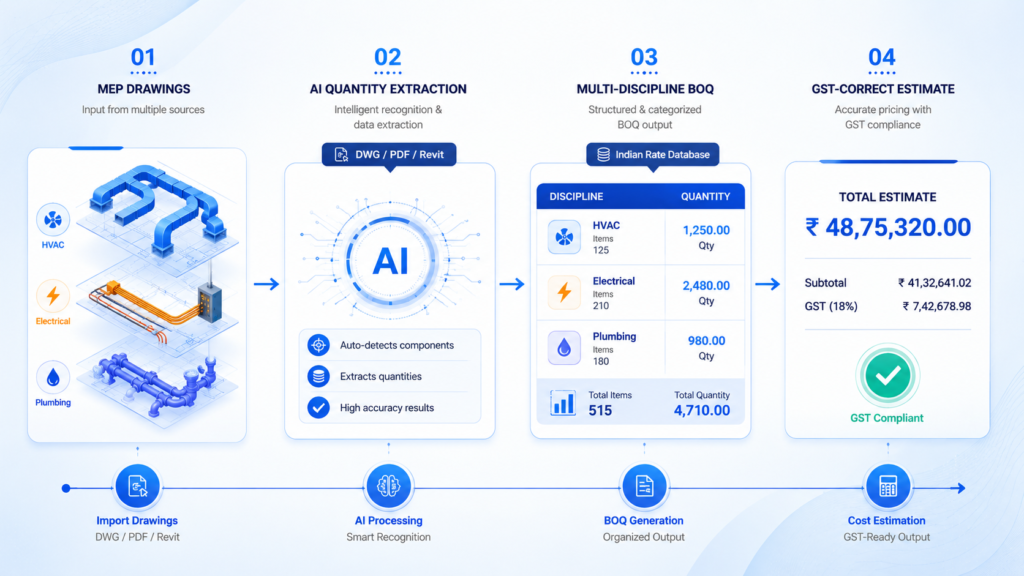
DesignDrafter's AI quantity extraction module addresses the accuracy problem directly. It extracts quantities from layouts and engineering calculation data rather than from manual counting, producing structured, specification-referenced BOQ outputs with item markups and brand-level detail. When the quantity data is accurate, the cost estimate built on it is accurate, and the VE analysis run against it is reliable.
For EPC contractors and design-and-build teams where BOQ accuracy directly determines tender competitiveness, the DesignDrafter contractor solution connects MEP design calculations to BOQ generation in a single workflow, eliminating the manual counting step that typically produces the variance that undermines both VE analysis and tender pricing.
One of the most consistently overlooked value engineering opportunities in Indian construction sits inside the MEP design process itself. It's called the Safety Margin Trap, and it works like this.
The consulting engineer adds a 10% thermal safety margin to the HVAC load calculation to cover model uncertainty. The specialist MEP contractor adds another 10% capacity buffer to cover installation risk. The equipment vendor quotes the next standard model size up, adding a further 10-15% capacity. The result is a chiller, AHU, or pump that's 30-40% larger than the building actually requires, at a proportionally higher capital cost, higher installation cost, higher electrical panel capacity requirement, and higher energy consumption over the building's lifecycle.
This compounding conservatism is a structural problem in traditional MEP workflows where load calculations and equipment selection happen sequentially rather than iteratively, and where each party in the chain adds their own conservative buffer without visibility into what the preceding party already added (SEA Consulting, 2026).
The fix is accurate load calculation at the design stage, connected directly to equipment selection, with each safety factor applied once and explicitly documented. When an engineer can show that the calculated load is X, the applied safety factor is Y%, and the resulting equipment specification is Z, the compounding conservatism disappears because every party can see the total margin already included in the calculation.
DesignDrafter's HVAC calculation module calculates cooling and heating loads to ASHRAE, ECBC, and ISHRAE standards with documented safety factors, producing equipment sizing recommendations that are based on actual building parameters rather than conservative rules of thumb. For MEP consultants who want to present clients with defensible, not-inflated equipment specifications, this calculation transparency is exactly what separates a value-engineered MEP design from an over-specified one.
Variable Speed Drives (VSDs) on pumps and fans are a textbook VE measure in this category. Replacing constant-speed pumps and fans with VSD-controlled equivalents on a typical Indian commercial building reduces annual energy bills by up to 25% with a payback period of 2-3 years (SEA Consulting, 2026). The VE decision only becomes visible when the BOQ breaks out motor types, drive specifications, and energy cost estimates as separate line items. An aggregate "mechanical services" budget figure buries it.
Quantity takeoff (QTO) is the process of measuring and counting all construction materials and work items from drawings and specifications to determine the quantities required. It's the step that sits between design drawings and cost estimation, and it's the step where the most consequential errors in construction cost management occur.
A quantity takeoff is important because it is the direct input to the cost estimate. An error in the quantity takeoff produces a proportional error in the cost estimate, which produces a proportional error in the tender price, which produces a budget discrepancy that either cuts the contractor's margin or triggers a variation claim against the client.
Traditional quantity takeoff involves an estimator manually measuring dimensions from printed or PDF drawings, entering them into a spreadsheet, and applying material conversion factors to produce quantities. This process is time-consuming (a full QTO for a medium commercial building takes 1-2 weeks manually), error-prone (estimators consistently under-count complex MEP runs), and disconnected from the design data (changes to the design require a full re-takeoff rather than an automatic update).
AI-powered quantity takeoff changes all three. It reads quantities directly from the design data or from uploaded drawings, applies material conversion factors automatically, and updates when the design changes without a manual re-takeoff cycle. The reduction in manual effort alone allows estimators to produce multiple VE alternatives with full quantity data in the time that a single manual takeoff would have taken. That speed is what makes real value engineering analysis possible at the design stage rather than as a post-tender scramble.
DesignDrafter's quantity extraction platform automates this process, extracting accurate quantities from layouts and engineering data to generate structured BOQ-ready outputs. Quantities are extracted with item markups, specification-level detail, and editable brand preferences so the output is usable for both procurement and VE analysis without a reformatting step.
The most significant source of quantity takeoff error in MEP work is the gap between the design calculation and the drawing. When a structural engineer sizes an HVAC duct at 400mm in the load calculation, and a drafter independently draws a 500mm duct in the layout because that's what fits in the ceiling space, the quantity takeoff from the drawing gives the wrong quantity for the wrong specification. The cost estimate is wrong before the estimator makes a single error.
DesignDrafter's connected MEP workflow solves this by linking calculation outputs to drawing generation. When the HVAC calculation produces a duct size, that dimension appears in the layout drawing automatically. The quantity takeoff from that drawing reflects the design-calculated specification, not a drafter's independent judgment. This calculation-to-drawing-to-BOQ connection is what makes DesignDrafter's BOQ data reliable enough to use for VE analysis rather than just for budgeting.
With an accurate BOQ and reliable quantity takeoff in hand, value engineering becomes a data-driven exercise rather than a negotiation. Here are the specific VE strategies that accurate BOQ data makes actionable:
Every tonne of unnecessary cooling capacity in an HVAC system costs approximately ₹50,000-80,000 in additional chiller capital cost, plus proportional increases in pump, pipe, duct, and electrical costs downstream. On a 100,000 sq ft commercial building where the initial HVAC specification is 20% over-capacity due to compounding safety margins, the VE saving from right-sizing to the calculated load is material.
The calculation accuracy that enables this VE is the direct output of DesignDrafter's HVAC calculation module. Room-by-room load calculations, solar heat gain analysis, and occupancy schedule inputs produce a cooling demand figure that can be defended against any client or contractor challenge, enabling confident right-sizing without the protective over-specification that inflates costs.
The 2025-2026 tariff actions on imported construction materials from China and Southeast Asia added 10-25% to landed costs on categories including porcelain tile, quartz slabs, and specialist lighting fixtures (Flume, 2026). In Indian projects, locally sourced equivalents at comparable performance specifications frequently cost 30-40% less than imported alternatives, even before tariff impacts.
A BOQ that specifies products at the performance specification level rather than the brand level enables this substitution comparison. DesignDrafter's technical product comparison tool provides side-by-side evaluation of MEP equipment, lighting fixtures, HVAC systems, and building products against detailed technical parameters, making the equivalence case for Indian-market alternatives quantifiable and documentable.
On a typical multi-story commercial building, 15-20% of MEP pipe and duct quantities are attributable to routing inefficiencies: longer runs than necessary, avoidable elevation changes, and coordination conflicts that force circuitous routes around structural elements or other MEP services. Each additional meter of large-diameter pipe or duct carries significant material cost, installation labor cost, and insulation cost.
When MEP layouts are generated from design calculations with clash detection applied before drawings are finalized, routing inefficiencies are eliminated before they become quantities in the BOQ. DesignDrafter's CAD to Revit BIM automation enables this coordinated multi-discipline layout environment, producing clash-free MEP routing that minimizes material quantities without compromising system performance.
Electrical systems represent 15-25% of total MEP cost on Indian commercial buildings. Oversized distribution boards, conservative cable sizing, and redundant circuit provision are the most common electrical VE opportunities. Power factor correction, properly specified from the load schedule, reduces apparent electrical load and can reduce main incomer cable size, saving significantly on copper cost.
DesignDrafter's electrical calculation module produces load schedules and distribution board sizing per IS/IEC standards, with power factor correction integrated into the analysis. An accurate electrical BOQ from this calculation output makes cable schedule VE analysis straightforward: every circuit is quantified with the correct cable specification, and alternatives can be evaluated against it with full cost data.
Value engineering is most effective when it operates across the full project workflow: design calculations informing BOQ, BOQ informing cost estimation, cost estimation informing VE analysis, and VE decisions feeding back into the design. Each of these steps is connected in DesignDrafter's platform.
The AI Design Agent executes complex multi-discipline tasks including MEP calculations, BOQ extraction, and documentation generation within a single session, with project context retained across all modules. An engineer who completes an HVAC load calculation can immediately trigger quantity extraction for the resulting duct and equipment schedule, review the cost implications at the line-item level, and make VE decisions based on actual quantities rather than approximations. That connected workflow compresses the VE cycle from days to hours.
For design firms managing multiple concurrent projects, this speed matters commercially. Firms that can produce defensible BOQs with VE alternatives faster than their competitors win tenders more consistently, manage cost overrun risk more reliably, and deliver better project economics for their clients.
As Rajesh Nair, a quantity surveyor with 20 years across commercial and industrial projects in India and the Gulf, put it: "The firms that consistently deliver on budget aren't the ones with the most aggressive VE processes. They're the ones with the most accurate quantity data at the design stage. When your BOQ is right from the start, VE is a fine-tuning exercise. When your BOQ is wrong, VE is crisis management."
Value engineering in construction delivers its greatest return when it's applied at the design stage, enabled by accurate quantity data, and informed by calculation-level specificity rather than budget-level aggregation. The sequence is clear: accurate MEP design calculations produce right-sized system specifications; connected quantity extraction produces an accurate, specification-referenced BOQ; that BOQ enables genuine VE analysis at the component level before procurement locks prices.
India's construction sector is carrying ₹5.42 lakh crore in cumulative cost overruns on monitored infrastructure projects alone. An IIT Madras study attributes 68% of those overruns to the detailed design stage. The tools to close that gap exist and are accessible to Indian AEC firms in 2026.
For MEP consultants, the starting point is accurate HVAC, electrical, plumbing, and fire fighting calculations referenced to ECBC, ASHRAE, and IS standards. For contractors and EPC firms, it's connecting those calculations to a BOQ that's extracted from the design data rather than manually counted. For architects, it's making MEP calculation context available during design development so structural and spatial decisions are made with awareness of their MEP cost implications.
DesignDrafter connects all three. Its MEP calculation modules produce ECBC and ASHRAE-referenced load outputs. Its AI quantity extraction module produces structured BOQs from those calculation outputs. Its technical product comparison tool enables data-driven VE at the equipment selection level. And its AI Design Agent executes the full workflow within a single connected session.
The cost difference between a well-value-engineered project and a poorly specified one, across MEP systems, materials, and routing efficiency, consistently runs at 15-30% of total MEP cost. On a commercial building where MEP is 35% of construction cost, that's a substantial saving that belongs to the project, not the contractor's contingency.
Start your free trial at designdrafter.com, run your next project's MEP calculations at designdrafter.com/design-calculation, and generate your first AI-powered BOQ at designdrafter.com/extract-quantity.
References & sources
Citations that back the claims in this post.
MoSPI India Infrastructure Cost Overrun Report
mospi.gov.in
Flume Value Engineering in Construction 2026
tryflume.ai
SEA Consulting MEP Value Engineering
seaconsulting.co.uk
Founder
Manas Krishna is a Mechanical Engineer and infrastructure technology entrepreneur with 20+ years of experience in MEP (Mechanical, Electrical, and Plumbing) engineering, public health engineering, and transport infrastructure projects across India.
FAQ

Value engineering in construction is a structured process of analyzing building functions, materials, and systems to deliver the same or better performance at a lower cost, without cutting scope or compromising quality. It increases value by improving the ratio of function to cost through alternative design approaches, material substitutions, or system optimizations. True value engineering is distinct from value cutting: it maintains performance standards while removing unnecessary cost from the specification, procurement, or design process.
Value engineering in BOQ involves using an accurate, line-item Bill of Quantities to identify where costs can be reduced without compromising function. When the BOQ specifies materials and quantities at the component level, VE analysis compares the cost of the specified item against alternatives that meet the same performance requirement. Without a detailed BOQ, VE discussions happen at the system level and lack the specificity needed for accurate cost comparison. An inaccurate BOQ can cost 10-30% of total project value in procurement disputes and variation claims.
The most effective ways to reduce project costs in construction are: running accurate MEP load calculations at design stage to right-size equipment rather than over-specify it; using AI-powered quantity takeoff to eliminate the 10-20% variance typical in manual BOQs; applying value engineering during design development before drawings are issued for tender; substituting imported materials with locally available equivalents at equivalent performance specifications; optimizing MEP routing to reduce material quantities; and connecting design calculations directly to BOQ generation so cost data is accurate from the start rather than corrected through variations.
Value engineering works best at the design stage because changes made before drawings are stamped and tendered cost nothing to implement in administrative or premium terms. Changes made after contracting typically carry 15-25% change order markups on top of the material and labor cost of the change itself. An IIT Madras study found 68% of construction cost overruns originate at the detailed design stage. Accurate BOQ data and MEP calculations available during design development allow engineers to make defensible VE decisions while every alternative is still economically viable.
An accurate BOQ supports value engineering by making costs visible at the component level rather than at the system level. When duct dimensions, equipment specifications, cable schedules, and pipe materials are individually quantified with current market rates, VE alternatives can be evaluated with full cost data. An aggregate budget figure hides the specific line items where savings are available. Firms using AI-powered quantity extraction report BOQ accuracy improvements that reduce post-contract variation claims and enable VE analysis that manual counting methods can’t support reliably.
Quantity takeoff is the measurement and counting process: it produces the raw quantities of materials and work items from drawings and specifications. A Bill of Quantities is the structured document that organizes those quantities with specifications, unit rates, and cost data into a format used for tendering, procurement, and project cost control. Every BOQ requires a quantity takeoff as its input. An accurate BOQ depends entirely on an accurate takeoff. AI-powered quantity takeoff tools extract quantities directly from design data, eliminating the manual measurement errors that produce the 10-20% variance typical in traditionally produced BOQs.
Value engineering on MEP systems can save 10-30% of the MEP budget, and since MEP represents 30-50% of total construction cost on commercial buildings, that translates to 3-15% of total project cost (Pulse Rev Ops, 2026). Specific VE measures include right-sizing HVAC equipment from accurate load calculations (removing 20-40% capacity buffers from over-specified systems), replacing constant-speed pumps and fans with VSD-controlled equivalents (reducing annual energy bills by up to 25%), and substituting imported materials with locally sourced equivalents (saving 30-40% on imported product categories affected by 2025-2026 tariff increases).
Indian infrastructure projects carry cumulative cost overruns of ₹5.42 lakh crore as of December 2025, with 68% of overruns originating at the detailed design stage (IIT Madras, MoSPI 2026). The primary drivers are inaccurate BOQs, over-specified MEP systems, scope creep from design changes, and procurement at inflated rates against under-costed estimates. Value engineering directly addresses the first two: accurate design-stage calculations prevent over-specification, and accurate BOQs prevent procurement surprises. RERA 2.0’s transparency requirements also make accurate BOQ preparation a regulatory necessity for developers.
An integrated MEP design and BOQ platform is more effective for value engineering than dedicated VE software in most Indian AEC practices. Value engineering decisions require calculation-level specificity (what load the HVAC system actually needs to meet), quantity-level accuracy (how many meters of each duct size and pipe diameter), and cost-level data (current market rates for each specification). Platforms like DesignDrafter connect all three in one workflow. Dedicated VE software typically operates on cost data inputs that still require accurate BOQs and calculations to be useful.
AI-powered quantity takeoff improves value engineering outcomes by producing accurate, specification-referenced quantity data faster than manual methods, enabling VE alternatives to be costed at full BOQ detail within the design development timeline rather than after tender. It eliminates the 10-20% variance typical in manual BOQs that invalidates VE cost comparisons. It also enables rapid re-takeoff when design changes are made during VE analysis, so alternative options can be compared with updated quantities rather than estimated adjustments to the original count. DesignDrafter’s AI extraction pulls quantities directly from design calculation outputs, ensuring alignment between engineering intent and procurement specification.

April 27 , 2026
July 14 , 2026

July 30 , 2026